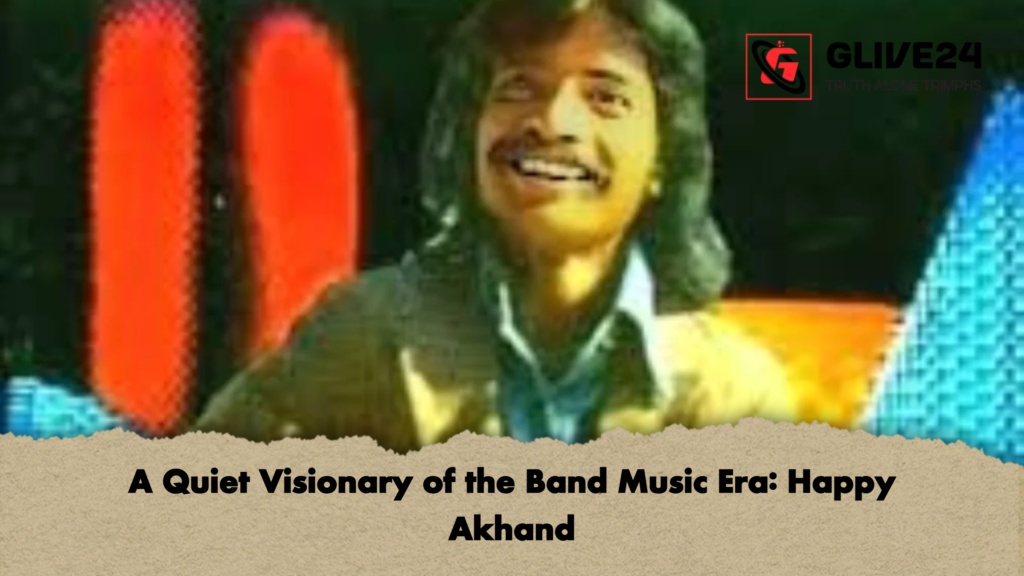
There are certain images in Bangladeshi cinema that remain etched in collective memory. One such scene shows a young man, guitar in hand, singing softly: “My heart will not listen, nothing feels right / Who plays the flute, why does my soul ache so?” Beside him sits a mesmerised Suborna Mustafa, while Rashedul Islam Asad and Nayla Azad Nupur appear in fleeting yet powerful moments. The song comes from Ghuddi (1980), and the young performer was none other than Happy Akhand, then barely twenty years old.
Yet Happy Akhand’s journey into music had begun much earlier. Born in Dhaka on 12 October 1960, he was already displaying prodigious talent by the age of thirteen. In 1973, audiences at Dhaka University’s TSC were astonished to see a slight teenager playing the keyboard with remarkable confidence alongside the band Spandan. That boy, whose fingers moved effortlessly across the keys, would soon emerge as one of the most influential musicians of his generation.
A major influence on Happy’s artistic growth was his elder brother, Lucky Akhand, already an established composer and a performer with Swadhin Bangla Betar Kendra. Lucky recognised Happy’s rare aptitude early on and guided him into the world of professional music. While Happy gravitated towards Latin blues and jazz, his brother introduced him to Russian, Roman and Greek music, giving his musical imagination an unusually wide horizon. This diversity would later define both his compositions and performances.
Happy’s national recognition grew rapidly. In 1977, his jazz-inflected improvisation of “Abar Elo Je Shondha” on BTV’s programme Bornali captivated audiences. On the same show, he performed “Ei Prithibir Buke Ashe Jara”, further cementing his reputation as an artist ahead of his time. Alongside performing, he arranged music for other artists even in his mid-teens, demonstrating an exceptional understanding of rhythm and structure.
In 1979, Happy co-founded the band Miles with Feroz Rashid. Their debut album Miles (1982) made history as Bangladesh’s first full English-language album, followed by A Step Further in 1986. Although an accomplished guitarist, Happy primarily played keyboards in the band before leaving in 1986.
His contributions extended far beyond performance. Songs like “Nil Nil Shari Pore”, “Pahari Jhorna”, “Ke Oi Jay Re Alo Jwele” and “Tumi Amar Prothom Premer Gaan” reveal his mastery of blues, jazz and reggae influences. The opening guitar solo of “Tumi Amar Prothom Premer Gaan” remains one of the most romantic passages in Bangla music—nostalgic, tender and timeless.
Happy Akhand was also a devoted mentor. At a time when formal music education was scarce, musicians learned by sitting together for hours, practising and exchanging ideas. Many renowned artists—including Ayub Bachchu, James, Shafin Ahmed, Kumar Bishwajit, and even Kolkata’s noted music director Madhu Mukherjee—benefited from his guidance.
Despite his brilliance, the socio-political climate of the era undervalued rock and contemporary music, offering little professional security. This reality weighed heavily on Happy. On 28 December 1987, Bangladesh lost him far too early. His passing left a profound void; even Lucky Akhand withdrew from music for years thereafter.
Yet Happy Akhand’s legacy continues to flow—like a mountain stream—through the music, memories and musicians he inspired. Even today, when one sees a young bohemian walking with a guitar slung over his shoulder, Happy Akhand’s name quietly comes to mind.
Key Facts at a Glance :
| Category | Details |
| Full Name | Happy Akhand |
| Date of Birth | 12 October 1960 |
| Place of Birth | Dhaka, Bangladesh |
| Date of Death | 28 December 1987 |
| Primary Instruments | Guitar, Keyboard |
| Notable Songs | Abar Elo Je Shondha, Ke Banshi Bajay Re, Tumi Amar Prothom Premer Gaan |
| Bands | Miles (Co-founder) |
| Historic Achievement | First full English-language album in Bangladesh |
| Legacy | Pioneer of modern Bangladeshi band music and mentor to leading artists |