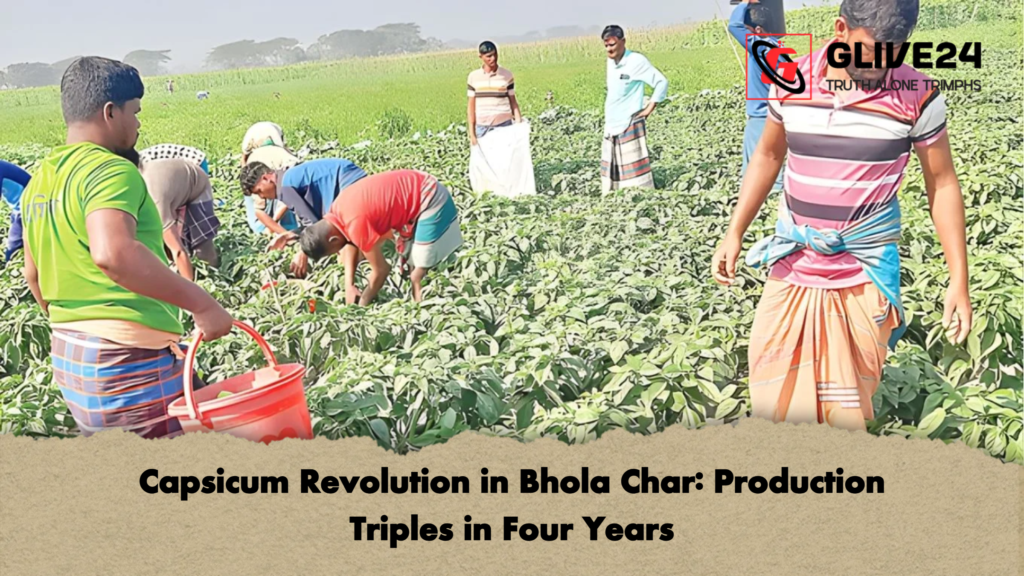
Capsicum, a staple in salads, noodles, and Chinese cuisine, has become an essential ingredient in the diets of Bangladeshi households. Over the past four years, the production of this exotic vegetable has more than tripled, reflecting a growing domestic appetite as well as favourable climatic conditions for cultivation, according to industry analysts.
Although capsicum is not traditionally a native crop, its cultivation has surged, with the island district of Bhola emerging as the primary production hub. Local agricultural officials attribute this success to the fertile silt deposited on the char lands of the region, which enhances crop yield. Farmers have also been attending specialised training programmes, improving both cultivation techniques and productivity.
Md. Khairul Islam Mallick, Deputy Director of the Bhola Department of Agricultural Extension, told Prothom Alo, “The char lands are highly suitable for capsicum cultivation. Farmers are increasingly adopting improved methods, and the combination of good prices and proper training has motivated them to expand production.”
According to Bangladesh Bureau of Statistics (BBS) data, national capsicum production rose from 151 tonnes in 2021–22 to 324 tonnes in 2023–24, and further to 475 tonnes in 2024–25—a growth of over 200% in four years. Cultivated area has also increased, from 111 acres in 2023–24 to 119 acres in 2024–25, with per-acre yields rising from 2,922 kg to 4,006 kg.
| Fiscal Year | Production (tonnes) | Area Cultivated (acres) | Yield per Acre (kg) |
|---|---|---|---|
| 2021–22 | 151 | — | — |
| 2023–24 | 324 | 111 | 2,922 |
| 2024–25 | 475 | 119 | 4,006 |
The increase in domestic production has slightly reduced market prices. Retailers report green capsicum is sold at BDT 220 per kg, while yellow and red varieties, prized for their taste and aroma, fetch BDT 400 per kg. Farmers benefit from strong local demand and minimal marketing difficulties, with produce often reaching Dhaka’s Karwan Bazar for nationwide distribution.
To reduce dependence on imported spices, the government launched a BDT 120 crore project in 2022, aiming to boost local production of 14 spice crops, including capsicum, across 110 upazilas. Farmers receive training in soil moisture management, fertilisation, pest control, and post-harvest handling, ensuring both quality and profitability.
Originally native to South America, particularly the Mexico–Peru region, capsicum is now widely cultivated worldwide. Nutritionally, it is rich in vitamins C and A, antioxidants, and essential minerals. Bangladesh Agricultural Research Institute has developed three high-yielding, locally adapted varieties, now distributed through the Bangladesh Export Development Board (BEDC) to farmers nationwide.
With consistent demand, profitable prices, and ongoing training support, Bhola is expected to remain at the forefront of Bangladesh’s capsicum production, continuing the country’s spice cultivation revolution.