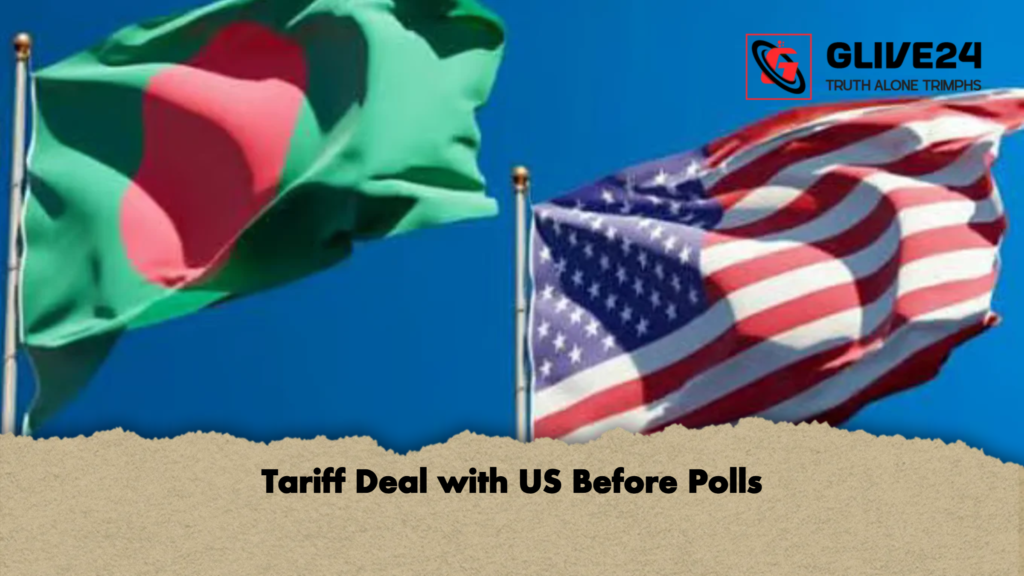
Just three days before Bangladesh’s forthcoming parliamentary election, the interim government is set to sign a significant tariff agreement with the United States, marking a notable development in the country’s external trade relations. The agreement is scheduled to be signed on 9 February in Washington, DC, with Bangladesh’s delegation led by Commerce Adviser Sheikh Bashir Uddin.
According to officials at the Ministry of Commerce, the deal concerns the reciprocal tariff rate of 20 per cent that the United States has imposed on Bangladeshi products. Although the two countries reached an understanding on this issue in August last year, the arrangement stopped short of a formal agreement. The upcoming ceremony in Washington is expected to formalise that earlier understanding and provide greater clarity for exporters on both sides.
To finalise the agreement, Commerce Adviser Sheikh Bashir Uddin and Commerce Secretary Mahbubur Rahman are due to depart Dhaka on 5 February. Their itinerary includes an initial visit to Japan, where Bangladesh and Japan will sign the Bangladesh–Japan Economic Partnership Agreement (BJEPA) in Tokyo on 6 February. Following the Tokyo event, the delegation will travel directly to Washington for the US tariff agreement.
Speaking to journalists at the Secretariat on Sunday, Commerce Secretary Mahbubur Rahman confirmed that Bangladesh had received confirmation of the signing date from the US authorities. He stated that the draft agreement, along with a summary seeking approval to sign on 9 February, had already been submitted through the appropriate government channels.
When asked whether the reciprocal tariff rate would remain at 20 per cent, the Commerce Secretary said that this was the prevailing rate, noting that some countries face similar levels while others face higher tariffs. He expressed cautious optimism that the rate might be reduced but acknowledged that a definitive answer would not be available before the signing date. The government has so far refrained from making any detailed public statement on the final terms of the agreement.
The Washington visit comes immediately after a major milestone in Bangladesh’s trade diplomacy with Japan. At a press conference held on 22 December, the Ministry of Commerce announced that once the BJEPA enters into force, 7,379 Bangladeshi products will enjoy duty-free access to the Japanese market from day one. In return, 1,039 Japanese products will receive immediate duty-free entry into Bangladesh, reflecting a reciprocal approach to market access.
| Agreement | Key Benefit for Bangladesh | Key Benefit for Partner Country |
|---|---|---|
| US Tariff Agreement | Potential reduction or stabilisation of 20% reciprocal tariff | Greater certainty in trade terms |
| Bangladesh–Japan EPA | 7,379 products gain duty-free access | 1,039 products enter Bangladesh duty-free |
Meanwhile, questions have been raised about whether Bangladesh is concerned by India’s recently signed free trade agreement with the European Union. Responding to this, Commerce Secretary Mahbubur Rahman downplayed any potential risk. He emphasised that Bangladesh has built strong capacity in the ready-made garments sector and is currently the world’s second-largest exporter in that industry. India, he noted, has a strong presence in textiles globally, and Bangladesh imports a significant volume of raw materials from India, indicating a complementary rather than adversarial relationship.
Trade analysts suggest that the near-simultaneous conclusion of agreements with both Japan and the United States could strengthen Bangladesh’s export prospects at a critical political moment. With elections imminent, the interim government appears keen to signal economic continuity and international engagement, particularly in securing market access for key export sectors such as garments, textiles and light manufacturing.