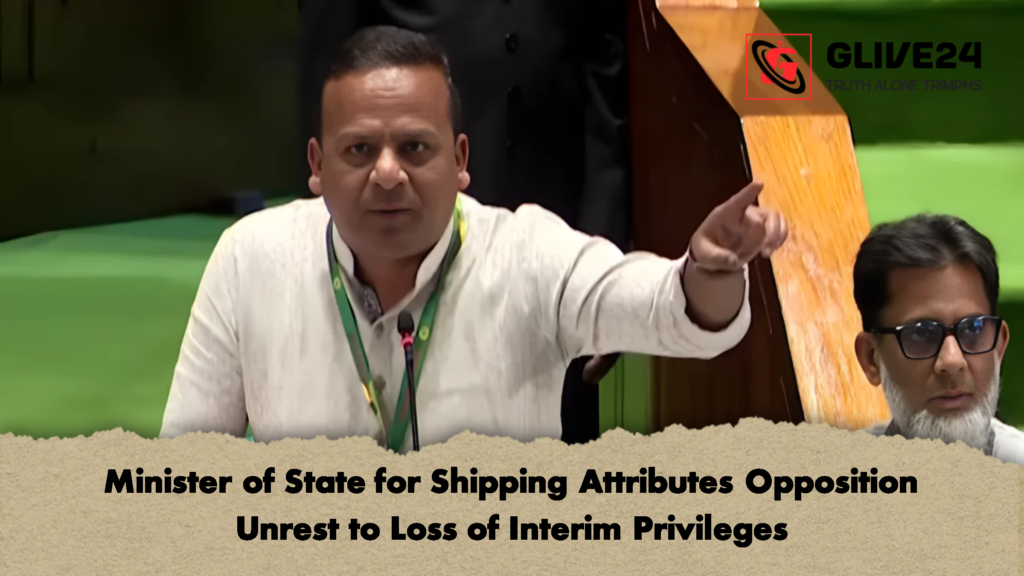
During a parliamentary session on Sunday, 26 April 2026, the Minister of State for Shipping, Rajib Ahsan, addressed the National Parliament regarding what he termed a noticeable “restlessness” amongst opposition members. Contributing to the discussion on the thanks-motion for the President’s speech, the Minister argued that the current friction in the House is a direct result of the opposition losing the unfettered access and “comfort” they purportedly enjoyed during the previous 18-month interim administration.
Minister Ahsan drew a historical parallel between the recent interim period and the military-backed caretaker government of 2007, commonly known as the “One-Eleven” administration. He asserted that the interim government, which concluded its term 18 months ago, was widely viewed as having the ideological support of Bangladesh Jamaat-e-Islami and the Nationalist Conservative Party (NCP)—the two primary entities now forming the parliamentary opposition.
Table of Contents
Allegations of Unregulated Administrative Access
The Minister’s delivery sparked an immediate outcry from the opposition benches as he claimed that the transition to the current government has disrupted an era of unregulated privilege. To support his thesis, Minister Ahsan referenced alleged private remarks made by a prominent figure within the Anti-Discrimination Student Movement.
“I can provide evidence of a student leader’s statement describing their conduct during that period,” the Minister remarked. “He reportedly claimed that they could enter the Chief Adviser’s residence or private quarters at will, and access the offices of senior Secretaries whenever they chose. Since those extraordinary facilities have been withdrawn, we are seeing this surge in instability.”
The Minister contended that the re-introduction of formal state protocols and administrative boundaries by the incumbent government has created significant “problems” for those who became accustomed to the lack of oversight during the interim phase.
Debate Over July Movement Casualty Records
A central theme of the Minister’s address was the discrepancy in the data regarding the fatalities of the July uprising. He noted that three separate Members of Parliament had recently cited conflicting figures: 844, over 1,000, and 1,400.
Minister Ahsan highlighted that while the Ministry of Health and the United Nations had initially estimated a figure exceeding 1,400, a final gazette published by the Ministry of Liberation War Affairs officially listed 844 martyrs. He specifically questioned a claim made by the Leader of the Opposition on 14 April, who stated he had visited the families of 1,200 martyrs.
“If the official government record stands at 844, it is mathematically difficult to reconcile how the Leader of the Opposition could have visited 1,200 bereaved families,” Ahsan observed. He stressed the importance of documenting accurate history to prevent the “commercial exploitation” of the July uprising’s legacy, drawing a comparison to the “distortions” he claimed have affected the history of the 1971 Liberation War over the past 54 years.
Political Decorum and Freedom of Expression
The Minister reiterated that the government upholds the principle of free speech, including the right to criticise the Prime Minister through satire or cartoons, provided such criticism remains within the bounds of civil discourse. However, he lamented the “indecent” rhetoric directed at the leadership and the family of the Prime Minister. He also condemned offensive remarks made regarding the late Begum Khaleda Zia, urging a return to political etiquette.
Minister Ahsan further requested a comprehensive disclosure of the political affiliations of the July martyrs. He argued that to label them solely as students or labourers while ignoring those who responded to the calls of political leadership would be a disservice to the reality of the struggle.
Rebuttal from the Leader of the Opposition
The Leader of the Opposition, Dr Shafiqur Rahman, responded to the Minister’s critiques later in the session. Addressing the discrepancy in the casualty figures, Dr Rahman referred to a statement by Sultan Salahuddin Tuku, who claimed that over 1,000 martyrs belonged specifically to the Bangladesh Nationalist Party (BNP) and its affiliated bodies.
Rejecting the Minister’s skepticism regarding his visits to victims’ families, Dr Rahman stated:
“I have not provided any fabricated information. Our organisation maintains a complete and verified profile of these individuals, which is accessible to the public on our website. We only include entries after a rigorous process of checking and cross-checking.”
The Leader of the Opposition invited the Minister to review the digital records maintained by the opposition, asserting that their data is based on first-hand verification and remains transparent for public scrutiny.