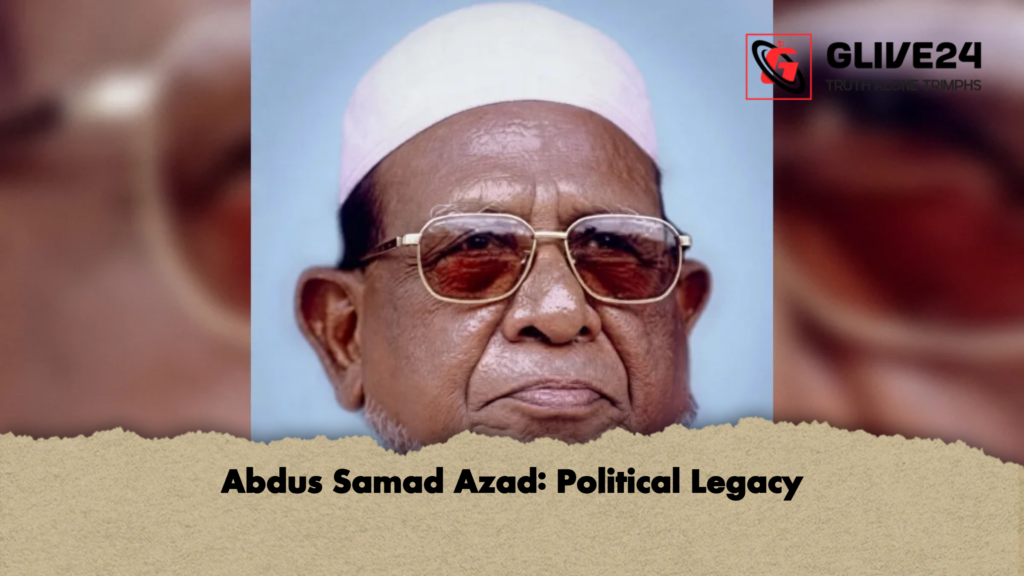
Abdus Samad Azad remains a distinguished and enduring figure in the political history of Bangladesh. A veteran politician, elected representative, and former minister, he devoted his life to public service, national movements, and the evolution of the country’s political landscape over several decades.
Born on 15 January 1922 in Bhurakhali village of Jagannathpur upazila in Sunamganj, Azad was the son of Mohammad Shariatullah. From an early age, he displayed leadership qualities that later shaped his political journey. He completed his matriculation from Sunamganj Government High School in 1943 and graduated from Murari Chand College in Sylhet in 1948.
His involvement in politics began in 1940 when he assumed the presidency of the Sunamganj Sub-Divisional Muslim Students’ Federation. Between 1944 and 1948, he served as president of the Sylhet District Students’ Federation, actively participating in various socio-political movements of the time. His activism led to multiple arrests during this formative phase.
Although he briefly worked as a teacher and in the insurance sector in the early 1950s, politics remained his primary pursuit. His participation in the Language Movement of 1952 marked a defining moment in his life, resulting in imprisonment and establishing his commitment to linguistic and cultural rights.
Over the following years, Azad continued to play a prominent role in regional and national politics. He became acting president of the East Pakistan Youth League in 1953. In 1954, he was elected to the Provincial Assembly from Sunamganj under the United Front alliance, strengthening his position as a representative of the people. In 1955, he joined the Awami League and served as its central labour secretary. Later, following ideological differences within the party structure, he joined the Krishak Sramik Party under the leadership of Maulana Bhashani.
His political career was repeatedly disrupted by periods of imprisonment. After the imposition of martial law in 1958, he was detained for four years. He was again arrested in 1964 for his role in efforts to resist communal violence. Despite these challenges, he remained active in political mobilisation and organisational work.
In 1969, he rejoined the Awami League and became president of its Sylhet district unit. In the 1970 general elections, he was elected to the National Assembly, further consolidating his influence. During the Liberation War of 1971, Azad played a significant organisational role in the Mujibnagar Government, initially serving as a political adviser and itinerant envoy, and later being appointed Foreign Minister in the provisional cabinet.
Following independence, he served as Minister for Agriculture in the government led by Sheikh Mujibur Rahman. He was elected to Parliament multiple times, including in 1973, 1991, 1996, and 2001 from Sunamganj-3, reflecting sustained public confidence in his leadership.
He was once again imprisoned after the political upheaval of 1975 and remained in custody until 1978. Abdus Samad Azad passed away on 27 April 2005 in Dhaka, leaving behind a long legacy of political engagement and public service.
Key Milestones
| Year | Event |
|---|---|
| 1922 | Born in Sunamganj |
| 1940 | Began student political leadership |
| 1952 | Arrested during Language Movement |
| 1954 | Elected Provincial Assembly Member |
| 1958–62 | Imprisoned under martial law |
| 1970 | Elected National Assembly Member |
| 1971 | Served in Mujibnagar Government |
| Post-1971 | Minister for Agriculture |
| 1991–2001 | Multiple parliamentary terms |
| 2005 | Passed away in Dhaka |
Abdus Samad Azad’s life reflects decades of political struggle, organisational leadership, and parliamentary service that significantly shaped Bangladesh’s national development.