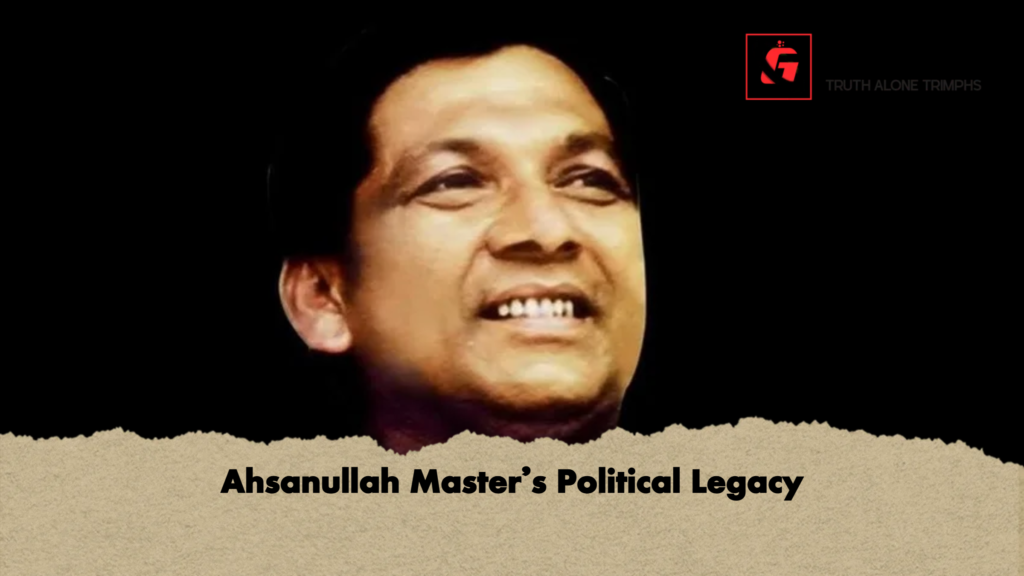
Ahsanullah Master was a Bangladeshi freedom fighter, educator, and political leader whose life was defined by service to the nation, labour rights, and public welfare. He consistently prioritised national interest and collective wellbeing over personal gain, serving as a representative figure for working people and a committed participant in the Liberation War of Bangladesh.
During the 1971 Liberation War, Ahsanullah Master actively participated in multiple armed engagements against the Pakistani forces. He served in frontline combat operations and demonstrated tactical resilience in several encounters. In one incident, when surrounded by enemy forces, he escaped by crossing a canal with a Sten gun and subsequently organised a counterattack that forced enemy withdrawal. In another engagement, he sustained injuries from a bayonet attack but continued fighting after removing the weapon and rejoining combat. His participation spanned several battle sites, including Dargabazar, Tongi TSC, Chayadana, and Kashimpur. He also took part in coordinated operations with allied forces, including grenade attacks on enemy positions that contributed to operational success.
Following the war, he pursued higher education and completed his graduation from the University of Dhaka in 1970. He subsequently entered the teaching profession and maintained a long association with education. His professional identity included roles as an educator alongside his involvement in political and labour movements.
Ahsanullah Master played a significant role in labour organisation and workers’ rights. He served as the Executive President and General Secretary of the National Workers’ League. In this capacity, he worked on trade union rights, occupational safety, and protections for migrant workers. He also supported initiatives such as establishing funds for legal assistance for workers and implementing welfare programmes.
His political career was closely connected with public service in Gazipur. He was elected Chairman of Pubail Union Parishad in 1983. He later served as Chairman of Gazipur Sadar Upazila Parishad. He was elected Member of Parliament from Gazipur-2 constituency in both 1996 and 2001, continuing his parliamentary role in representing local and national issues.
His conduct in public life reflected a consistent position on national identity and historical recognition. During an official visit to Japan, when presented with gifts by labour leaders, he declined them and instead requested that a photograph of Sheikh Mujibur Rahman be preserved in a Japanese museum, reflecting his emphasis on national historical memory.
He was born on 9 November 1950 and died on 7 May 2004.
| Category | Information |
|---|---|
| Full Name | Ahsanullah Master |
| Date of Birth | 9 November 1950 |
| Date of Death | 7 May 2004 |
| Education | Graduation, University of Dhaka (1970) |
| Occupation | Teacher, Politician, Labour Leader |
| War Participation | Active combatant in 1971 Liberation War |
| Parliamentary Role | Member of Parliament (Gazipur-2, 1996 & 2001) |
| Local Government Role | Chairman, Pubail Union Parishad (1983); Chairman, Gazipur Sadar Upazila Parishad |
Ahsanullah Master’s public life combined roles in armed resistance, education, and labour politics, forming a career centred on civic engagement and institutional participation in Bangladesh’s post-independence development.