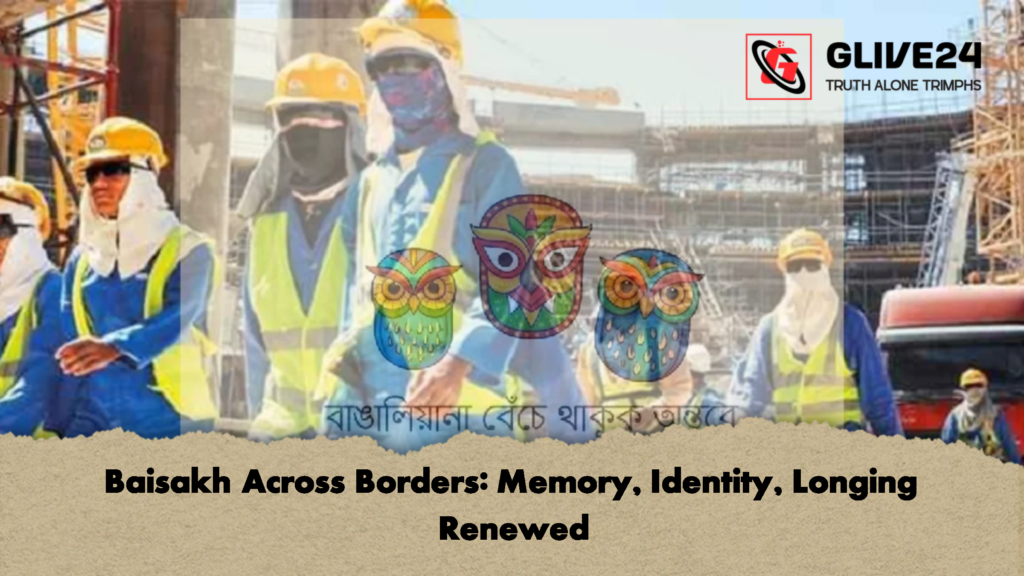
Pohela Boishakh arrives once again, ushering in the Bengali New Year with its familiar symbolism of renewal, cultural pride and collective memory. For Bengalis everywhere, it is far more than a calendrical transition; it is an emotional milestone embedded deeply within identity. Yet for those living away from their homeland, particularly within the diaspora, the occasion is often experienced not through celebration alone, but through reflection, nostalgia and quiet longing.
In Bogura, a northern city of Bangladesh, Baisakh once revealed itself in its most vivid and instinctive form. Dawn would break over bustling streets already alive with anticipation. The gentle current of the Karatoya River flowed alongside the rhythm of daily life, as if itself participating in the festivities. Trees sprouted fresh leaves, the air carried a soft warmth, and the sky shifted through subtle shades of gold and blue, marking the arrival of a new year steeped in nature’s own renewal.
For many, childhood memories of Pohela Boishakh remain inseparable from rain-drenched afternoons, the scent of ripe mangoes, carefree play in open fields, and the simplicity of days unburdened by responsibility. In those moments, relationships were defined by closeness and familiarity, where community and kinship formed the centre of existence. The word “we” was not merely linguistic—it was lived experience.
However, the realities of migration and economic necessity have carried countless individuals far from these landscapes. In countries such as Canada, home to a significant Bangladeshi diaspora, Baisakh unfolds in a markedly different rhythm. Spring emerges gradually: snow melts into streams, buds cautiously appear on bare branches, and nature awakens in slow, deliberate stages. Yet even in this transformed environment, cultural memory persists with remarkable resilience.
Within expatriate communities, Pohela Boishakh is primarily sustained through collective effort. Cultural organisations, community associations and volunteer groups come together to host festivals, stage performances, and organise traditional food fairs. These events seek to recreate fragments of Bangladesh abroad—spaces where language, music, attire and cuisine converge to form a symbolic homeland, however temporary.
Still, despite their vibrancy, such celebrations cannot fully replicate the emotional texture of lived experience in one’s birthplace. For many expatriates, Baisakh becomes less an outward festival and more an inward journey. It is a moment of return—if only in memory—to riverbanks once walked, fields once run across, and relationships once lived in effortless proximity.
Two Worlds of Baisakh: A Comparative Overview
| Aspect | Bangladesh (Bogura) | Diaspora (e.g., Canada) |
|---|---|---|
| Natural Setting | Rivers, fields, warm spring air | Gradual thaw, melting snow, late spring bloom |
| Mode of Celebration | Spontaneous public participation | Organised community-led events |
| Emotional Character | Collective joy, immediacy, sensory richness | Nostalgia, reflection, emotional distance |
| Cultural Expression | Integrated into everyday life | Actively reconstructed through associations |
| Dominant Experience | Presence and participation | Memory and remembrance |
In this duality lies the contemporary meaning of Pohela Boishakh for the diaspora. It is simultaneously celebration and remembrance, presence and absence, continuity and distance. Even while adapting to new cultural environments, individuals continue to carry within them an enduring connection to origin—one that is neither diminished by geography nor erased by time.
Ultimately, the Bengali New Year transcends its role as a temporal marker. It becomes an emotional bridge linking past and present, homeland and diaspora, memory and identity. In living abroad, this connection often grows deeper, as absence sharpens remembrance and distance intensifies belonging.
Thus, Baisakh in the diaspora is not merely observed—it is felt. It exists in recollection, in conversation, in shared meals, and in the quiet moments where memory briefly restores what geography has set apart. It is here that the festival reveals its most enduring truth: that identity is not bound by place, but sustained through remembrance.