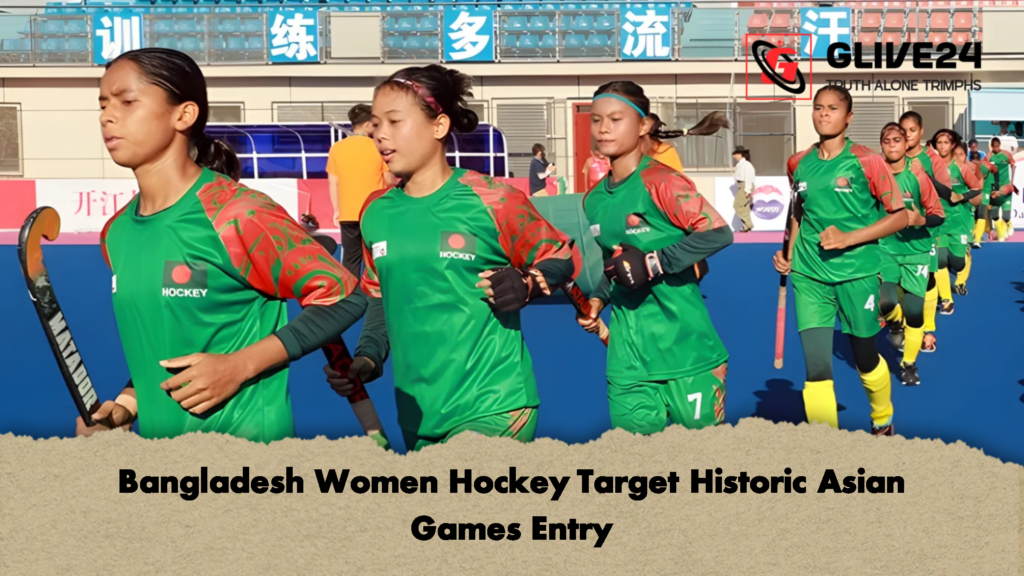
Bangladesh’s women’s hockey team is preparing for a defining moment in its sporting history as it sets its sights on qualification for the upcoming Asian Games, scheduled to be held in Nagoya, Japan this September. While the men’s national side has already secured its place through the qualifying pathway, the women’s team is now ready to embark on its own landmark international campaign.
Although hockey has long been established in Bangladesh’s sporting landscape, the women’s senior national team has yet to make its debut on the global stage. Until now, female players have largely competed at junior and age-group levels. The upcoming qualification tournament therefore represents the first-ever opportunity for Bangladesh’s women to reach a major continental multi-sport event at senior level.
Table of Contents
Qualification Battle in Jakarta
The decisive qualification tournament will take place from 23 to 29 April in Jakarta, Indonesia, bringing together eight Asian nations competing for a limited number of Asian Games spots.
Bangladesh have been drawn in Group A, alongside Chinese Taipei, Uzbekistan, and Hong Kong. The competition format is highly competitive: the top two teams from each group will progress to the semi-finals, and all four semi-finalists will automatically qualify for the Asian Games.
| Group A | Group B (details not specified) |
|---|---|
| Bangladesh | — |
| Chinese Taipei | — |
| Uzbekistan | — |
| Hong Kong | — |
A Historic Step for Women’s Hockey
For Bangladesh, this campaign represents far more than a qualification attempt—it marks the country’s first genuine entry into senior women’s international hockey.
The squad includes several promising players who previously represented Bangladesh at Under-18 level, where they achieved a notable bronze medal at the Asian Cup. Many of these athletes have emerged from the Bangladesh Krira Shikkha Protishtan (BKSP), the country’s leading sports academy, which has played a pivotal role in developing structured hockey talent at youth level.
Their transition into senior international hockey is expected to provide both technical quality and competitive resilience as they face more experienced opposition.
Coach Sees Opportunity Despite Tough Draw
Head coach Zahid Hossain Raju has adopted a realistic yet hopeful tone regarding Bangladesh’s prospects, acknowledging the strength of Group A opponents while stressing the importance of targeted victories.
“Chinese Taipei will be the strongest side in our group,” he noted. “However, we are confident of competing strongly against Uzbekistan and Hong Kong. If we can achieve positive results in those matches, there is a real possibility of finishing second in the group and reaching the semi-finals. That would be a major achievement for women’s hockey in Bangladesh.”
Preparation and Team Development
The national squad has been undergoing structured training since February, with emphasis placed on tactical organisation, physical conditioning, and match awareness at international intensity.
According to team management, the combination of junior international experience and recent intensive preparation is forming the foundation of their strategy. Coaches believe that exposure to competitive youth tournaments has helped develop mental resilience, which will be crucial as players transition into senior-level competition for the first time.
Gateway to a New Era
A top-four finish in Jakarta would secure Bangladesh’s qualification for the Asian Games, marking a breakthrough moment for women’s hockey in the country. It would also represent a significant step forward in expanding the sport beyond its traditionally male-dominated structure.
While the challenge remains formidable—particularly against more established Asian teams—the opportunity is unprecedented. Success in this qualification campaign would not only ensure Asian Games participation but could also serve as a catalyst for long-term development of women’s hockey in Bangladesh.
For now, all attention is focused on Jakarta, where a young and determined squad will attempt to turn years of gradual development into a historic international breakthrough.