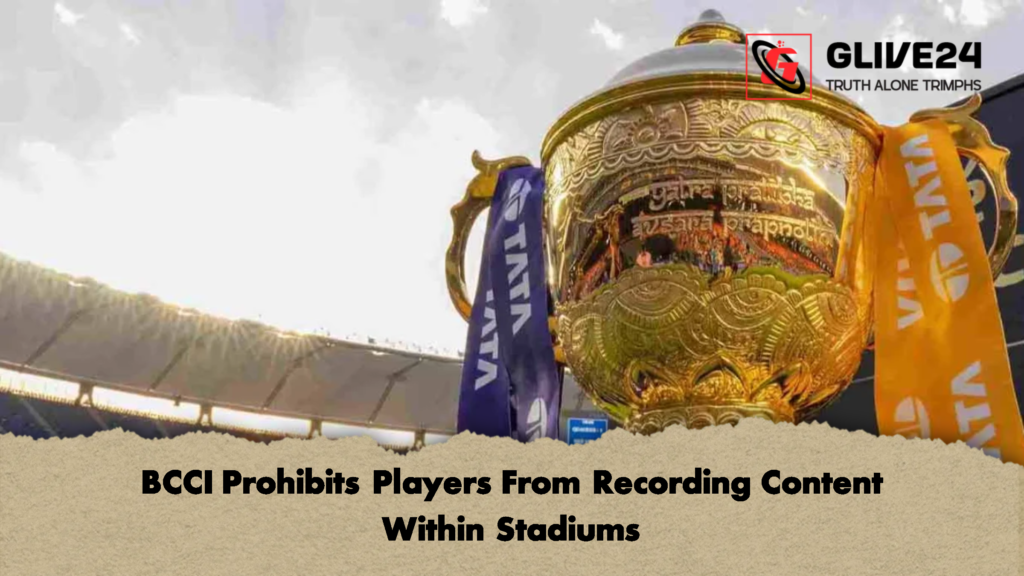
The Board of Control for Cricket in India (BCCI) has significantly intensified its regulatory framework regarding digital content creation during the ongoing season of the Indian Premier League (IPL). In a move designed to fortify anti-corruption measures and protect exclusive broadcasting rights, the governing body has issued a comprehensive prohibition against players, officials, and support staff recording or uploading video content from within the stadium premises on match days.
Table of Contents
Strict Enforcement of New Content Protocols
According to reports from NDTV and The Times of India, the BCCI has established a “zero-tolerance” policy concerning unauthorised filming. The new directive extends beyond the players to include match officials, broadcasters, and even the family members of those involved in the tournament. Under these guidelines, any individual associated with the BCCI or an IPL franchise who records video footage inside the stadium—particularly in restricted zones—could face formal legal notices and disciplinary action.
The primary motivation behind this escalation is the preservation of security and the mitigation of risks within the Players and Match Officials Area (PMOA). The BCCI maintains that the recording of footage in these sensitive locations could inadvertently leak tactical information or create vulnerabilities that might be exploited for corrupt purposes.
Recent Disciplinary Actions and Incidents
The formalisation of this ban follows a series of specific incidents that highlighted the growing trend of “vlogging” and social media engagement amongst athletes.
-
Arshdeep Singh: The Punjab Kings pace bowler was recently instructed by the Board to cease his social media vlogging activities immediately. This intervention served as a precursor to the wider policy announcement.
-
Former International Cricketer: During a high-intensity moment of a recent match, a former international cricketer—acting in a commentary or ambassadorial role—was observed recording video near the dugout for his personal YouTube channel. The BCCI Anti-Corruption Unit (ACU) intervened swiftly to halt the recording. Sources indicate that the individual now faces potential legal proceedings for the breach.
-
Broadcaster Reprimands: Several commentators and broadcast staff have reportedly received formal warnings for violating the “no-video” rule. The BCCI has explicitly stated that anyone wearing official IPL or Board attire is strictly prohibited from capturing unauthorised imagery inside the ground.
Concerns Over “Reel Culture” and Safety
The BCCI has expressed growing concern regarding the “Reel culture” and the perceived addiction to social media platforms amongst the current generation of cricketers. This concern was exacerbated by a recent controversy involving Yuzvendra Chahal, who featured in a video allegedly related to smoking on an aircraft. Such incidents have prompted the Board to exert greater control over the off-field activities of players to maintain the professional image of the league.
Furthermore, the restrictions apply to the families of players. Relatives residing within the team environment have been requested to refrain from posting any behind-the-scenes photographs or videos during the course of the IPL season.
Impact on Franchise Content Teams
While the ban is absolute for players and individual staff members, the BCCI has clarified that official franchise content teams are exempt, provided they operate within predefined boundaries. These professional units are the only entities permitted to utilise cameras in sensitive areas, ensuring that all published material undergoes a vetting process to comply with the league’s security and commercial standards.
| Restricted Category | Enforcement Measure |
| Players & Officials | Immediate ban on vlogging and filming |
| Sensitive Areas | PMOA and Dugouts declared “No-Camera” zones |
| Family Members | Prohibited from posting stadium-side media |
| Penalties | Legal notices, fines, and formal reprimands |
By implementing these stringent protocols, the BCCI aims to decouple the sporting spectacle from the distractions of individual digital entrepreneurship. As the IPL continues, the focus remains firmly on the integrity of the game, ensuring that the stadium environment remains a secure space for professional competition rather than a backdrop for unauthorised social media production.