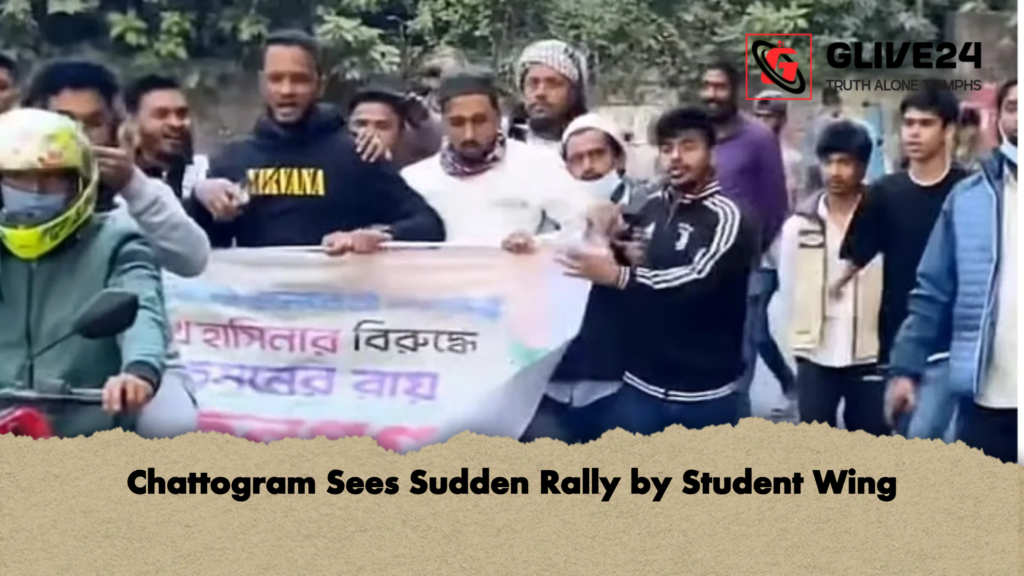
A sudden political demonstration by a banned student organisation has stirred debate and concern in Chattogram, Bangladesh. On Wednesday morning, a group claiming to represent the outlawed Bangladesh Chhatra League staged a surprise rally in the CRB area under Kotwali Police Station, despite government directives prohibiting their activities.
Eyewitnesses reported that a group of approximately 15–20 young men, most appearing to be between 18 and 27 years of age, marched with a banner bearing the name of the disallowed organisation. Several videos, quickly circulated across social media platforms, show the group chanting political slogans, including “Joy Bangla, Joy Bangabandhu” and “Sheikh Hasina is returning, Bangladesh is rising.” These clips sparked immediate reactions online, with many questioning whether the ban is being enforced, and if such activities are receiving covert protection.
Kotwali Police Station’s Officer-in-Charge, Abdul Karim, confirmed awareness of the incident but insisted that no arrests had been made at the time. In his brief statement he said, “We are investigating the matter. So far, no one has been detained.” The OC declined to clarify whether police officers were present during the rally or whether the group dispersed before officers arrived.
The event has revived a recent controversy. On 29 November, another flash rally was conducted in the Chateshwari neighbourhood, also attributed to the banned student wing. What made that incident more problematic was that on-patrol police officers who witnessed the march reportedly failed to inform their superiors. Following internal review, four policemen from Chawkbazar Police Station were withdrawn from duty on 1 December, an action seen as a disciplinary message intended to reinforce the seriousness of monitoring political demonstrations.
Political analysts and local journalists say these rallies highlight deeper tensions within Bangladesh’s political landscape, where prohibition does not necessarily translate into political inactivity. Some believe certain factions may be testing the boundaries of state tolerance ahead of upcoming political developments. Others view these flash processions as strategic attempts to influence public perception, particularly among young voters.
Residents interviewed near CRB expressed mixed reactions. Some shrugged off the rally as “a typical show of muscle,” while others voiced concern that sporadic political mobilisation might escalate. A local shop owner remarked, “If they are banned, how can they organise openly? Who is allowing it?” This question resonates with many citizens who are used to highly monitored street politics.
The government has not issued a formal response, but legal experts stress that any banned organisation holding rallies contravenes public order regulations. The situation leaves a lingering dilemma: is the ban merely symbolic, or are law enforcement agencies struggling to enforce it?
As the videos continue to spread, the sudden appearance of the banned group in Chattogram highlights how political visibility in Bangladesh remains fluid, unpredictable and often beyond clear official control.