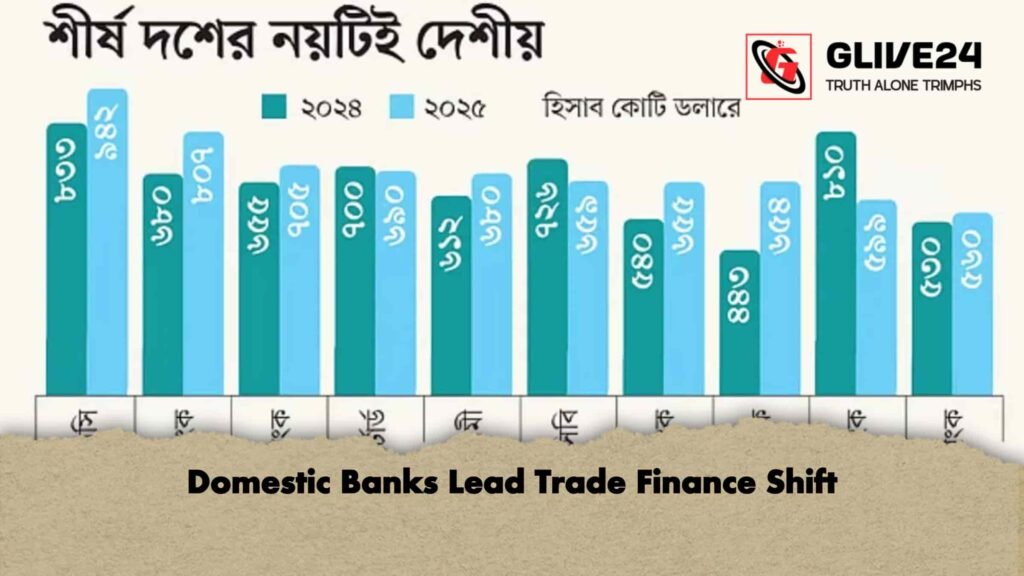
Domestic lenders have emerged as pivotal intermediaries in the nation’s external trade, marking a decisive structural shift from the landscape of a decade ago. Previously, the financing of capital machinery and industrial raw material imports was largely channelled through foreign banks, which benefited from stronger foreign currency lines, advanced risk management architecture and superior technological infrastructure. Local banks, constrained by limited foreign exchange exposure limits and comparatively modest compliance systems, struggled to compete.
Over the past ten years, however, sustained investment in digital platforms, automation of compliance protocols and the development of specialised trade finance teams have transformed the competitive environment. Domestic institutions now dominate import settlements, export financing and the issuance of bank guarantees, consolidating their position at the core of cross-border commercial activity.
Industry data for 2025 underscores this realignment. HSBC retained the top position in aggregate trade transactions, recording 9.42 billion US dollars in 2025, up from 8.33 billion US dollars in 2024. Notably, two of the top three positions are now occupied by local banks. City Bank reported trade volumes of 8.07 billion US dollars in 2025, a substantial increase from 6.80 billion US dollars a year earlier. Pubali Bank secured its standing among the leaders with transactions exceeding 7 billion US dollars.
A comparative snapshot of selected banks is set out below:
| Bank | 2024 (USD bn) | 2025 (USD bn) |
|---|---|---|
| HSBC | 8.33 | 9.42 |
| City Bank | 6.80 | 8.07 |
| Standard Chartered | 7.00 | 6.90 |
| Shahjalal Islami Bank | 6.12 | 6.80 |
| United Commercial Bank | 7.26 | 6.59 |
| BRAC Bank | — | 6.55 |
| Eastern Bank | — | 6.54 |
| Islami Bank | 8.10 | 6.54 |
| Southeast Bank | 5.30 | 5.60 |
With annual external trade estimated at approximately 120 billion US dollars, nearly 100 billion US dollars is executed through just 20 banks. This concentration indicates that trade flows are increasingly being managed by a relatively small cohort of technologically sophisticated and well-capitalised institutions.
Several structural drivers underpin the rise of domestic banks. Paperless documentation systems, automated compliance verification, expedited settlement cycles and improved foreign exchange liquidity management have enhanced operational efficiency. Participation in structured trade finance and international risk-sharing arrangements has widened access to offshore liquidity, reducing counterparty risk for exporters. Close alignment with the ready-made garments sector has further stabilised transaction pipelines and strengthened client retention.
Nonetheless, vulnerabilities remain. Globally, between 80 and 85 per cent of trade is now conducted on open account terms, heightening payment risk for exporters. While trade credit insurance is widely utilised in advanced markets, its domestic adoption remains limited. Analysts argue that broader deployment of modern risk mitigation instruments, supported by enabling policy frameworks, could position domestic banks to capture a larger share of regional trade flows.
Overall, local banks are no longer peripheral participants. They have evolved into central pillars of the country’s external trade architecture, reflecting a deeper institutional maturation and a recalibrated balance between domestic and foreign financial actors.