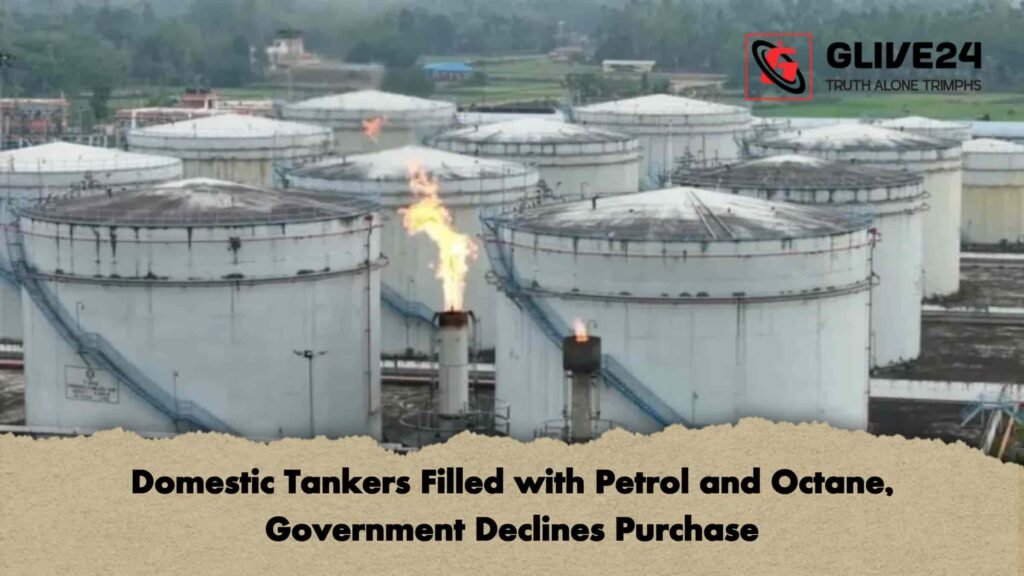
A renewed disruption has emerged in the country’s petroleum supply chain, as petrol and octane supplied by domestic companies are reportedly accumulating in storage tanks while the state-run Bangladesh Petroleum Corporation (Bangladesh Petroleum Corporation) is not accepting fresh deliveries. The development has coincided with extended queues at fuel stations and growing stockpiles at production facilities.
According to relevant sources, domestic producers collectively meet around 75 per cent of national demand for petrol and octane. This supply is generated by five local companies, comprising four private operators and one state-owned entity. The country’s monthly requirement is estimated at approximately 75,000 tonnes, with Super Petrochemical PLC accounting for the largest individual share, supplying around 40 to 45 per cent of total petrol and octane.
Concerns have arisen following reports that the Bangladesh Petroleum Corporation (Bangladesh Petroleum Corporation) issued a communication on 8 April stating that it would not receive fuel from Super Petrochemical PLC. As a result, the company’s storage tanks have reportedly reached near-capacity levels, raising operational concerns about continued production.
Industry sources further indicate that storage constraints have become a significant issue. The national octane storage capacity stands at 53,000 tonnes, while current stock levels are reported at around 55,000 tonnes, exceeding available capacity. Adding further pressure, a shipment carrying 37,000 tonnes of octane arrived on 10 April.
In a letter dated 16 April addressed to the chairman of the Bangladesh Petroleum Corporation, the Chief Executive Officer of Super Petrochemical PLC, Pranab Kumar Saha, expressed concern over the situation. He stated that during a meeting on 5 April, the company had been instructed to prepare for supplying 37,000 tonnes of petrol and octane along with 5,000 tonnes of diesel during April, and preparations were accordingly completed. However, from 8 April onwards, distribution companies reportedly ceased lifting fuel. He also noted that a previous shipment in February had not been collected as scheduled, forcing a suspension of production in March. Another shipment of raw materials is expected on 20 April, but continued operations may be disrupted if storage limitations persist.
Officials from Meghna Petroleum have stated that octane storage capacity is currently exhausted, necessitating controlled and limited procurement from private suppliers. Fuel distribution is being managed by Padma Oil Company, Meghna Petroleum, and Jamuna Oil Company.
At present, the three distribution companies collectively supply approximately 12,777 tonnes of diesel, 1,496 tonnes of petrol, and 1,193 tonnes of octane daily. Following geopolitical tensions in the Middle East in late February, fuel rationing was introduced in March. Although rationing was later lifted ahead of the Eid period, supply restrictions have reportedly remained in place.
Officials have suggested that constrained distribution has contributed to public uncertainty and increased precautionary buying, resulting in long queues at filling stations. However, the continued refusal to fully receive domestically produced fuel despite ongoing production has raised questions within the sector.
Fuel Supply Overview
| Item | Figure |
|---|---|
| Monthly national demand (petrol & octane) | 75,000 tonnes |
| Domestic supply contribution | ~75% |
| Super Petrochemical PLC share | 40–45% |
| Octane storage capacity | 53,000 tonnes |
| Current octane stock | 55,000 tonnes |
| Incoming octane shipment (10 April) | 37,000 tonnes |
| Daily supply (3 distributors combined) | 15,466 tonnes (approx.) |