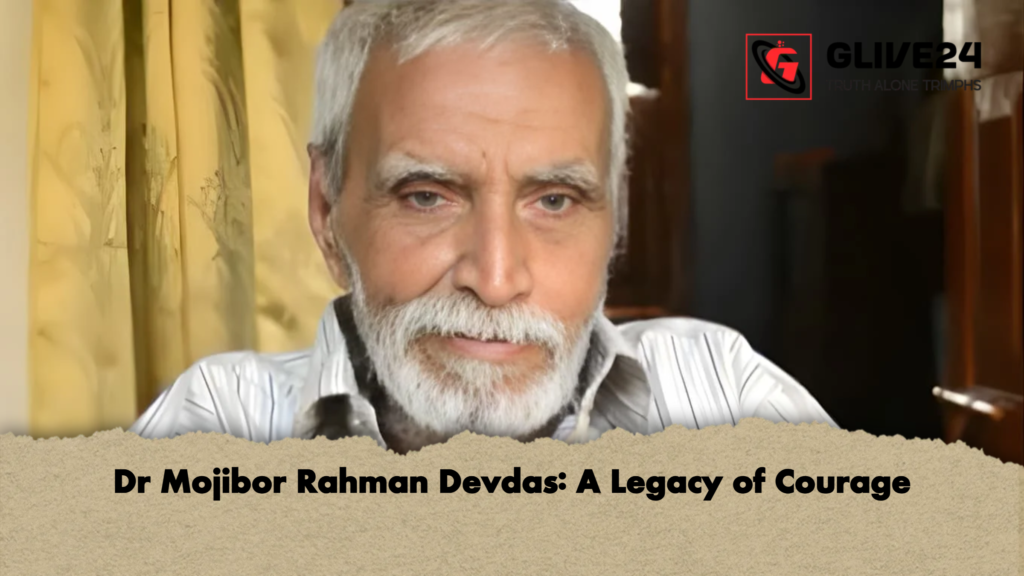
The history of the Bangladesh Liberation War is often told through the lens of military stratagems and political shifts. However, the narrative of Dr Mojibor Rahman Devdas offers a profound insight into the intellectual and moral resistance that defined the era. A scholar of international repute and a faculty member at the University of Rajshahi, his life became a testament to unyielding integrity in the face of systemic oppression.
Table of Contents
Academic Foundation and Professional Tenure
Born in Joypurhat, Mojibor Rahman established himself as a brilliant academic early in his career. After completing his Master’s degree at the University of Dhaka, he pursued higher studies abroad, earning an MSc in Applied Mathematics from the University of Melbourne in 1964. Upon his return to East Pakistan, he joined the Department of Mathematics at the University of Rajshahi as a Senior Lecturer in 1967. His contributions to the field of mathematics and his dedication to pedagogy marked him as a rising figure in the nation’s academic landscape.
1971: The Act of Defiance
The year 1971 brought an unprecedented humanitarian crisis to East Pakistan. As the Pakistani military launched its crackdown, religious minorities, particularly Hindus, were systematically targeted. While many were forced to conceal their identities for survival, Mojibor Rahman chose a radical path of solidarity and protest. He legally adopted the name “Devdas”—a traditionally Hindu name—appending it to his own. This was not merely a nominal change but a deliberate, silent, yet powerful protest against the communal violence and bigotry of the occupying forces.
On 10 May 1971, he issued a formal declaration on the official letterhead of the University of Rajshahi’s Mathematics Department. He stated that the university had been transformed from a seat of learning into a military camp, and he vowed not to return until an environment conducive to education was restored.
Captivity and Post-War Struggles
Following his declaration, the Pakistani military apprehended him. He was detained for approximately five months in a torture cell, subjected to severe physical and psychological abuse. The brutality of his incarceration left him permanently scarred; the writer Nazim Mahmud later described him as a “Living Martyr” due to the profound mental and physical toll he endured.
Despite the liberation of Bangladesh, his struggles persisted. When he attempted to resume his duties at the university, he faced bureaucratic resistance. The administration insisted he return under his original name, “Mojibor Rahman.” Refusing to compromise his principles or erase the history of his protest, he formalised his name as “Mojibor Rahman Devdas” via affidavit. This steadfastness led to his eventual isolation, and he spent much of his remaining life in relative obscurity in his home village in Joypurhat.
Career and Recognition Summary
| Attribute | Details |
| Education | MSc in Applied Mathematics, University of Melbourne (1964) |
| Primary Affiliation | Senior Lecturer, Dept. of Mathematics, University of Rajshahi |
| Date of Protest | 10 May 1971 |
| Nature of Protest | Name change to ‘Devdas’ and refusal to teach under military occupation |
| Consequence | Five months of torture and subsequent professional marginalisation |
| State Award | Ekushey Padak (2015) |
| Final Years | Resided in Joypurhat until his passing in 2020 |
Recognition and Legacy
In 2015, the Government of Bangladesh finally acknowledged his extraordinary contributions to the nation’s moral fabric by awarding him the Ekushey Padak, the country’s second-highest civilian award. Dr Mojibor Rahman Devdas remains a singular figure in Bangladeshi history—a man who sacrificed his career and health to stand as a shield for the persecuted, embodying the true spirit of intellectual resistance.