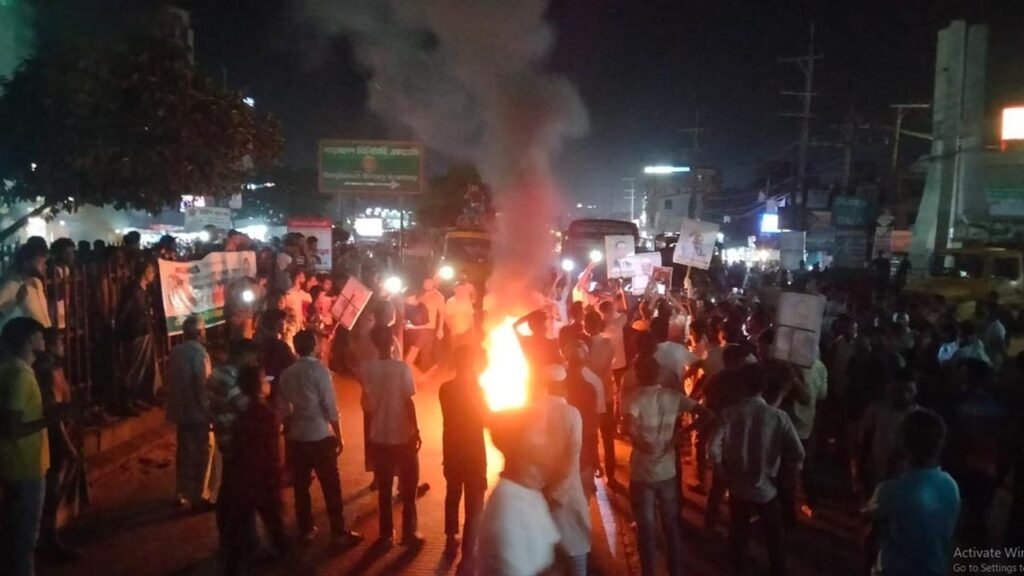
Internal tensions within the Bangladesh Nationalist Party escalated sharply on Saturday, as activists across eight constituencies launched coordinated demonstrations against the party’s newly announced list of parliamentary candidates. What began as scattered discontent has now grown into a visible wave of protests—stretching from Meherpur in the west to Chattogram in the east—underscoring the depth of dissatisfaction at grassroots level.
The BNP’s candidate list, announced on 3 November, named 237 contenders. Yet the announcement immediately triggered grievances from rival local factions, many of whom argued that the leadership had overlooked popular, long-serving activists in favour of politically connected or centrally favoured nominees. The withdrawal of a nomination within just one day further fuelled speculation of instability within the party’s selection process.
Saturday’s mobilisation unfolded in Dhaka-14, Chattogram-4, Munshiganj-1, Rajshahi-3, Gaibandha-1, Meherpur-2, Brahmanbaria-4 and Kishoreganj-5. The latter remains without a BNP candidate, prompting supporters to stage human chains to ensure the seat is not bargained away in alliance negotiations.
Perhaps the most striking display of dissent occurred in Chattogram-4, where thousands joined an extraordinary 40-kilometre human chain demanding that the party replace its chosen candidate, Kazi Mohammad Salauddin. The protest, organised by supporters of Aslam Chowdhury, reflected not only personal loyalty but also frustration among local workers who feel increasingly distanced from the central leadership.
In Dhaka-14, evening streets lit up with a torch procession calling for the removal of nominee Sanjida Islam Tuli and advocating the candidacy of SA Siddique Saju. Protesters also accused Tuli of making disparaging remarks concerning religious issues, intensifying the controversy surrounding her nomination.
Munshiganj-1 saw yet another dramatic scene as demonstrators blocked portions of the Dhaka–Mawa Expressway. The blockade highlighted a fierce contest between rival aspirants who claimed greater grassroots legitimacy than the nominated candidate, Sheikh Md Abdullah. Traffic slowed to a crawl until senior leaders intervened.
A more unconventional protest took place in Rajshahi-3, where activists physically lay down on the highway to demand a local nominee, criticising the selection of Shafiqul Haque—an outsider to the constituency. The demonstration created a tailback stretching several kilometres along the Rajshahi–Natore route.
In Gaibandha-1, objections centred on the perceived absence of the nominated candidate, Dr Khondoker Ziaul Islam, from constituency affairs due to his medical profession in Dhaka. Protesters instead demanded the nomination of local businessman Arefin Aziz Sardar. Similar anti-nomination human chains were seen in Meherpur-2 and Brahmanbaria-4, where activists voiced support for alternative candidates seen as more rooted in local communities.
The final wave of demonstrations occurred in Kishoreganj-5, where supporters of Sheikh Mujibur Rahman Iqbal formed multiple human chains across Bazitpur and Nikli to press for his nomination.
Taken together, the protests reveal a deepening divide within the BNP. Analysts suggest that unless the leadership swiftly engages with the grievances of grassroots activists, the party risks entering the election season with fractured organisational strength and diminished field mobilisation.