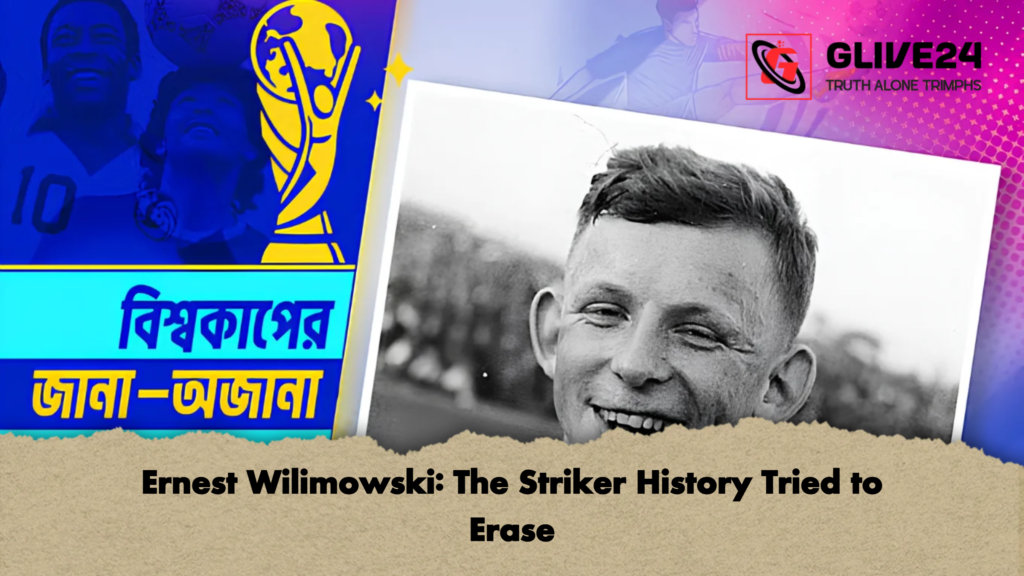
Despite a goal-scoring record that rivals the greatest names in football history, Ernest Wilimowski remains a ghost in the annals of Polish sport. There are no statues in his honour outside stadiums, and his name is absent from the hospitality suites of Poland’s national arenas. For a man who netted 21 goals in 22 appearances for Poland, his systematic erasure from the national consciousness serves as a stark reminder of the complexities of identity during the Second World War.
Table of Contents
Early Life and Physical Uniqueness
Born Ernest Otto Prandella in 1916 in Kattowitz, then part of the German Empire, Wilimowski’s early life was shaped by geopolitical upheaval. His father died fighting for Germany in the First World War, an event that predated Ernest’s memory of him. Following the war, Kattowitz became Katowice, part of the newly independent Poland. After his mother remarried, Ernest took his stepfather’s surname, becoming Ernest Wilimowski.
Physically, Wilimowski was distinct, possessing red hair and prominent ears. Most notably, he was born with polydactyly on his right foot, featuring six toes. Far from viewing this as a deformity, Wilimowski regarded his eleventh toe as a talisman for his exceptional agility and clinical finishing on the pitch.
Domestic Dominance and Discipline
Wilimowski’s club career was defined by his tenure at Ruch Chorzów. During the 1930s, he led the club to four consecutive league titles. He was the league’s top scorer in 1934 and 1936. However, his career was not without controversy; in 1935, he was handed a one-year suspension for public intoxication following a league match, an incident that cost him a place in the 1936 Berlin Olympics.
The 1938 World Cup and the “Last Game”
The pinnacle of his international career occurred during the 1938 FIFA World Cup in France. In a legendary encounter against Brazil in Strasbourg, Poland trailed 3-1 at half-time. Wilimowski produced a historic performance, scoring a hat-trick in the second half to level the game at 4-4. He added a fourth in extra time, becoming the first player to score four goals in a single World Cup match. Although Brazil ultimately won 6-5, Wilimowski’s talent was undisputed.
On 27 August 1939, Wilimowski scored another hat-trick in a 4-2 victory over Hungary. This match is remembered in Poland as “The Last Game,” occurring just four days before the Nazi invasion of Poland triggered the Second World War.
War, Identity, and Exile
As the war progressed, Wilimowski, who identified as a Silesian (a blend of Polish and German heritage), re-accepted German citizenship. To the Polish population suffering under occupation, seeing their star striker wear the jersey of the Third Reich was viewed as an act of ultimate betrayal.
Historical evidence suggests a more sombre motivation: Wilimowski’s mother had been sent to the Auschwitz concentration camp due to an intimate relationship with a Russian Jew. It is widely believed that Wilimowski used his status and his participation in German “propaganda matches” to secure her survival.
Statistical Overview: Ernest Wilimowski
| Category | Details/Statistics |
| Full Name | Ernest Otto Wilimowski (born Prandella) |
| International Goals (Poland) | 21 goals in 22 matches |
| International Goals (Germany) | 13 goals in 8 matches |
| World Cup Record | First player to score 4 goals in one match (1938) |
| Domestic Honours | 4-time Polish Champion (Ruch Chorzów) |
| League Top Scorer | 1934 (33 goals), 1936 (18 goals) |
| Career Longevity | Active until age 43 (various German clubs) |
Post-War Rejection
Following the war, Wilimowski attempted to return to Poland, but the Communist government officially branded him a traitor and barred his entry. He spent the remainder of his life in West Germany.
A final moment of tragedy occurred during the 1974 World Cup held in West Germany. Wilimowski sought permission to visit the Polish national team at their base, but he was strictly forbidden from doing so by Polish officials. He watched from the stands as a stranger to the nation he had once represented with such distinction. Ernest Wilimowski died in Karlsruhe in 1997, largely forgotten by the footballing world he once dazzled.