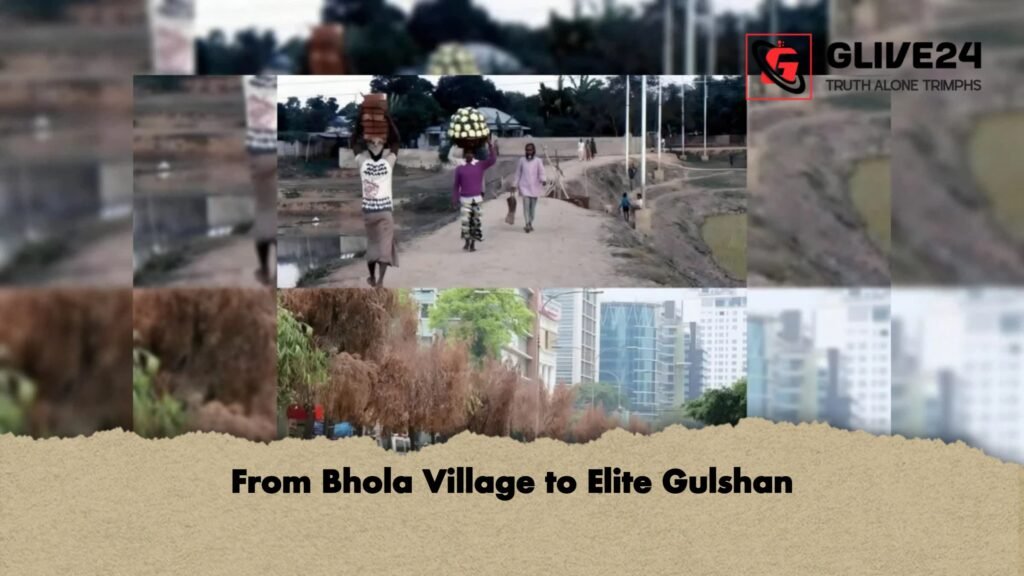
Among Dhaka’s most prestigious residential and diplomatic zones, Gulshan stands today as a unique and distinguished name. With its modern high-rise buildings, foreign embassies, corporate offices, luxury restaurants, and shopping malls, it resembles a contemporary international city within the heart of Dhaka. Yet behind this polished image lies a history deeply rooted in a once quiet, green rural settlement known as “Bhola Village”.
Table of Contents
A peaceful agrarian village
The present-day Gulshan was once a landscape of agricultural land, canals, and dense greenery. Locally, it was known as “Bhola Village”. It is believed that farming families from Bhola district settled here and began cultivating the land. Rice, vegetables, and fruit farming were the primary livelihoods of the inhabitants. The population was sparse, and life followed a simple rural rhythm.
At night, the area was filled with the sounds of jackals, while dense bushes and isolated paths stretched across the landscape. According to local accounts, until the early 1960s, wildlife activity was still common in the area. The entire region existed as a calm rural world, far removed from the urban life of Dhaka.
Historical background in the Mughal and British eras
During the Mughal period, the outskirts of Dhaka consisted largely of rivers, canals, and agricultural land. The Gulshan area was then part of a river-based agrarian landscape with small rural settlements. Although urbanisation gradually began during British rule, this region remained predominantly agricultural for a long time. Some land came under the control of landlords, yet ordinary farming communities continued cultivation. The name “Bhola Village” remained widely used locally.
The planned birth of Gulshan (Pakistan period)
After 1947, Dhaka experienced rapid population growth and urban expansion. In the 1960s, the then Dhaka Improvement Trust (DIT) initiated plans to develop organised residential areas. Gulshan was selected as a model township.
Around 1961, the area was formally acquired under government planning, and infrastructural development began gradually. During this period, a senior administrative figure played a role in renaming the area “Gulshan”, meaning “flower garden”. The name was reportedly inspired by an elite neighbourhood in Karachi.
Early infrastructure and urban development
In its early days, Gulshan lacked modern facilities. There were no proper roads, bridges, markets, police stations, or schools. People even had to walk from Mohakhali to reach the area. Gradually, however, planned development began. Lakes were excavated, roads were constructed, bridges built, and street lighting introduced.
Initially, apart from a few schools and religious institutions, there was little infrastructure. Over time, however, affluent and elite families began purchasing land and building houses. They constructed modest yet elegant homes, maintained gardens, and created social gathering spaces, gradually transforming the area into an upscale neighbourhood.
Administrative growth and modern Gulshan
After Bangladesh gained independence in 1971, Gulshan developed into a structured police station area. By the 1980s, it became part of Dhaka Municipality. Rapid urbanisation followed, and the area steadily emerged as one of the country’s most important diplomatic and commercial hubs.
Gulshan today
Today, Gulshan is not merely a residential area; it is the diplomatic and corporate heart of Bangladesh. It hosts numerous foreign embassies, international organisations, banks, multinational companies, luxury hotels, and fine dining establishments. Every element of modern urban living is present here.
Yet beneath this modern identity lies the memory of “Bhola Village”—once a place of agricultural livelihoods, simple rural life, green fields, and tranquil surroundings.
The history of Gulshan is essentially a story of transformation—from rural agricultural settlement to planned modern urban centre. It reflects multiple historical layers: the natural landscape of the Mughal era, agricultural continuity under British rule, structured development during the Pakistan period, and rapid urbanisation in independent Bangladesh. Together, these phases make Gulshan a symbol of profound urban evolution.
To be continued…
Author: A B N Zakirul Haque Titon
Editor & Publisher: G-Live 24