The foreign exchange market in Bangladesh opened on Tuesday with a broadly mixed performance, as global geopolitical tensions—particularly ongoing instability in the Middle East—continue to influence currency movements. Over the past two months, the market has experienced persistent volatility, with most foreign currencies fluctuating against the Bangladeshi Taka amid shifting global demand and import pressures.
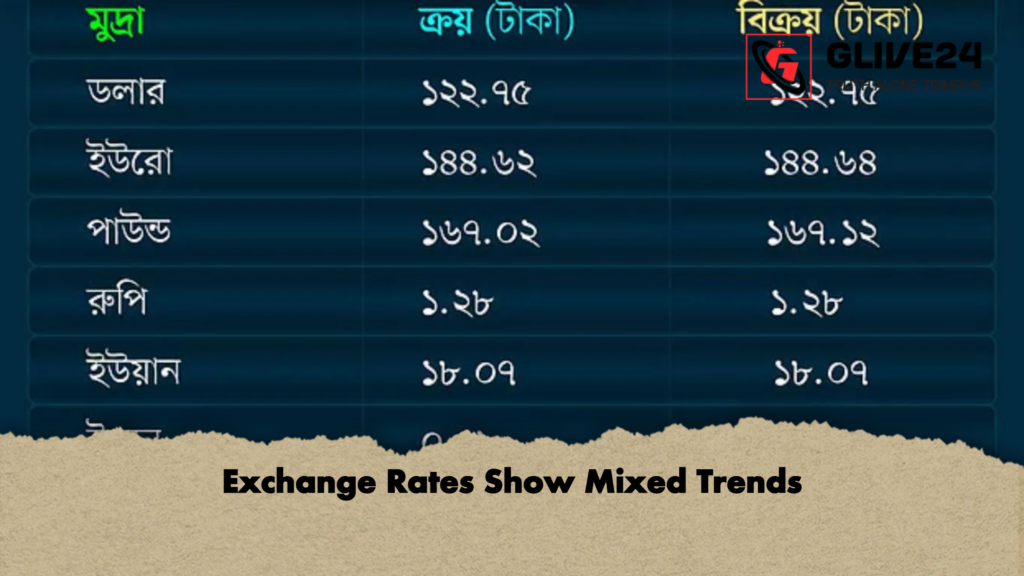
According to data released by the Bangladesh Bank, the US Dollar remained unchanged today, averaging at BDT 122.75. The American currency has been relatively unstable over recent months, although it recorded a modest upward drift over the past month. This gradual appreciation has kept import-related costs under pressure, especially for fuel, industrial raw materials, and capital machinery.
Market observations suggest a mixed pattern across other major currencies. The Euro, British Pound, Indian Rupee, and Singapore Dollar all recorded slight declines compared to previous trading sessions. In contrast, the Chinese Yuan showed a mild increase, reflecting shifting trade dynamics in the Asia-Pacific region. Meanwhile, the Japanese Yen and Australian Dollar remained stable, showing no significant movement in today’s trading session.
Economists note that Bangladesh’s foreign exchange market often reflects external economic conditions more sharply due to the country’s import-dependent structure. As a result, fluctuations in global energy prices, international interest rates, and geopolitical developments tend to have a direct impact on domestic currency valuations.
It is also observed that exchange rates in the open market are typically slightly higher than the official rates published by the central bank. This gap is influenced by demand-supply imbalances, remittance flows, and informal market dynamics. Such variations ultimately affect the cost of doing business in the country, particularly for importers and exporters who rely heavily on foreign currency transactions.
Analysts further caution that continued volatility may influence inflationary pressures in the coming months, especially if global uncertainties persist. However, steady remittance inflows from expatriates continue to provide partial support to foreign exchange reserves, helping to stabilise the broader currency market.
Foreign Exchange Overview (Tuesday)
| Currency | Bangladesh Bank Rate / Movement | Market Note |
|---|---|---|
| US Dollar (USD) | BDT 122.75 | Unchanged |
| Euro (EUR) | Not specified | Slight decrease |
| British Pound (GBP) | Not specified | Slight decrease |
| Indian Rupee (INR) | Not specified | Slight decrease |
| Singapore Dollar (SGD) | Not specified | Slight decrease |
| Chinese Yuan (CNY) | Not specified | Slight increase |
| Japanese Yen (JPY) | Not specified | Stable |
| Australian Dollar (AUD) | Not specified | Stable |
Overall, the currency market continues to reflect a cautious sentiment, with traders closely monitoring international developments that may shape future exchange rate movements.