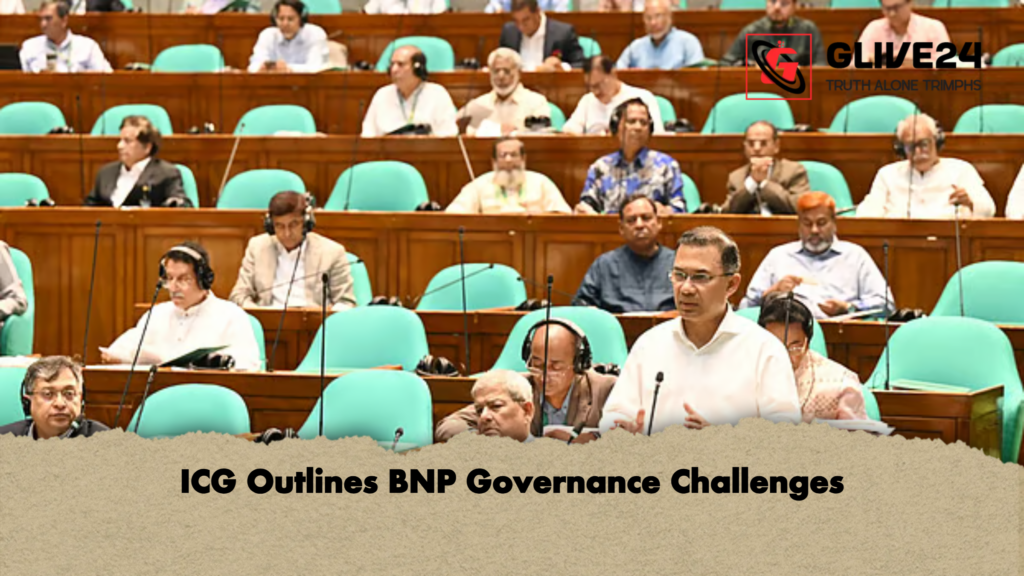
The International Crisis Group (ICG) has highlighted that the Bangladesh Nationalist Party (BNP) faces a series of significant governance tests in the coming years, particularly in relation to economic recovery, internal security, political reform, and the handling of the political future of the Awami League. The analysis appears in a report titled “Bangladesh’s New Government Gets to Work”, published on Thursday on the organisation’s website.
The Brussels-based non-profit organisation, which works globally on conflict prevention and resolution, notes that Bangladesh’s transition following a prolonged period of increasingly authoritarian governance represents a major political milestone. While the electorate has delivered a clear mandate, the report stresses that it remains uncertain whether this mandate can be translated into long-term stability and sustained popular legitimacy.
ICG argues that the BNP government will be judged primarily on its ability to revive the economy, improve security conditions, advance institutional reforms, and address the contentious issue of the Awami League’s political future. Failure to meet the political and economic expectations that underpinned recent mass movements could, it warns, return the country to instability.
A central concern raised is the urgency of early governance action. The report recommends that the BNP should use the initial phase of its tenure to implement reforms in the economy, governance, and security sectors, while avoiding confrontational politics with opposition groups. It also urges a careful review of legal cases filed against Awami League members.
Key Governance Challenges Identified
| Area | ICG Assessment | Risk Highlighted |
|---|---|---|
| Economy | Requires urgent revitalisation | Failure may trigger renewed instability |
| Security | Police reform and public order needed | Weak enforcement capacity and mob violence |
| Political reform | Divisions over constitutional changes | Risk of parliamentary and street-level conflict |
| Awami League future | Legal status unresolved | Potential for political polarisation |
| Foreign policy | Balancing major global partners | Overdependence or diplomatic imbalance |
The report underlines that political reform could become a particularly contentious issue. Although the BNP has endorsed several proposals outlined in the “July Charter”, including support for implementation, its parliamentary members previously declined to take an oath related to a proposed constitutional reform council. Moreover, uncertainty remains over which reforms the party would ultimately support if it uses its parliamentary majority to amend the constitution.
Disagreement persists over several provisions, including proportional representation in an upper parliamentary chamber. ICG warns that excluding key reform elements could weaken checks and balances and become a rallying point for opposition movements.
The report further notes that any perception of the BNP retreating from meaningful reform could strengthen opposition forces, including Islamist-oriented political groups and emerging political alliances. Such developments, it adds, may translate into both parliamentary and street-level mobilisation.
On the question of the Awami League, ICG highlights one of the most complex political dilemmas facing the new administration. The party’s activities remain suspended pending the conclusion of trials at the International Crimes Tribunal. The report suggests that maintaining or lifting the ban will require careful consideration of legal outcomes, public sentiment, and regional political dynamics.
ICG also raises concerns about prolonged political exclusion of a major party, warning that it could fuel instability if not managed carefully. It notes that leadership continuity under Sheikh Hasina remains a sensitive factor, complicating any potential reintegration of the party into formal politics.
In terms of law enforcement, the report identifies serious challenges in restoring public trust in the police. It calls for strengthening the chain of command, limiting political interference, and avoiding the politicisation of recruitment, a practice associated with previous administrations. It also emphasises the need for structural police reform and improved capacity to manage protests and mob violence.
Economically, the BNP is advised to act swiftly to stabilise conditions, particularly given Bangladesh’s reliance on energy imports and exposure to global market fluctuations. The report links domestic economic resilience directly to political stability.
On foreign policy, ICG observes that Bangladesh is operating in a rapidly shifting regional and global environment. The report highlights the need for balanced relations with major partners, including India, China, the United States, the European Union, Japan, and Gulf states, while avoiding excessive alignment with any single bloc. It also identifies the Rohingya refugee crisis as an unresolved and persistent diplomatic challenge.
Finally, the report concludes that the BNP government’s overall success will depend on whether it can generate employment, improve governance, and meet public expectations for institutional reform. Failure to do so, it warns, could once again place Bangladesh on a path towards political uncertainty and renewed unrest.