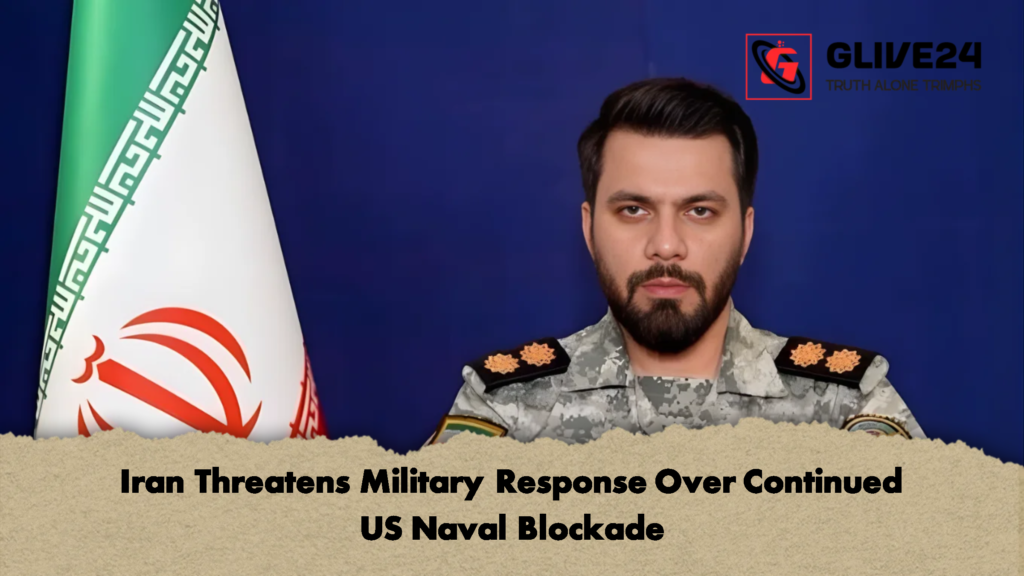
The Iranian military has issued an ultimatum to the United States, vowing a “counter-response” if the ongoing American maritime blockade in the Strait of Hormuz is not rescinded. This formal warning, reported by the BBC and disseminated through various Iranian state media channels, signals a sharp intensification of the naval standoff within one of the world’s most vital strategic and commercial waterways.
In a statement released on Saturday, 25 April 2026, the General Staff of the Armed Forces of the Islamic Republic of Iran declared that United States naval operations in the region have reached a “critical threshold.” The command centre indicated that Tehran would be compelled to initiate a direct military and strategic retaliation should the American forces continue what it describes as “unlawful maritime interference.”
Accusations of “Piracy” and Escalated Alert Status
The Iranian communiqué, published by the Tasnim News Agency, employed severe rhetoric to describe the recent actions of the U.S. Navy. The Iranian military leadership accused Washington of orchestrating acts of “maritime piracy, banditry, and sea robbery” in international waters.
The statement further confirmed that both the Iranian Navy and the Islamic Revolutionary Guard Corps (IRGC) have been placed on a heightened state of combat readiness. Tehran maintains that the American blockade constitutes a direct infringement upon its sovereign rights and a violation of established international maritime protocols. The warning stated explicitly that a “retributive response” would become unavoidable should the United States persist in intercepting vessels engaged in Iranian trade.
Origins and Impact of the Maritime Standoff
The current crisis originated on 13 April 2026, when the United States implemented a comprehensive maritime blockade. This policy mandates the interception of all vessels either approaching or departing from Iranian ports. The U.S. administration has defended these measures as essential for preventing the transport of sanctioned goods and ensuring the safety of international merchant shipping.
In the twelve days since the blockade’s inception, the United States Navy has intercepted and detained several vessels, including commercial tankers and cargo ships, pending detailed inspection. Tehran has consistently denounced these seizures, asserting that the vessels were conducting legitimate trade and that their detention is a breach of the universal right to freedom of navigation.
The Strait of Hormuz remains the world’s most significant energy chokepoint, facilitating the transit of approximately 20% of the global petroleum supply. Consequently, the threat of military confrontation in this sector has immediate and far-reaching consequences for global energy security and economic stability.
Global Security Concerns and Legal Disparities
The prospect of an Iranian “counter-response” has generated substantial concern within the global shipping industry and amongst maritime insurers. Historical precedents of conflict in the Strait include the deployment of naval mines, the harassment of tankers by fast-attack craft, and the reciprocal seizure of vessels—all of which could potentially disrupt global trade routes.
From a legal perspective, the situation reflects a deep divide in the interpretation of the United Nations Convention on the Law of the Sea (UNCLOS). Washington frames its naval blockade as a legitimate enforcement of international security and sanctions, whereas Tehran views the intervention as a violation of its territorial integrity and the principle of innocent passage.
The Iranian command concluded its Saturday address by affirming that its military forces possess both the “capability and the resolve” to defend national maritime interests. As of Saturday evening, neither the U.S. Department of Defence nor the Pentagon has issued a formal rebuttal to this specific warning. Nevertheless, the U.S. Fifth Fleet, based in Bahrain, remains fully operational in the Persian Gulf and the Gulf of Oman, continuing the enforcement duties began on 13 April. The international community remains on high alert, as the potential for an accidental or intentional escalation continues to threaten regional peace.