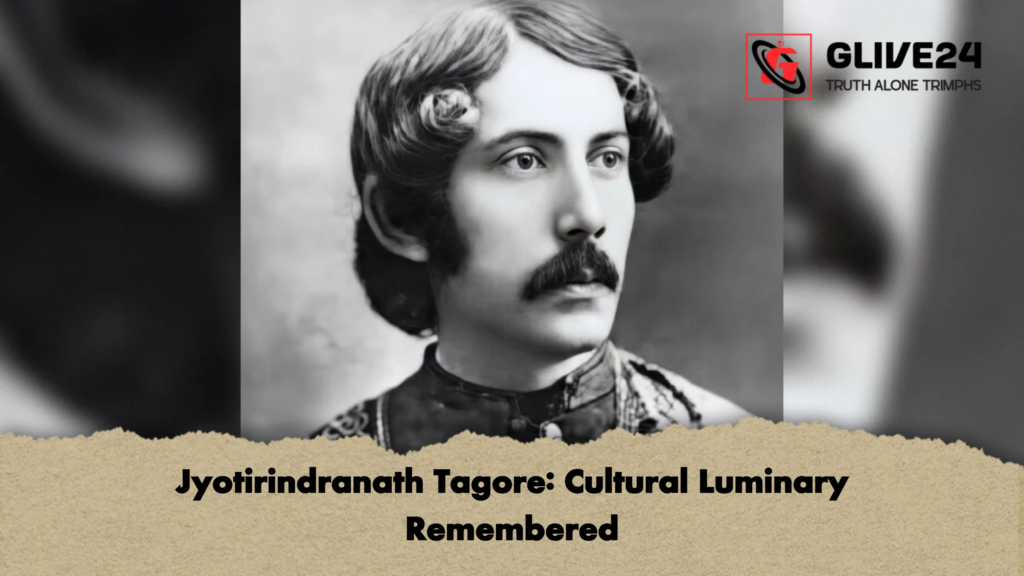
Jyotirindranath Tagore remains one of the most distinguished figures of the Bengal Renaissance, a period that reshaped the cultural, intellectual, and artistic landscape of colonial India. A dramatist, lyricist, musician, translator, painter, and organiser, he exemplified the spirit of a true polymath whose contributions continue to illuminate Bengali cultural history.
Born on 4 May 1849 in the illustrious Tagore household at Jorasanko in Calcutta, Jyotirindranath was the fifth son of Maharshi Debendranath Tagore and the elder brother of the Nobel laureate Rabindranath Tagore. He grew up in an environment deeply enriched by literature, philosophy, and artistic exploration, which profoundly shaped his intellectual and creative pursuits from an early age.
In 1868, he married Kadambari Devi, a relationship often regarded by historians as emotionally significant in shaping the Tagore family’s inner dynamics, particularly influencing Rabindranath Tagore’s early literary sensibilities. The emotional resonance of this period is frequently reflected in the broader Tagore literary legacy.
A strong advocate of cultural nationalism, Jyotirindranath became actively involved with the Hindu Mela in 1867, an organisation that sought to promote indigenous culture and national pride. His patriotic composition “Udbodhon” is considered an early literary expression of nationalist sentiment. He also played a pivotal role in establishing and nurturing several intellectual and reformist associations, including the Brahma Dharma Bodhini Sabha and Sarস্বত Society, contributing significantly to social awakening movements of his time.
Literary and Artistic Contributions
Jyotirindranath’s literary career was marked primarily by his contributions to Bengali theatre. His works combined historical consciousness with social critique, while his farcical plays displayed sharp wit and satire targeting societal absurdities.
| Category | Notable Works |
|---|---|
| Farce | Kinchit Jalogog, Hothat Nawab, Alik Babu |
| Historical Drama | Purubikram, Sarojini or the Siege of Chittor |
| Tragedy & Drama | Ashrumati, Swapnamayi |
| Cultural Work | Swaralipi Gitimala (Music Notation Compilation) |
Beyond original writing, he enriched Bengali literature through translations of several Sanskrit, French, and English plays, thereby widening the intellectual horizon of Bengali theatre.
Musical Innovation
Jyotirindranath’s contribution to music was equally remarkable. He was not only a composer but also a skilled performer and innovator in musical notation. His work Swaralipi Gitimala remains an important reference in the study of Bengali musical tradition. Proficient in instruments such as the sitar, violin, and piano, he played a pioneering role in blending Western and Indian musical traditions. He also composed 61 Brahmo hymns, many of which are preserved as part of the Brahmo musical heritage.
His influence on Rabindranath Tagore’s musical development was profound. In the formative years of the poet’s life, Jyotirindranath introduced him to rhythm, melody, and compositional discipline, shaping his early artistic growth.
Legacy
Jyotirindranath Tagore passed away on 4 March 1925 in Ranchi. Yet his legacy endures as a cornerstone of Bengal’s cultural renaissance. His life stands as a testament to creative versatility and intellectual courage, embodying the ideals of artistic innovation, social engagement, and national consciousness.
He is remembered not merely as an individual genius, but as a defining presence in an entire cultural epoch—one whose influence continues to inspire generations in literature, music, and the broader sphere of creative expression.