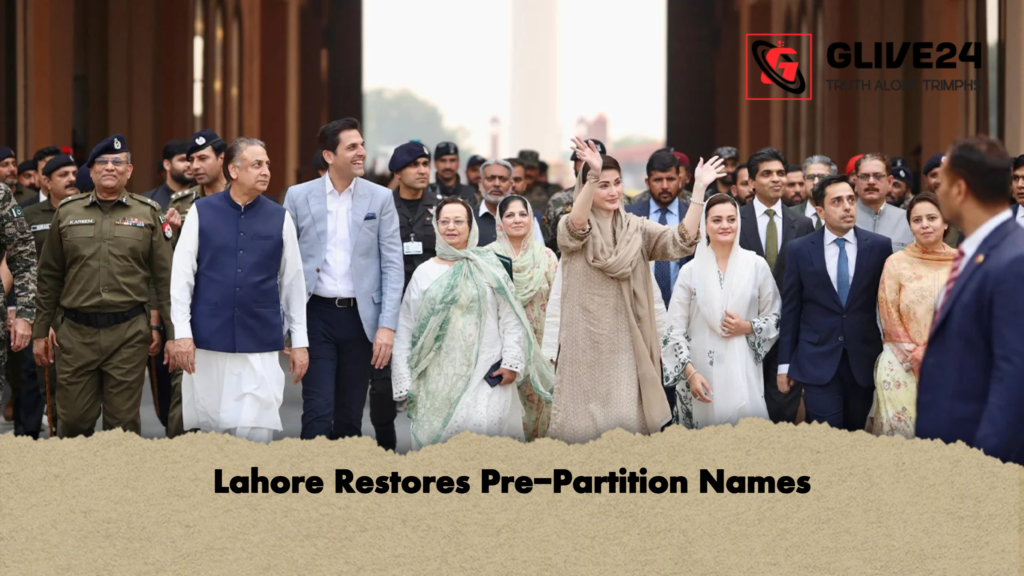
More than eight decades after the Partition of 1947, Pakistan is witnessing an unexpected reversal in its long-standing approach to urban nomenclature. The provincial government of Punjab has approved a sweeping decision to restore several historical names in Lahore, replacing a number of Islamic-era titles with their pre-Partition Hindu, Sikh, Jain and colonial-era equivalents.
The decision, endorsed during a cabinet meeting chaired by Chief Minister Maryam Nawaz, forms part of a broader initiative known as the “Lahore Heritage Areas Revival Project”. Officials describe it as an effort to reconnect the city with its layered past and to present a more inclusive historical narrative to younger generations.
Historically, many of Lahore’s streets and neighbourhoods were renamed after 1947 to reflect Islamic identity or prominent Pakistani figures. However, researchers note that the older names have never fully disappeared from everyday usage, remaining embedded in local memory and colloquial speech.
According to the Lahore Authority for Heritage Revival, the city’s identity is not rooted in a single tradition but is instead a fusion of Muslim, Hindu, Sikh, Christian and Parsi heritage. The restoration project is intended to reflect that pluralistic legacy.
Selected Name Restorations
| Current Name (Post-1947) | Restored Name (Pre-Partition) | Historical Reference |
|---|---|---|
| Islam Pura | Krishna Nagar | Hindu heritage locality |
| Sunnat Nagar | Sant Nagar | Sikh cultural reference |
| Mustafaabad | Dharampura | Ancient mixed settlement |
| Babri Mosque Chowk | Jain Mandir Chowk | Jain historical site |
| Maulana Zafar Ali Khan Chowk | Lakshmi Chowk | Hindu goddess reference |
| Bagh-e-Jinnah / Lawrence Road | Lawrence Road | British colonial era |
| Fatima Jinnah Road | Queen’s Road | British colonial era |
Beyond street renaming, proposals are also being considered to reconstruct parts of Minato Park (now Greater Iqbal Park), including historic wrestling arenas and cricket grounds that once hosted pre-Partition sporting legends. These sites were later demolished during urban development projects, a move that had previously drawn criticism from heritage advocates and sports historians.
Political observers suggest the initiative also carries an element of institutional image restoration, particularly in relation to earlier redevelopment decisions that altered several heritage landscapes.
Academics from Punjab University’s departments of history and archaeology have largely welcomed the move, arguing that landmarks such as Lakshmi Chowk and Ganga Ram Hospital represent an inseparable part of Lahore’s composite history.
However, the decision has not been entirely free of debate. Some local commentators have raised concerns about replacing names associated with national figures, though the provincial government has insisted that changes will be implemented gradually following expert consultation.
Ultimately, the project signals a broader shift in heritage policy—one that appears to acknowledge Lahore not as a city defined by a single identity, but as a living archive of South Asia’s shared and complex past.