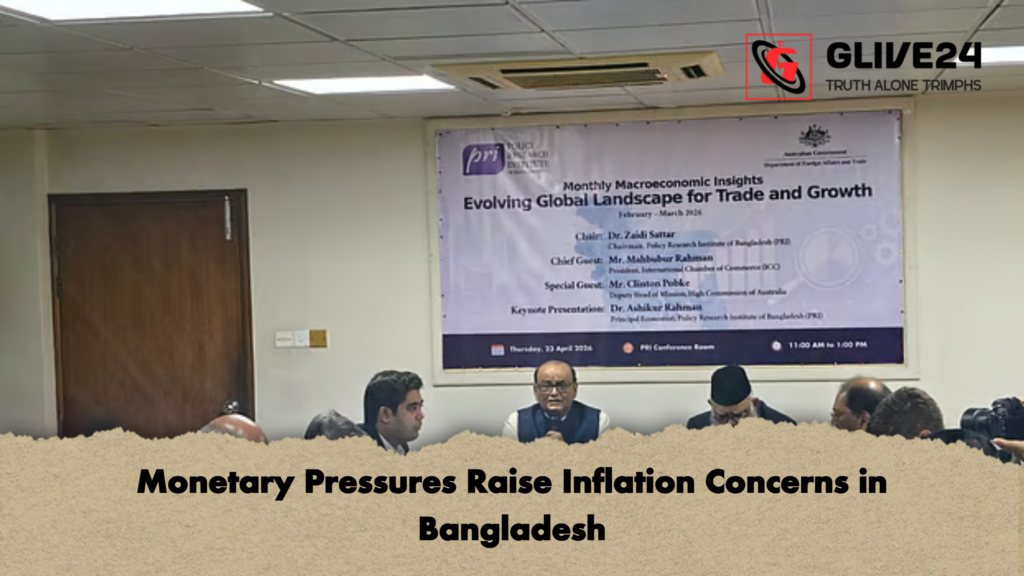
Concerns are mounting over increasing monetary pressures and inflationary risks within Bangladesh’s financial system, following fresh warnings from leading economists. The Chief Economist of the Policy Research Institute (PRI), Ashikur Rahman, has cautioned that recent government borrowing from the central bank could intensify inflationary pressures in the months ahead.
Speaking at a seminar on the overall economic situation covering February and March, held on Thursday at the PRI office in Banani, Dhaka, he noted that the government borrowed approximately Tk 20,000 crore from Bangladesh Bank in March alone. According to him, such borrowing effectively expands money supply in the economy, thereby increasing liquidity and potentially fuelling inflation.
The event was attended by prominent figures from the business and policy community. The President of the International Chamber of Commerce Bangladesh (ICCB), Mahbubur Rahman, participated as the chief guest, while PRI Chairman Zaidy Sattar presided over the discussion.
Inflationary pressure and policy concerns
In his keynote presentation, Ashikur Rahman warned that any retreat from ongoing economic reform initiatives could prove counterproductive for long-term stability. He stressed that reforms in the banking sector, particularly structured resolution mechanisms for distressed banks, require careful and sustained implementation.
He further argued that delays or inconsistencies in reform programmes could generate uncertainty regarding Bangladesh’s commitments under international financial arrangements, including those linked to the International Monetary Fund (IMF). Such uncertainty, he said, may weaken investor confidence and negatively affect macroeconomic stability.
Investment climate under strain
Business leaders at the seminar highlighted growing concerns over the investment environment. ICCB President Mahbubur Rahman stated that investors are currently facing hesitation due to uncertainty in policy direction and operational constraints, particularly in the energy sector. Irregularities in gas supply and electricity availability were identified as key challenges affecting industrial productivity and business expansion.
PRI Chairman Zaidy Sattar added that global energy market volatility continues to exert inflationary pressure on domestic prices. He pointed to geopolitical tensions in strategically important regions such as the Strait of Hormuz, which have contributed to instability in global oil and energy supply chains.
He also emphasised that sustainable economic stability would require comprehensive structural reforms implemented under a stable and accountable political framework.
Key macroeconomic indicators
| Indicator | Status | Remarks |
|---|---|---|
| Government borrowing (March) | Approx. Tk 20,000 crore | Borrowed from Bangladesh Bank |
| Inflation risk | Rising | Due to increased money supply |
| Investment climate | Uncertain | Energy and policy instability |
| Banking sector reform | Slow progress | Resolution framework under review |
| Global energy impact | High | Driven by geopolitical tensions |
Outlook
Economists believe that while increased liquidity may provide short-term support to economic activity, it also carries the risk of sustained price pressures if not managed carefully. Without timely reforms in the banking and energy sectors, financial stability could face additional strain.
Overall, the discussions underscored that Bangladesh’s economy is currently navigating a delicate balance between managing inflationary risks and restoring investor confidence amid structural and external challenges.