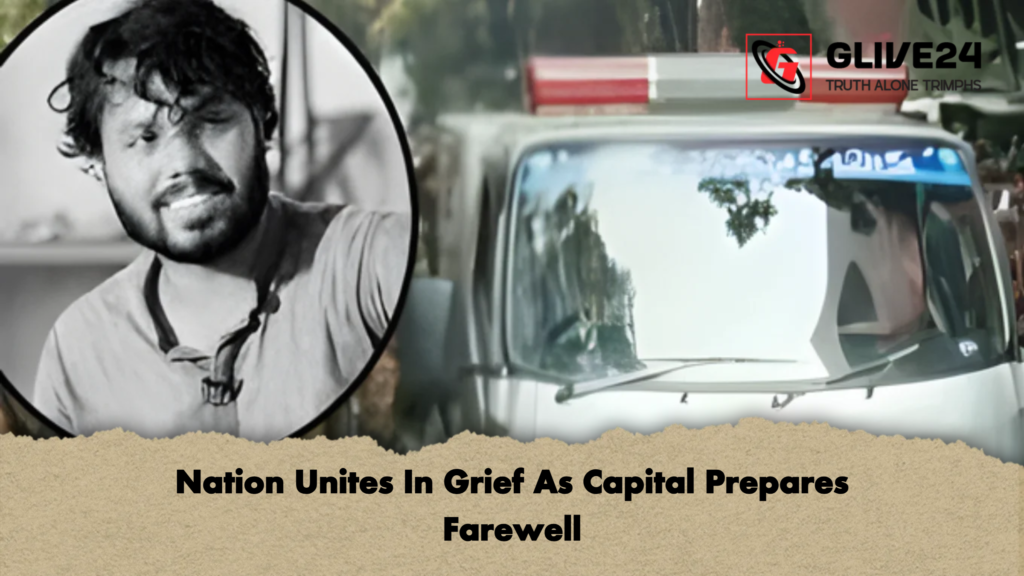
Dhaka entered Saturday under a pall of collective grief, as the capital prepared to bid a final farewell to Sharif Osman Hadi, convenor of Inkilab Manch, whose violent death has deeply shaken Bangladesh’s political and social conscience. Streets around key institutions appeared quieter than usual, while conversations in public spaces carried a subdued tone, reflecting the weight of a loss felt far beyond his immediate circle of supporters.
Early in the morning, Hadi’s body was transported for a post-mortem examination to Shaheed Suhrawardy Medical College Hospital, a necessary legal formality following his death. At approximately 9:30 a.m., an ambulance departed from the National Institute of Cardiovascular Diseases and reached the medical college under strict security arrangements. Officials confirmed that once the autopsy is completed in line with established procedures, the body would be returned to the morgue of the National Institute of Cardiovascular Diseases, ahead of funeral prayers scheduled later in the day.
From dawn onwards, the area surrounding Suhrawardy Medical College Hospital was placed under heightened security. By mid-morning, members of the Ansar, police, Border Guard Bangladesh, and the army were jointly deployed around the morgue premises. Barricades restricted access, entry points were closely monitored, and law enforcement agencies remained on high alert to prevent any disturbance during what authorities described as an exceptionally sensitive period.
Despite the tight security, people from diverse backgrounds steadily gathered in the surrounding areas to pay their respects. Political activists, university and college students, cultural workers, and ordinary citizens stood patiently, many hoping for a final glimpse of Hadi before his burial and to take part in his janaza. The atmosphere was heavy with emotion; grief was etched on faces, accompanied in some quarters by quiet anger and disbelief over the circumstances of his death.
Among those present was Fahad Hossain, a student from Tongi Government College in Gazipur, who described Hadi as far more than a political figure. To many young people, he said, Hadi had been a voice for the voiceless, articulating frustrations and aspirations that others were afraid to express openly. His commitment to honesty, his moral courage, and his unwavering stance against injustice had inspired countless youths. Fahad added that the sudden silencing of such a voice has created a void that will be difficult to fill.
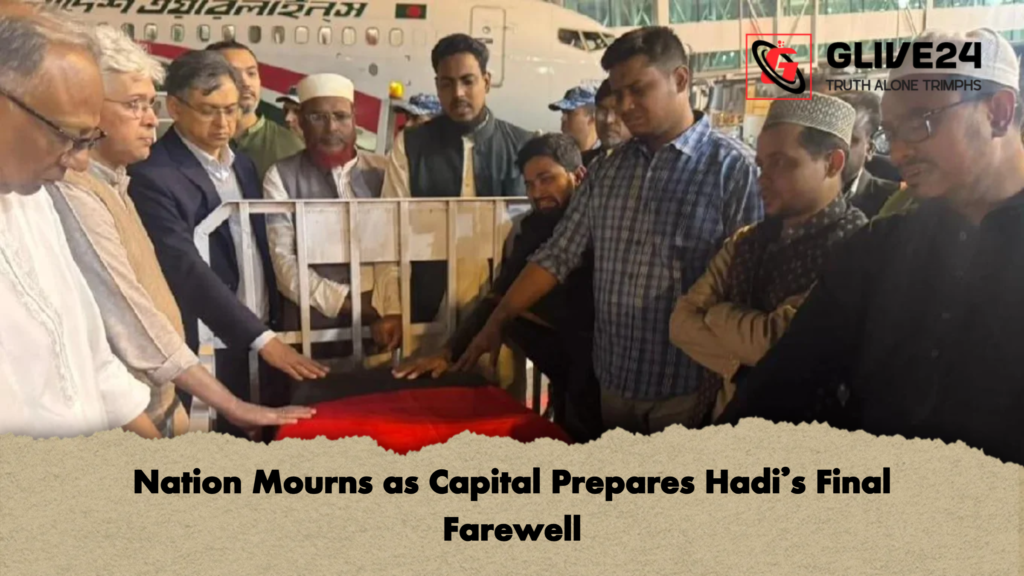
Hadi’s body was brought back to Bangladesh from Singapore on Friday after days of anxious waiting. His first funeral prayer is scheduled for 2 p.m. on Saturday at the South Plaza of the National Parliament Building, a location symbolically linked to the country’s democratic aspirations. Following the prayer, he is to be laid to rest near the grave of national poet Kazi Nazrul Islam at the University of Dhaka, according to family members and organisational sources.
Sharif Osman Hadi died at around 9:45 p.m. on Thursday while undergoing treatment in Singapore. In response to his death, the government has declared a day of state mourning. He had been critically injured on 12 December, just one day after the announcement of the national election and referendum schedule, when assailants shot him in the head on Box Culvert Road in Dhaka’s Purana Paltan area. He was first treated at Dhaka Medical College Hospital and later moved to Evercare Hospital. As his condition deteriorated, he was airlifted to Singapore on 15 December for advanced medical care, where he eventually succumbed to his injuries.
Hadi’s passing represents not only a personal and familial tragedy but also a profound national loss. His death has left a lasting imprint on Bangladesh’s political narrative, highlighting the perils faced by outspoken figures and encapsulating the sorrow of a nation united in mourning.