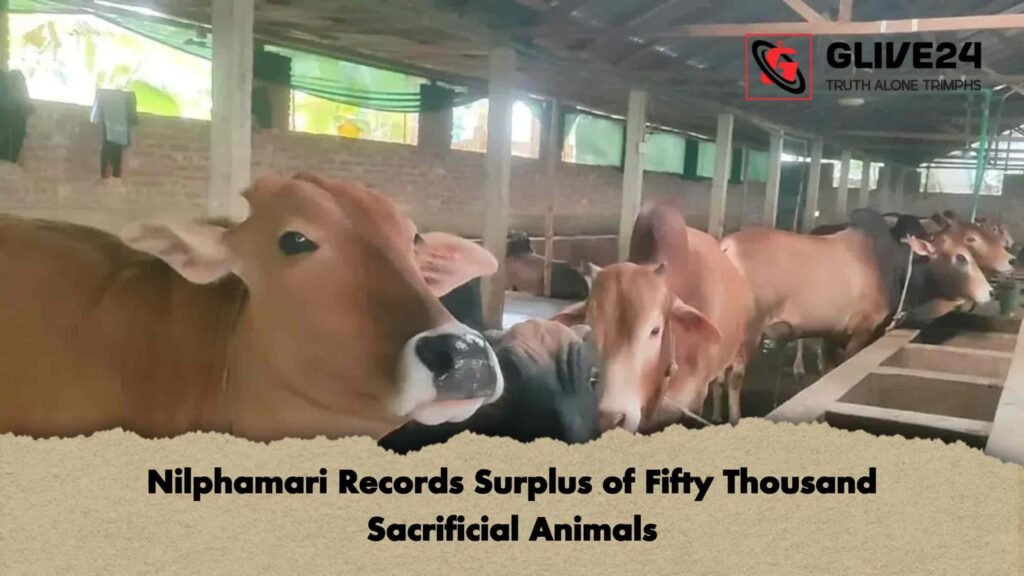
The Department of Livestock Services (DLS) in Nilphamari has confirmed a significant surplus of livestock ahead of the upcoming Eid-ul-Adha. Official data indicates that the district has produced over 50,000 more animals than the projected local demand. Consequently, farmers, local buyers, and wholesale traders have commenced large-scale commercial activities, supported by technical guidance from the DLS to ensure the supply of healthy livestock.
Table of Contents
Statistical Overview of Livestock Production
According to the District Livestock Department, a total of 282,850 animals have been prepared across 34,803 commercial and family-owned farms. The total demand within the district is estimated at 232,676 animals, resulting in a net surplus of 50,174. These additional animals are expected to be transported to various regions across Bangladesh to meet national demand.
The following table provides a detailed breakdown of the livestock available in Nilphamari for the current season:
| Category of Livestock | Quantity (Units) |
| Bulls (Castrated and Intact) | 51,881 |
| Oxen | 4,164 |
| Cows | 25,865 |
| Buffaloes | 94 |
| Goats | 185,309 |
| Sheep | 15,532 |
| Total Available Livestock | 282,850 |
Geographic Distribution of Farmers
The district supports 30,972 registered farmers engaged in livestock rearing. The distribution across the various sub-districts (Upazilas) is as follows:
-
Nilphamari Sadar: 5,850 farmers
-
Jaldhaka: 6,123 farmers
-
Kishoreganj: 5,133 farmers
-
Dimla: 4,889 farmers
-
Domar: 4,702 farmers
-
Saidpur: 4,275 farmers
Farmer Insights and Market Dynamics
Local farmers have reported a preference for indigenous breeds, which are primarily raised on natural fodder such as green grass, oilcake, bran, maize, and rice husk. Despite the rise in production costs due to increased feed prices, farmers remain optimistic. There is a strong consensus among producers, including owners of large-scale enterprises like Ammar Livestock & Agro and Mohana Agro Farm, that the prohibition of illegal cattle entry from neighbouring India is essential for maintaining fair market prices.
Innovative sales methods have also emerged; some farms, such as Siju Agro Limited, have introduced selling cattle based on live weight (per kilogram), a practice that has received positive feedback from buyers. Meanwhile, wholesale traders from distant cities, including Chittagong, have begun transporting loads of cattle, although they have noted that market infrastructure for external traders requires improvement.
Official Oversight and Safety Measures
Dr Md. Rashedul Islam, the District Livestock Officer, stated that the department maintains strict surveillance to prevent unethical fattening practices. The DLS provides regular vaccinations and vitamins to ensure animal health. Furthermore, the local administration has prepared comprehensive security measures for cattle markets, including medical teams to provide immediate treatment for any sick animals and to ensure a seamless transaction process for all parties involved.