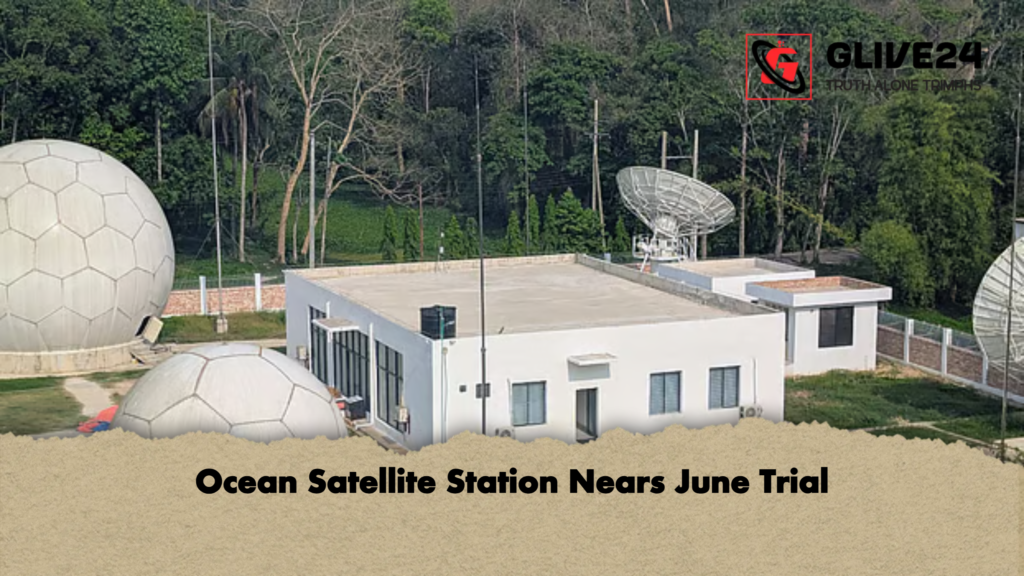
The construction of the country’s first ocean satellite ground station has been completed, with preparatory arrangements now underway for its trial operation, which project officials expect to begin in June. The facility has been established on the campus of Chittagong University.
The project, which commenced on 26 March last year, has involved a total expenditure of approximately 70 crore taka. Of this, around 50 crore taka has been provided as technical assistance by China’s Second Institute of Oceanography, while the remaining 20 crore taka has been funded by Chittagong University authorities.
The ground station has a data storage capacity of approximately 420 terabytes. Although construction work has been finalised, several operational tasks remain before full commissioning. The facility is designed to connect with 11 satellites, and partial linkage has already been established with around seven of them. High-quality data is currently being received from several Chinese satellites, while additional information is also being collected from satellites operated by Japan and NASA.
Work is ongoing to determine which satellite sources provide the most effective datasets for different applications. In parallel, specialised software is being developed to process and analyse incoming data. Project officials have indicated that a Chinese delegation is expected to visit in June, during which trial operations are likely to commence.
Project Overview
| Category | Details |
|---|---|
| Project location | Chittagong University campus |
| Total cost | ~70 crore taka |
| Foreign technical support | ~50 crore taka (China’s Second Institute of Oceanography) |
| Local funding | ~20 crore taka (Chittagong University) |
| Storage capacity | ~420 terabytes |
| Target satellite connectivity | 11 satellites |
| Current partial connectivity | Around 7 satellites |
| Data sources | China, Japan, NASA satellites |
| Expected trial operation | 7–9 June (anticipated window) |
Once operational, the ground station is expected to significantly enhance Bangladesh’s capacity in environmental and oceanographic data processing. According to project-related statements, it will support faster access to information on weather changes, cyclone forecasting, river erosion, deforestation, and other environmental indicators.
At present, Bangladesh relies largely on external systems, including those of the United States and India, for cyclone and storm surge forecasting. Officials involved in the project state that the new facility will reduce this dependence and significantly shorten data acquisition time from approximately 20–30 hours to around 15–20 minutes. This acceleration is expected to improve cyclone tracking, coastal flood modelling, and broader climate and meteorological analysis.
The system is also expected to contribute to sustainable fisheries management by helping identify potential fishing zones in the Bay of Bengal, supporting progress towards Sustainable Development Goal 14, which focuses on the conservation and sustainable use of oceans and marine resources.
The project is coordinated by Professor Mohammad Moslem Uddin of the Oceanography Department at Chittagong University. He has stated that the initiative is primarily intended for research and education rather than commercial use. Under the system, students and researchers will be able to submit formal research proposals to access data for academic work and publications.
Professor Moslem Uddin also clarified that the facility functions solely as a downlink station, meaning it receives satellite data but does not transmit signals. He further noted that China’s involvement should be viewed as part of technical cooperation and international collaboration.
The initiative aligns with China’s Belt and Road Initiative. A memorandum of understanding between Chittagong University and the Second Institute of Oceanography was signed in December 2024, following which construction began under the supervision of the university’s former vice-chancellor, Professor Muhammad Yahya Akhtar.
On 21 February this year, the university syndicate approved the facility as a separate centre titled the “Satellite Ocean Observation and Data Innovation Centre”, with Professor Moslem Uddin appointed as its director.
University authorities are also planning to sign additional agreements with relevant institutions to share operational costs, including expenditure on computing infrastructure, internet services, and electricity, in order to reduce the financial burden on the university.
Vice-Chancellor Mohammad Al-Forkan has stated that the project is nearing completion, with trial operations likely to be conducted between 7 and 9 June. He also indicated that further plans are in place to enhance the station’s operational efficiency.