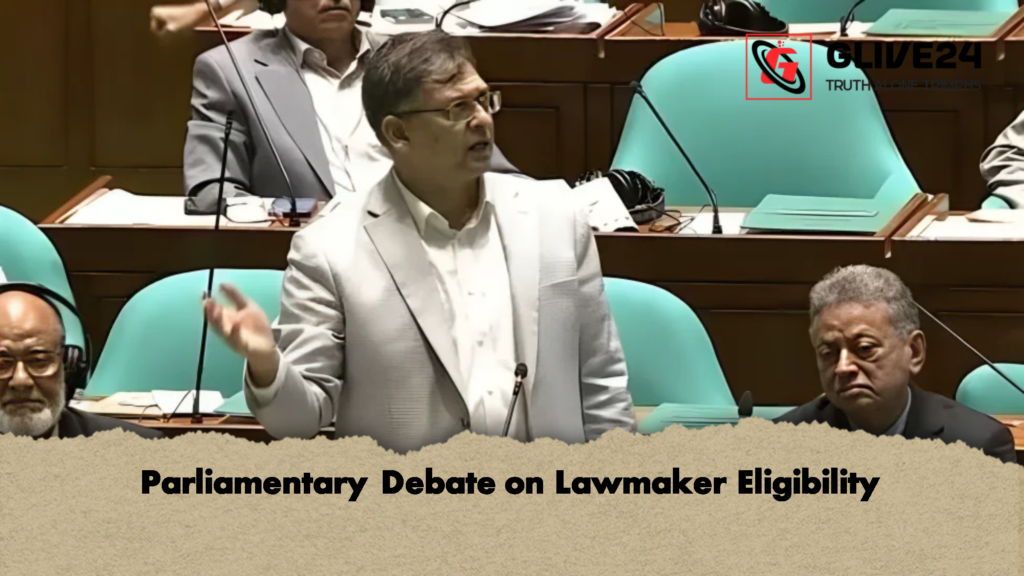
The statements from the Home Minister were delivered on Thursday, 18 June, during a parliamentary session. His remarks were made in response to a speech delivered on a point of order by Nahid Islam, who serves as the Opposition Chief Whip and the Convenor of the National Citizen’s Party (NCP).
During his address, Home Minister Salahuddin Ahmed cited the existing legal frameworks governing national elections, specifically mentioning the Representation of the People Order (RPO) alongside other statutory rules and regulations. The Home Minister explained that under these explicit legal provisions, if an individual is formally adjudged or officially declared a loan defaulter by a court of law, they are legally disqualified from contesting elections and are entirely barred from submitting a nomination for the position of a Member of Parliament (MP).
The Home Minister maintained that because these individuals successfully contested the elections and were voted into parliament, it implies they may possess debts, but they are not legally defined as defaulters. He argued that any assertion claiming loan defaulters were granted nominations to run for this parliament is entirely inconsistent with established legal interpretations.
Table of Contents
Legal Clearances and Expunction Request
Expanding on the legal standing of the lawmakers, the Home Affairs Minister noted that even if certain nominated individuals previously faced pending lawsuits filed by banks or other private financial institutions, those legal disputes had been resolved in the High Court or the Supreme Court prior to the elections. He emphasised that once a matter is legally settled by the judiciary and an individual is officially declared a valid candidate, they no longer carry the legal status of a loan defaulter.
Obliged by these legal clarifications, the Home Minister argued that characterising the current legislature as a “parliament of loan defaulters” is completely inaccurate and constitutes a defamatory statement against the institution. He concluded his remarks by requesting that the specific defamatory comments be formally expunged from the parliamentary record.
Allegations Raised by the Opposition Chief Whip
Conversely, the Opposition Chief Whip, Nahid Islam, maintained his critical stance regarding the financial backgrounds of several lawmakers. He stated that he had actively spoken out against loan defaulters prior to the national elections, asserting that such individuals had been granted party nominations to contest the polls.
Nahid Islam further noted that during his initial speech in the first session of the parliament following the elections, he had explicitly highlighted the specific numbers of substantial defaults associated with various sitting members of parliament. He mentioned that he had purposefully withheld the specific names of the accused lawmakers out of respect for their positions.
The NCP Convenor argued that if a significant number of loan defaulters remain within the legislative body, it is entirely natural for the general public to label the institution as a parliament of loan defaulters. He added that ordinary citizens would naturally draw this conclusion, particularly regarding the ruling party members who have secured a two-thirds majority in the House and brought such individuals into governance.
The Legal Framework of the Representation of the People Order
To provide necessary context to the debate, the Representation of the People Order (RPO), 1972, serves as the primary legislative framework governing the conduct of parliamentary elections in Bangladesh. Under Article 12 of the RPO, stringent financial disclosures are mandatory for all aspiring political candidates during the nomination process. Candidates are legally required to submit a sworn affidavit detailing their personal assets, liabilities, educational qualifications, and criminal records, alongside certificates from the Credit Information Bureau (CIB) of the central bank to verify their loan statuses.
If the CIB or a financial tribunal identifies an applicant as an un-discharged insolvent or a willful defaulter on a commercial bank loan at the time of nomination scrutiny, the Election Commission is legally empowered to reject the nomination, subject to judicial review by the higher divisions of the Supreme Court.
Parliamentary Conventions Regarding Expunction
In Westminster-style parliamentary systems, which influence the legislative procedures of Bangladesh, the process of expunction serves as a critical mechanism to maintain the decorum and dignity of the House. Under the Rules of Procedure of the Parliament, the Speaker possesses the sole discretionary authority to order the removal of words, expressions, or remarks from the official broadcasting and written logs if they are deemed unparliamentary, defamatory, indecent, or undignified. When the Speaker directs that a specific portion of a speech be expedite or expunged, those remarks are omitted from the official publication of parliamentary debates, and news agencies are traditionally restricted from reporting the expunged portions as part of the formal assembly proceedings. This convention balanced freedom of speech on the legislative floor with the preservation of institutional integrity.