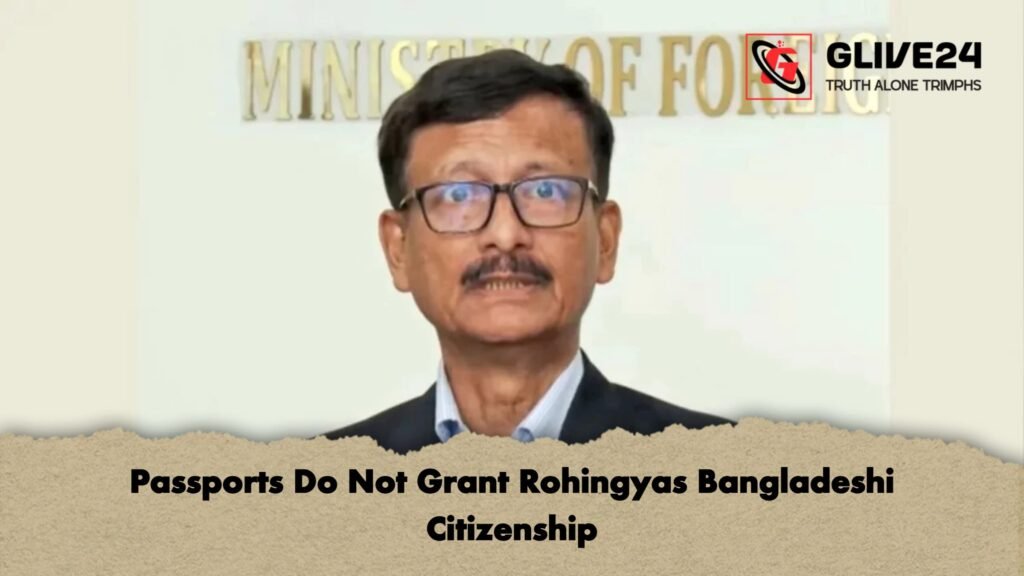
In a candid disclosure on Wednesday, Bangladesh’s Foreign Affairs Adviser, Md Touhid Hossain, addressed the complex diplomatic dilemma surrounding travel documents held by the Rohingya community. He asserted that while tens of thousands of Rohingyas possess Bangladeshi passports, these documents are merely administrative tools and do not constitute legal proof of citizenship.
Hossain attributed this predicament to historical “mistakes” by the Bangladeshi authorities. Decades ago, during the era of handwritten passports, systemic corruption and insufficient vetting allowed a significant number of Rohingyas to obtain travel documents. These individuals subsequently migrated abroad—primarily to the Middle East—leaving the current administration to manage the legal fallout.
The Saudi Pressure and “National Interests”
The issue has recently been pushed to the forefront by the Kingdom of Saudi Arabia. Thousands of Rohingyas who entered the Kingdom using Bangladeshi papers now find themselves in a precarious position as their documents expire.
“The Saudi authorities are pressuring us to renew the passports of those who went there with our documents,” the Adviser explained at the Ministry of Foreign Affairs. He revealed that while the government was initially reluctant, a strategic decision was made to issue or renew passports for 69,000 Rohingyas currently in Saudi Arabia to safeguard broader bilateral interests.
“A passport does not mean the person is a citizen of Bangladesh,” Hossain clarified, noting that travel documents can, under specific diplomatic arrangements, be issued to non-citizens.
Long-term Repatriation and Technical Hurdles
The Adviser reaffirmed that the ultimate solution remains the repatriation of the approximately 1.3 million Rohingyas currently residing in Bangladesh. He reminded the international community that this population has deep ancestral roots in Myanmar’s Rakhine State, where they have lived for centuries.
| Group Category | Approximate Population | Legal/Diplomatic Standing |
| Rohingyas in Saudi Arabia | 69,000 | Issued passports to facilitate residency; not citizens. |
| Rohingyas in Bangladesh | 1,300,000 | Recognised as residents of Rakhine, Myanmar. |
| Passport Medium | Handwritten (Old) | Historically prone to corruption and forgery. |
| Current Mandate | Repatriation | Targeted goal once a “safe environment” is created. |
Strategic Autonomy in Foreign Policy
Beyond the Rohingya crisis, Hossain touched upon broader geopolitical shifts. When questioned about a leaked audio clip involving a US diplomat, he declined to speculate on the future of US-Bangladesh relations until the results of the upcoming American elections are clear.
Furthermore, responding to the US Ambassador’s recent comments regarding China, the Adviser maintained a firm stance of non-alignment. He stated succinctly that Dhaka would continue to make diplomatic and economic decisions based entirely on its own sovereign interests, rather than being swayed by the rivalries of global superpowers.