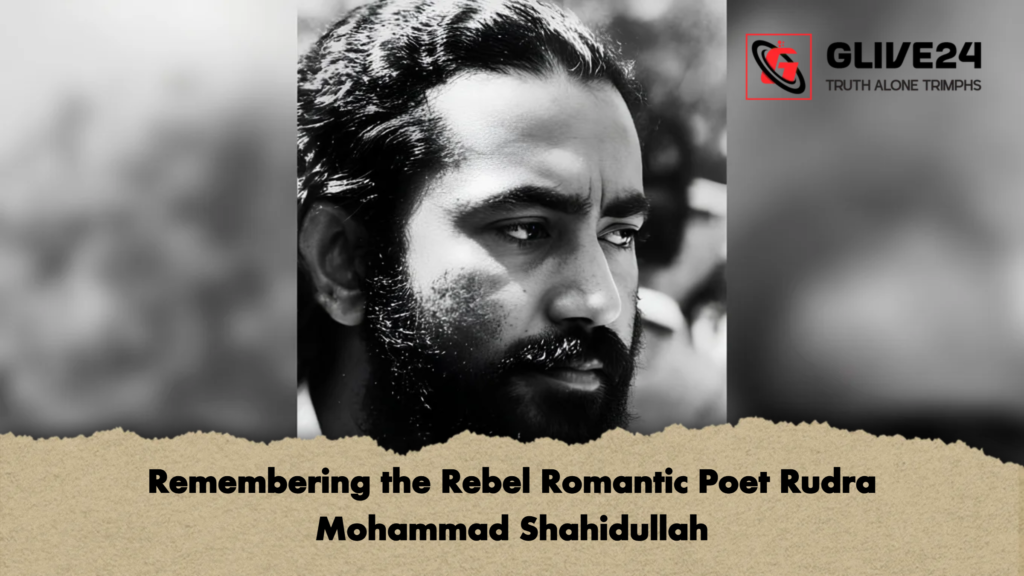
Rudra Mohammad Shahidullah remains a brilliant yet short-lived star in the horizon of Bengali poetry. He articulated love, rebellion, dreams, struggles, and the aspiration for human liberation in such a powerful language that he is widely termed the ‘rebel romantic poet’ of Bengali literature. In 2024, thirty-three years after his demise, the Government of Bangladesh posthumously conferred the Ekushey Padak upon him. This state honour re-established his dignity and recognized his outstanding literary contributions as a poet of the people’s consciousness.
Born on 16 October 1956 in the then Barisal district, Rudra Mohammad Shahidullah’s ancestral home was located in Mithekhali village under the Mongla Upazila of Bagerhat district. He exhibited a profound passion for literature and culture from his early childhood. He completed his Secondary School Certificate (SSC) from West End High School in Dhaka in 1973 and his Higher Secondary Certificate (HSC) in 1975. Subsequently, he obtained his Bachelor’s and Master’s degrees in Bengali Language and Literature from the University of Dhaka.
During the 1980s, a cultural movement focused on poetry recitation in the poet’s own voice gained immense popularity across Bangladesh, and Rudra was one of its leading pioneers. The poems recited in his robust voice moved not only literature enthusiasts but also resonated deeply with the general public. His verses seamlessly balanced the tenderness of romance with a thunderous voice against oppression, injustice, and exploitation.
His immortal lines continue to serve as a fierce protest against socio-political realities and remain highly relevant today:
“The field from which the call for independence came,
Today, a marketplace for addiction sits in that field”
and
“I still smell the scent of corpses in the air”
The personal life of the poet was also a subject of widespread discussion. In 1981, he married the prominent writer Taslima Nasrin. However, their marital relationship concluded in a divorce in 1986. The various struggles and emotional trials of his personal life left a deep impact on his poetic expressions.
During a brief lifespan of only 35 years, he significantly enriched Bengali literature by composing seven volumes of poetry, a verse drama, short stories, and more than fifty songs. His celebrated song “Bhalo Achhi Bhalo Theko” (I am well, stay well), which he both wrote and composed, remains timeless and deeply cherished in the world of Bengali music.
On 21 June 1991, the poet passed away. Despite his physical absence, his poetry, music, and revolutionary spirit continue to inspire younger generations, instilling the courage to stand firmly against injustice. To preserve his memory and pass his philosophy down to future generations, the ‘Rudra Smriti Sangsad’ was established in his birthplace of Mithekhali, Mongla, actively working to promote his literary legacy.
Overview of Rudra Mohammad Shahidullah’s Life and Legacy
| Category | Details |
| Full Name | Rudra Mohammad Shahidullah |
| Date of Birth | 16 October 1956 |
| Place of Birth & Ancestry | Barisal (Birthplace); Mithekhali, Mongla, Bagerhat (Ancestral home) |
| Educational Qualifications | SSC (1973), HSC (1975), BA & MA in Bengali (University of Dhaka) |
| Marital History | Married to Taslima Nasrin (1981–1986; divorced) |
| Literary Works | 7 poetry books, 1 verse drama, short stories, and 50+ songs |
| Notable Composition | “Bhalo Achhi Bhalo Theko” |
| Date of Demise | 21 June 1991 (Aged 35) |
| State Recognition | Ekushey Padak (Posthumously awarded in 2024) |
| Memorial Organisation | Rudra Smriti Sangsad (Mithekhali, Mongla) |
On the anniversary of his passing, deep respect is paid to this revolutionary poet who turned love into the language of struggle and gave protest the aesthetic beauty of poetry. Human debt to fellow human beings can never be fully repaid; nonetheless, his verses continue to awaken the collective conscience.