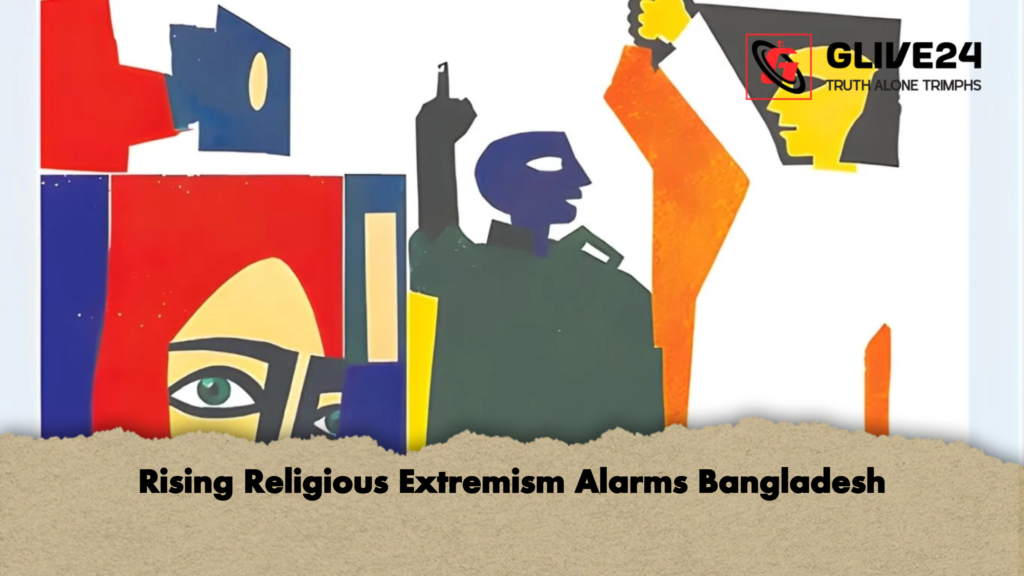
Religious extremism in Bangladesh has reached a level that experts describe as deeply concerning. Activities promoting radical ideologies are increasingly visible both online and offline, while extremist narratives are gradually normalising within society. Their influence is amplified by growing networks, active engagement, and a rising number of followers.
A December 2025 report by Canadian research organisation SecDev, titled “Shadows over the Ballot”, analysed the dynamics and dominance of extremist groups in Bangladesh, highlighting the rapid expansion of their ideological and operational reach.
Table of Contents
Online and Offline Extremist Presence
According to SecDev, violent religious groups have been exploiting societal grievances—including discontent among citizens, women’s issues, anti-India sentiment, alleged misgovernance by the ruling Awami League, and debates over the role of religion in governance—to construct persuasive new narratives.
Drawing on the framework from Ario W. Krugolangkir’s The Three Pillars of Radicalization (2019), extremism thrives through three elements: Needs, Narrative, and Network. Extremists manipulate individuals’ perceived deprivation, insecurity, and desire for revenge by creating a sense of purpose, shaping narratives, and expanding networks.
David Jackman, in Syndicates and Societies: Criminal Politics in Dhaka (2024), emphasises that these groups operate with strict internal control while sustaining a state of psychological tension among followers.
Philippine journalist Maria Ressa has observed that online impunity gradually translates into offline impunity, potentially undermining the system of checks and balances essential to democratic governance.
Extent of Online Influence
SecDev’s analysis reveals that over 30 million online subscribers in Bangladesh are linked to extremist networks. Platforms such as Facebook, TikTok, and YouTube are employed to target youth with misleading or unverified content, including videos, deepfakes, and propaganda.
| Platform | Users (Million) | Target Audience | Typical Activities |
|---|---|---|---|
| 64.0 | Youth | Misinformation, unverified narratives | |
| TikTok | 56.2 | Youth | Videos, deepfakes, information distortion |
| YouTube | 49.8 | Youth | Edited videos, propaganda |
With 47% of Bangladesh’s population under the age of 25, cultivating distrust in the democratic process among roughly 15 million young voters enhances the influence of extremist groups.
Ideology and Threats
Radical religious organisations in Bangladesh reject democratic principles and advocate the establishment of Sharia law. In contrast, Islamist political parties attempt to promote religious legislation through electoral processes. Analysis of 15,000 social media posts shows that extremists frequently portray democracy as un-Islamic and detrimental to Muslim communities.
A defining feature of these groups is takfirism, whereby dissenting Muslims are declared apostates, creating an “internal enemy” narrative that legitimises violence. Influences from organisations resembling the Tehrik-i-Taliban and Al-Qaeda are evident in local activities.
Countering Extremism
No single approach can counter religious extremism. The most effective strategy involves the promotion of democratic values, human rights, and a culture of tolerance. Broad-based dialogue, informed debate, and dissemination of alternative narratives are essential to reducing violence.
Strengthening democratic culture remains the most potent tool to prevent religious extremism. It is a collective responsibility—shared by individuals, institutions, and the state—to break cycles of violence and restore societal stability.