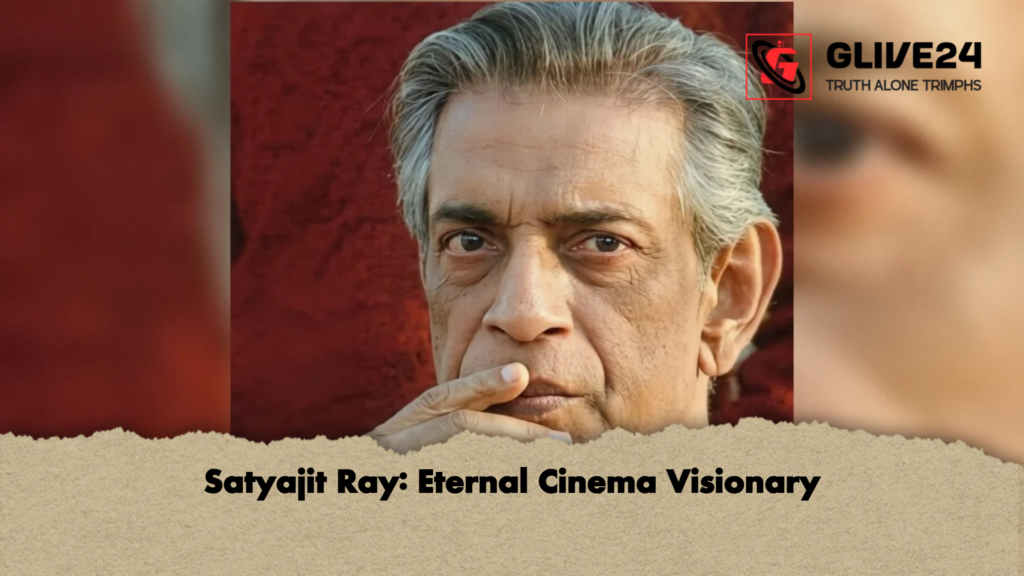
Satyajit Ray stands as one of the most luminous figures in the history of world cinema, a creative force whose influence transcends borders and generations. Far more than a filmmaker, he was an accomplished illustrator, writer, composer, and graphic designer—an all-round artist whose imagination reshaped Bengali cultural identity and elevated it to global recognition. Satyajit Ray remains a towering symbol of artistic integrity and humanist storytelling.
Born on 2 May 1921 in Kolkata into an illustrious and culturally rich family, Ray inherited a profound artistic legacy. His father, Sukumar Ray, was a celebrated writer and illustrator, while his grandfather, Upendrakishore Ray Chowdhury, was a pioneer of Bengali children’s literature. After the early death of his father, Ray was raised by his mother, Suprabha Ray, whose guidance and resilience deeply shaped his intellectual and emotional outlook.
His education at Visva-Bharati University in Santiniketan broadened his aesthetic sensibilities, exposing him to Rabindranath Tagore’s philosophy of holistic learning. Later, his professional experience in an advertising agency refined his understanding of visual composition, typography, and design—skills that would later define his distinctive cinematic style.
Ray’s encounter with international cinema proved transformative. Inspired by Italian neorealism and particularly Vittorio De Sica’s Bicycle Thieves, as well as his interaction with French filmmaker Jean Renoir, he embarked on the ambitious adaptation of Bibhutibhushan Bandyopadhyay’s novel Pather Panchali. Despite severe financial constraints and personal sacrifices, including selling possessions, Ray persisted with unwavering determination. The film was eventually completed with government support and released in 1955, marking a watershed moment in Indian cinema.
The impact of Pather Panchali was immediate and profound. It was hailed internationally for its lyrical realism and emotional depth, introducing global audiences to the richness of Indian storytelling. This success led to the completion of the acclaimed Apu Trilogy, establishing Ray as a master storyteller of rare sensitivity.
Major Films of Satyajit Ray
| Year | Film Title | Significance |
|---|---|---|
| 1955 | Pather Panchali | International breakthrough |
| 1956 | Aparajito | Continuation of Apu’s journey |
| 1959 | Apur Sansar | Completion of Apu Trilogy |
| 1964 | Charulata | Critically acclaimed drama |
| 1969 | Goopy Gyne Bagha Byne | Musical fantasy classic |
Beyond cinema, Ray made a lasting contribution to literature through his iconic characters Feluda, the detective, and Professor Shanku, the eccentric scientist. These creations remain deeply embedded in Bengali popular culture.
His achievements were recognised globally, including the Bharat Ratna, India’s highest civilian honour, the Dadasaheb Phalke Award, and an honorary Academy Award for lifetime achievement.
Satyajit Ray passed away on 23 April 1992 in Kolkata, but his artistic legacy continues to illuminate world cinema. His works remain timeless studies of humanity, emotion, and social realism—ensuring his place as one of the greatest cultural figures of the twentieth century.