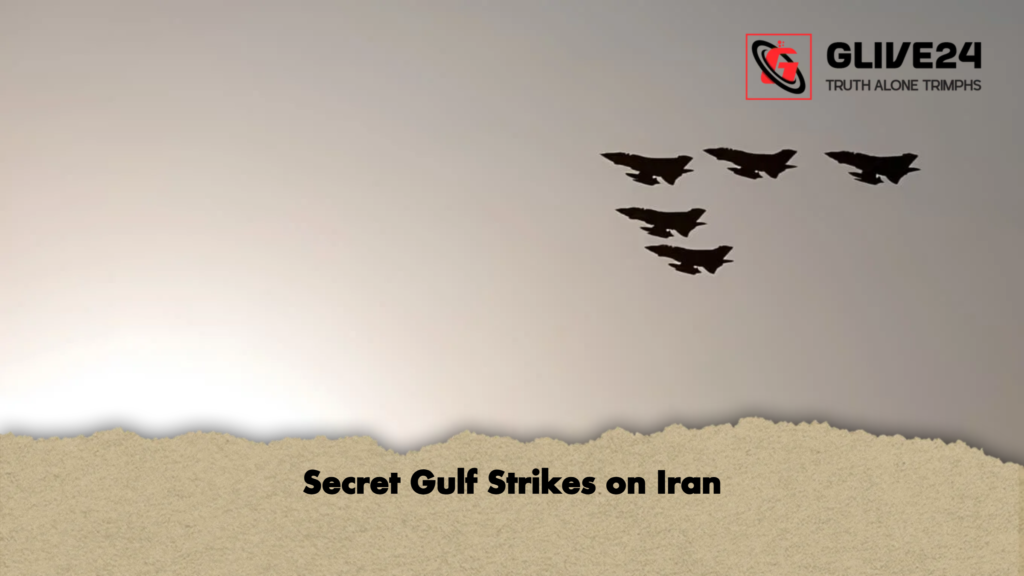
Reports from The Reuters state that during United States–Israel military operations against Iran, two neighbouring Gulf states—Saudi Arabia and the United Arab Emirates—carried out covert strikes inside Iranian territory. According to unnamed officials cited in the reports, at least two Gulf countries were involved in clandestine bombing operations during the conflict. None of the governments concerned—Washington, Tehran, Riyadh, or Abu Dhabi—has confirmed these claims.
Table of Contents
Reported details of alleged strikes
| Actor | Timing | Reported targets | Source claims |
|---|---|---|---|
| United Arab Emirates | Early April | Several sites in Iran, including a refinery on Lavan Island in the Persian Gulf | Reported by The Wall Street Journal citing officials |
| Saudi Arabia | Late March | Multiple aerial strikes inside Iran | Reported by Reuters citing Iranian and Western officials |
The The Wall Street Journal reported on Monday, citing officials familiar with the matter, that the United Arab Emirates conducted strikes in early April against several Iranian installations, including a refinery on Lavan Island in the Persian Gulf.
Subsequently, Reuters reported on Tuesday, citing two Iranian officials and two Western officials, that Saudi Arabia carried out “multiple” air strikes inside Iran in late March.
Verification status of claims
The authenticity of the reported strikes remains unconfirmed. If verified, the incidents could represent a significant escalation in regional tensions across the Middle East. However, no official confirmation has been issued by the United States, Iran, Saudi Arabia, or the United Arab Emirates.
If substantiated, these would constitute the first known direct strikes by two Gulf states on Iranian territory.
Expert assessments
Veronica Hinman, Deputy Director of the Portsmouth Military Education Team at the University of Portsmouth, stated that some imagery related to the UAE suggests possible military involvement.
Independent analysts have also reportedly identified imagery of French Mirage fighter jets and Chinese Wing Loong drones operating in Iranian airspace. It is noted that the UAE operates both platforms.
Shahin Modarres of the International Team for the Study of Security Verona stated that both Saudi Arabia and the UAE possess the capability to conduct such operations. He confirmed that both countries maintain advanced and well-equipped air forces with precision-strike capability against infrastructure targets.
However, he also raised the question of political intent, noting that both states previously stated they did not allow the United States to use their airspace for strikes against Iran prior to the conflict.
Iranian attacks and regional context
During the conflict, Iran reportedly launched drone and missile strikes against both Gulf states. According to the reports, Iran’s objectives included increasing the cost of the war for the United States and Israel, damaging critical energy infrastructure, and undermining the Gulf states’ reputation as safe destinations for international investment.
Hinman noted that Saudi Arabia was affected by Iranian strikes, though the UAE was reportedly targeted more frequently than any other state in the region.
According to The Wall Street Journal, Iran launched more than 2,800 drone and missile attacks against the UAE during the conflict, exceeding the number directed at Israel.
Strategic interpretation
Andreas Krieg of King’s College London stated that if the reports are accurate, the strikes may have been intended to establish a deterrent precedent, demonstrating that Gulf states are capable of responding directly to Iranian actions.
He also noted that the UAE has adopted a more assertive posture and has stated that it retains the right to self-defence. He added that the UAE is reportedly coordinating more closely with Israel.
It has also been reported that during Iranian attacks on the UAE, Israel provided air defence support, including the transfer of Iron Dome systems and training personnel.
Reports further state that Israeli Prime Minister Benjamin Netanyahu visited the UAE during the conflict, although the UAE has denied this visit. The UAE maintains diplomatic relations with Israel under the Abraham Accords established in 2020.
Political responses and accusations
Iran’s Foreign Minister Abbas Araghchi criticised the UAE during a BRICS summit in India, accusing Abu Dhabi of being an active participant in what he described as US–Israeli aggression against Iran. He also stated that the UAE had refused to condemn the initial escalation.
Krieg noted that Saudi Arabia has adopted a more cautious approach, maintaining diplomatic channels with Pakistan, Oman, and Qatar, and has clearly indicated it does not intend to join any joint military action with Israel.
Secrecy and strategic rationale
Hinman stated that any such operations would likely have been conducted in secrecy to avoid further escalation. Krieg added that covert action would prevent public humiliation of Iran while still sending a message directly to its leadership.
He also stated that the UAE may have stronger reasons to deny involvement, as open attribution could reinforce Iranian narratives portraying the UAE as aligned with Israel.
Longer-term implications
Analysts cited in the reports suggest that if confirmed, the strikes could have long-term implications for regional diplomacy. Hinman noted that restarting negotiations as though previous events had not occurred would be difficult.
Modarres suggested that the developments may indicate a gradual shift in Gulf states’ defence posture, with increased emphasis on self-reliance rather than dependence on the United States.
He further noted that while Washington may view increased regional participation in countering Iran positively in the short term, such actions could also signal a gradual re-evaluation of reliance on US security guarantees.