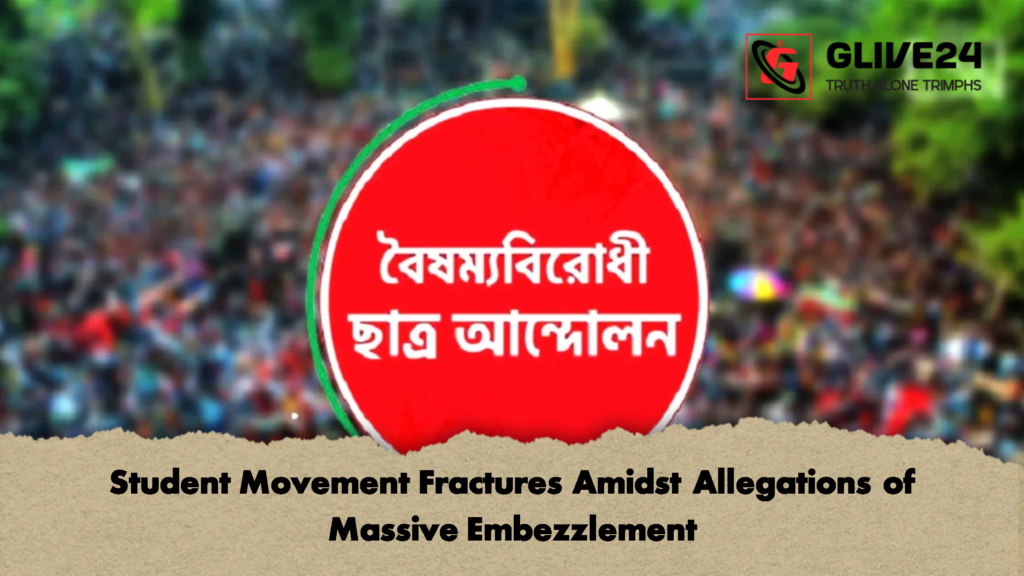
The Anti-Discrimination Student Movement, the formidable vanguard that spearheaded the historic “July Mass Uprising,” is currently grappling with a severe existential crisis. What began as a unified front against autocracy has descended into a bitter internal schism, characterised by leadership voids, the abrupt dissolution of its central committee, and explosive allegations of financial impropriety involving sums exceeding 10 million BDT (one crore).
Table of Contents
The Catalyst of the Schism
The stability of the organisation was fundamentally undermined following the high-profile exodus of its primary leadership. President Rifat Rashid and Office Secretary Shahadat Hossain, alongside several other influential coordinators, recently announced their affiliation with a nascent political entity, the National Citizens’ Party (NCP).
This transition into formal politics, occurring well before the completion of their organisational mandates, has induced significant administrative paralysis. In a reactive move on 18th April, a notice signed by the departing leadership announced the immediate suspension of the central committee and the establishment of a five-member Interim Advisory Council.
Leadership Transition and the Advisory Council
The newly formed council has been tasked with overseeing all organisational affairs for a transitional period of thirty days. However, the legitimacy of this body is being fiercely contested by a vocal faction of the movement who view the manoeuvre as a unilateral and undemocratic “power grab” intended to bypass standard electoral processes.
| Role in New Council | Name of Appointee |
| Advisor | Abu Sayed Leon |
| Advisor | Hamza Mahbub |
| Advisor | Tarikul Islam (Reza) |
| Advisor | Muinul Islam |
| Advisor | Shahadat Hossain |
Allegations of Financial Malfeasance
Perhaps the most damaging blow to the movement’s reputation stems from the organisation’s own spokesperson, Cynthia Jahin Ayesha. In a series of startling disclosures, she alleged that the migration of senior leaders into the NCP was a calculated manoeuvre to evade accountability for massive financial irregularities.
“A substantial amount of money—exceeding one crore—has been looted,” Ayesha asserted with conviction. “We were demanding transparent answers regarding these financial discrepancies, and suddenly they announced their move to a political party to shroud the matter in silence.”
Ayesha further revealed that after voicing her opposition to the suspension of the central committee, she was summarily removed from the organisation’s official communication channels. She has since vowed to hold a comprehensive press briefing to provide a detailed audit of the allegedly embezzled funds and the resulting breach of trust.
Internal Rebuttals and Counter-Claims
The accused leaders have been quick to dismiss these claims as the byproduct of internal jealousy and resentment over the new leadership structure. Muinul Islam, a member of the newly formed Advisory Council, maintained his personal integrity while acknowledging the organisational vacuum left by the previous executives.
“The committee naturally becomes non-functional when the President and Secretary are no longer present,” Muinul explained. He further refuted the financial claims, stating, “I have remained economically honest, and while others may face allegations, I have had no involvement in such transactions.”
Similarly, the former Office Secretary, Shahadat Hossain, dismissed the outcry as typical “internal strife.” He argued that the move to political parties was a natural progression discussed over many months and denied that the NCP was exerting undue influence over the student platform.
A Crisis of Identity and the Road Ahead
The movement, which consistently identified as a strictly non-political platform during the uprising, now finds its “apolitical” status in tatters. The involvement of the Private University Students’ Alliance adds another layer of complexity. Atik Shahriar, the alliance’s Member Secretary, issued a stern warning against the “hijacking” of the movement’s spirit for personal gain.
As the Advisory Council begins its 30-day countdown to restructure the organisation, the shadow of the “missing crore” looms large. The upcoming press briefing promised by the dissident faction is expected to be a pivotal moment for the movement’s survival. Whether the Anti-Discrimination Student Movement can cleanse its ranks and reclaim its moral authority remains the defining question for the student community of Bangladesh.