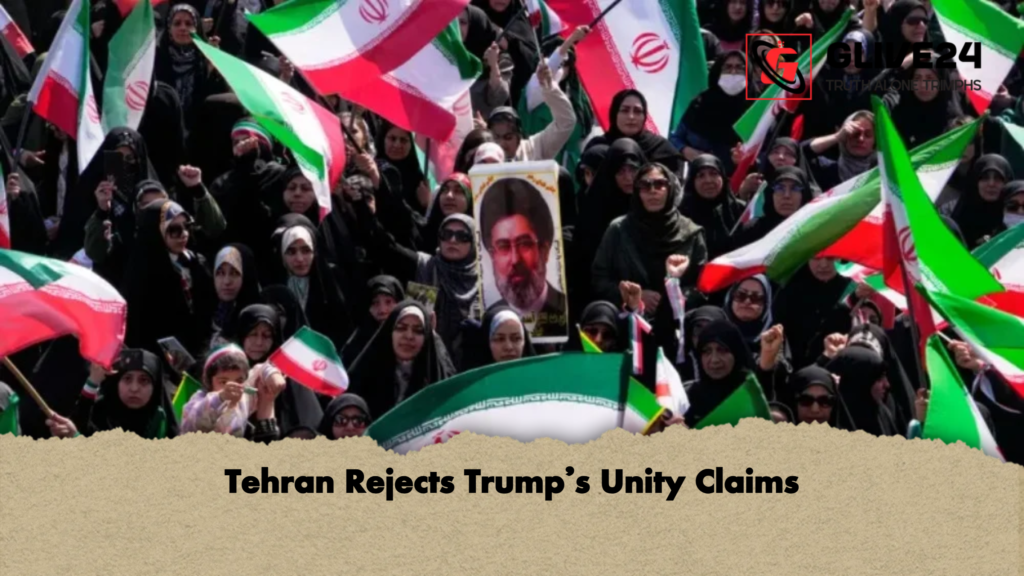
Tehran has firmly dismissed recent assertions by former United States President Donald Trump regarding alleged divisions within Iran’s political leadership, branding the claims as entirely unfounded and detached from reality. Iranian officials insist that the country is more unified than ever, with no meaningful rifts between the state leadership and the public.
According to reports attributed to international media outlets, including Al Jazeera, Trump and several of his associates had suggested that Iran’s governing structure was facing deep internal disagreements. These claims described an apparent power struggle between hardline and moderate factions within the establishment. However, senior Iranian figures have strongly rejected this narrative, characterising it as politically motivated misinformation aimed at undermining the country’s image.
In a series of separate statements, Iranian President Masoud Pezeshkian, Foreign Minister Abbas Araghchi, and Speaker of Parliament Mohammad Bagher Ghalibaf all categorically denied the existence of any internal political fragmentation. They emphasised that, despite ideological diversity within the political system, national unity prevails particularly during periods of external pressure or crisis.
In a joint message, President Pezeshkian and Speaker Ghalibaf stated that concepts such as hardline-versus-moderate division are misrepresentations of Iran’s political reality. They asserted that all political actors remain aligned under a shared revolutionary ethos and continue to demonstrate unwavering loyalty to the country’s highest leadership. They further stressed that Iran remains fully prepared to resist any form of foreign interference or aggression through collective national resolve.
First Vice-President Mohammad Reza Aref echoed these sentiments, describing Iran as a symbol of cohesion rather than division. He acknowledged the presence of differing political viewpoints but maintained that such differences dissolve when matters of national security and sovereignty are at stake.
Despite these official denials, some international observers and media outlets have recently speculated about internal uncertainty within Iran’s leadership, particularly following reports of a February incident involving an attack and its aftermath. Iranian authorities, however, have dismissed such reports as exaggerated or entirely false, accusing foreign actors of deliberately spreading disinformation.
Summary of Iran’s Official Position
| Issue | Iranian Government Position |
|---|---|
| Alleged leadership divisions | Completely denied |
| Government–public relations | Strong national unity affirmed |
| Foreign claims of internal rifts | Described as politically motivated propaganda |
| National response posture | Unified resistance and cohesion |
Iranian officials also criticised ongoing economic sanctions and political pressure from the United States, arguing that such measures contribute to regional instability and obstruct potential diplomatic engagement. They maintained that, rather than weakening the country, external pressure has reinforced internal cohesion and strengthened commitment to national sovereignty.
Overall, Tehran has reiterated its position that narratives of internal division are baseless and form part of a broader attempt to distort Iran’s political reality on the international stage.