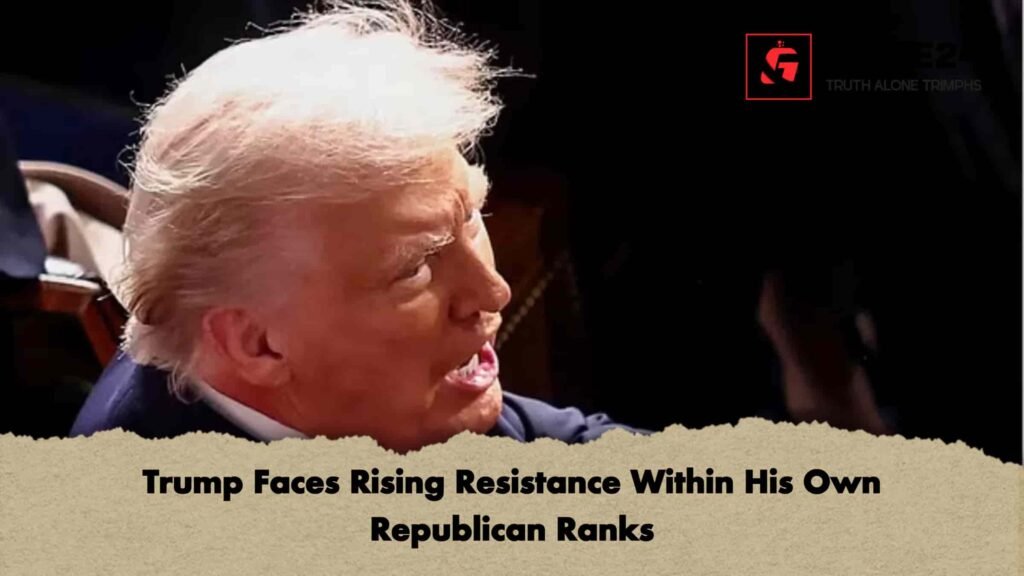
US President Donald Trump is facing escalating friction from within his own party. Republican lawmakers in Congress, who have historically demonstrated a reluctance to challenge his decisions, are now actively opposing several of his high-profile legislative and financial initiatives.
Pushback Over Funding and Foreign Policy
In recent weeks, Republican members across both the Senate and the House of Representatives have openly criticized President Trump’s confrontational approach toward Iran. Resistance has translated into concrete legislative action, with lawmakers rejecting a $1 billion (£800 million) fund allocated for the White House ballroom. Furthermore, congressional pressure forced the President to back down from his proposed $1.8 billion “anti-weaponisation” fund, whilst lawmakers simultaneously blocked his domestic surveillance legislation.
Defying the President’s explicit wishes, House Republicans joined forces to pass a bill providing aid to Ukraine and implementing new sanctions against Russia. The legislation passed despite a strong probability of a presidential veto.
While lawmakers from both the Republican and Democratic parties question whether this resistance constitutes an outright rebellion, the actions of a specific Republican faction suggest a widening rift. This faction includes several individuals whom Trump previously attempted to purge from the party. Analysts suggest this internal dissent could pose a serious threat to the President’s primary legislative goals in the lead-up to the midterm elections.
Former Republican Senator Thom Tillis, who announced his retirement from the Senate last year after opposing Trump’s “One Big Beautiful Bill,” remarked on the changing political landscape:
“I think as the election draws near, you are seeing representatives vote in alignment with the desires of their local constituents.”
Conversely, many Democrats remain skeptical about a permanent party fracture. Democratic Senator John Fetterman downplayed the significance of the dissent, stating:
“Those who are breaking away are individuals Trump himself sidelined. This actually demonstrates his absolute control over the party.”
An anonymous White House official dismissed the friction as typical “election-year politics,” noting that lawmakers are simply reluctant to incur political costs on every single issue during a campaign cycle. White House spokeswoman Abigail Jackson added:
“While the media and the Democrats are attempting to fabricate non-existent divisions, we look forward to maintaining this close relationship to deliver President Trump’s agenda.”
Growing Frustration Over Party Leadership
For years, Republican lawmakers maintained public loyalty to the President by endorsing controversial ministerial appointments, withholding opposition to executive orders, and supporting core legislation despite harboring private reservations regarding the growing national deficit and cuts to the Medicaid healthcare programme.
According to congressional aides, internal anger began to intensify after President Trump opposed the re-election campaigns of Republican Senators Bill Cassidy and John Cornyn. Lawmakers felt these poorly timed interventions placed the broader Republican legislative agenda at serious risk.
The situation reached a turning point just before the Memorial Day holiday. Following Trump’s opposition to Cornyn and his announcement of the “anti-weaponisation” fund, Senate Republicans were forced to abandon their plans to advance a $70 billion immigration enforcement funding bill. The development left lawmakers to depart Washington for the recess in a state of visible frustration. A Senate Republican aide described the timing as a “perfect storm of negative events.”
The Senate eventually passed the immigration control bill on Friday, with Republicans voting against a Democratic amendment aimed at blocking the fund. Some critics expressed concern that the capital could potentially be repurposed to assist individuals involved in the 6 January 2021 Capitol riot, alongside other political allies of the President.
Clashes Over Key Confirmations
Further friction arose when President Trump bypassed objections from senior Republican leaders to appoint a trusted ally, Bill Pulte, as Acting Director of National Intelligence (DNI), replacing Tulsi Gabbard.
Senate Republican leader Mitch McConnell has made it clear that he will not support Pulte for a permanent role. Commenting on the qualifications required for the post, McConnell stated:
“The rule of law dictates that a nominee must possess extensive, relevant experience. Any nominee failing to meet this standard will not receive my vote.”
Concurrently, vulnerable Republican Senators Susan Collins, John Husted, and Dan Sullivan joined a Democratic proposal to ban Trump’s “anti-weaponisation” fund. Although that specific measure failed, alongside two subsequent Republican attempts to restrict the capital, the cross-party alignment underscored the shifting dynamics. Defending the funding, Trump ally Senator Jim Banks stated that the primary objective remains securing the border and funding Immigration and Customs Enforcement (ICE).
The President’s next major legislative hurdle centers on the permanent confirmation of his former attorney, Todd Blanche, as US Attorney General. Blanche faces a difficult confirmation path, beginning in the Senate Judiciary Committee. Senator John Cornyn, a committee member who has been a target of Trump’s recent criticism, indicated his vote remains conditional.
“The Attorney General is not the President’s personal lawyer,” Cornyn told reporters. “I want to be entirely certain that he understands this distinction and is fully committed to the proper enforcement of the law.”
Chronology of Key Events and Congressional Actions
The following timeline details the key confrontations and legislative friction points between President Trump and congressional lawmakers between late 2025 and mid-2026.
Senator John Husted addresses reporters on the 40th day of a federal government shutdown, highlighting early cracks in party unity regarding executive strategies.
President Trump delivers his State of the Union speech to a joint session of Congress at the US Capitol amidst undercurrents of internal policy disagreements.
Senator Mitch McConnell speaks during a high-stakes US Appropriations Subcommittee on Defence hearing, signaling strict standards for upcoming intelligence and judicial confirmations.
Trump opposes Senator Cornyn’s re-election and introduces the controversial ‘anti-weaponisation’ fund. Frustrated Senate Republicans abandon a $70 billion immigration enforcement bill and head into recess.
The House of Representatives passes a Ukraine aid and Russia sanctions bill against the President’s explicit wishes. Three Senate Republicans break ranks to vote against Trump’s specialty fund, and the Senate finally passes the amended immigration bill.