
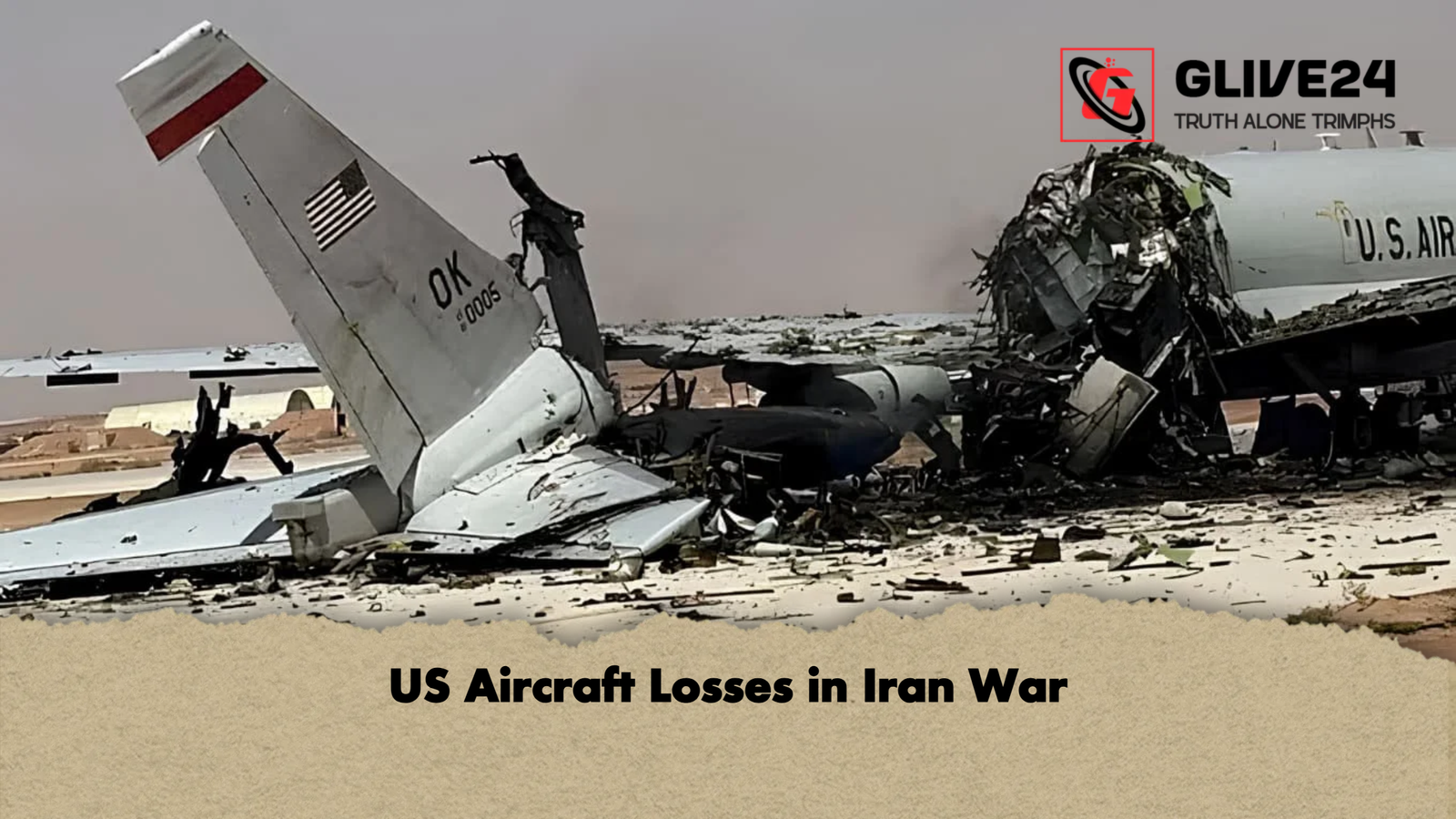
A recent report by the US Congressional Research Service (CRS) indicates that at least 42 aircraft belonging to the United States military were either destroyed or damaged during the conflict in Iran. The affected assets include a range of platforms such as bomber aircraft, unmanned aerial vehicles, surveillance aircraft, and aerial refuelling tankers.
According to the report, the total number of losses may rise further due to classification issues, the ongoing nature of the conflict, and the complexity involved in verifying and attributing battlefield damage.
The CRS, a non-partisan research body providing policy and legal analysis to the US Congress, compiled the assessment using statements from the Pentagon and US Central Command, alongside verified media reporting. However, the Pentagon has not yet issued a comprehensive official assessment of total losses from the operation.
Table of Contents
Operation and Timeline
The conflict began on 28 February when the United States and Israel jointly launched a military campaign against Iran, named Operation Epic Fury. After approximately 40 days of hostilities, a temporary ceasefire was agreed on 8 April through mediation involving Pakistan.
The US Department of Defense has stated that the cost of the operation has already reached approximately $29 billion. During a congressional hearing on 12 May, Pentagon financial chief Jules Hurst explained that the rising expenditure reflects updated and more accurate estimates of repair and replacement costs for damaged or destroyed military equipment.
He stated that improved assessments of battlefield losses had resulted in a higher overall cost than initially projected, particularly due to the need for repairs and procurement of replacement systems.
Reported Aircraft Losses
The CRS report lists a wide range of aircraft types among the losses. These include both manned and unmanned platforms used for combat, reconnaissance, refuelling, and special operations support.
| Aircraft Type | Number Affected |
|---|---|
| F-15E Strike Eagle fighter jets | 4 |
| F-35A Lightning II fighter jet | 1 |
| A-10 Thunderbolt II ground-attack aircraft | 1 |
| KC-135 Stratotanker aerial refuelling aircraft | 7 |
| E-3 Sentry airborne warning and control aircraft | 1 |
| MC-130J Commando II special operations aircraft | 2 |
| HH-60W Jolly Green II combat search and rescue helicopter | 1 |
| MQ-9 Reaper medium-altitude long-endurance drones | 24 |
| MQ-4C Triton high-altitude long-endurance drone | 1 |
In total, the report accounts for at least 42 aircraft either damaged or destroyed across multiple categories of US military aviation capability.
Assessment and Verification Context
The CRS emphasises that its findings are based on publicly available Pentagon statements, US Central Command communications, and open-source reporting. The absence of a fully detailed official Pentagon assessment means that the figures remain subject to refinement as more information becomes available.
The report also highlights that ongoing classification restrictions and the difficulty of independently verifying battlefield losses contribute to uncertainty regarding the final total.
Iranian Response
Iranian Foreign Minister Abbas Araghchi commented on the CRS findings by sharing the report on social media platform X (formerly Twitter). He stated that Iran had gained significant experience from the conflict prior to the April ceasefire, noting that this had been acknowledged by the United States.
Araghchi further warned that if former US President Donald Trump were to initiate renewed military action against the Islamic Republic, Tehran would use its acquired experience to present what he described as “many surprises” to US forces.
He also stated that, months after the conflict began, the US Congress had acknowledged the loss of aircraft worth billions of dollars. He further claimed that Iranian armed forces had been responsible for downing the widely referenced F-35 aircraft, presenting it as a confirmed development.