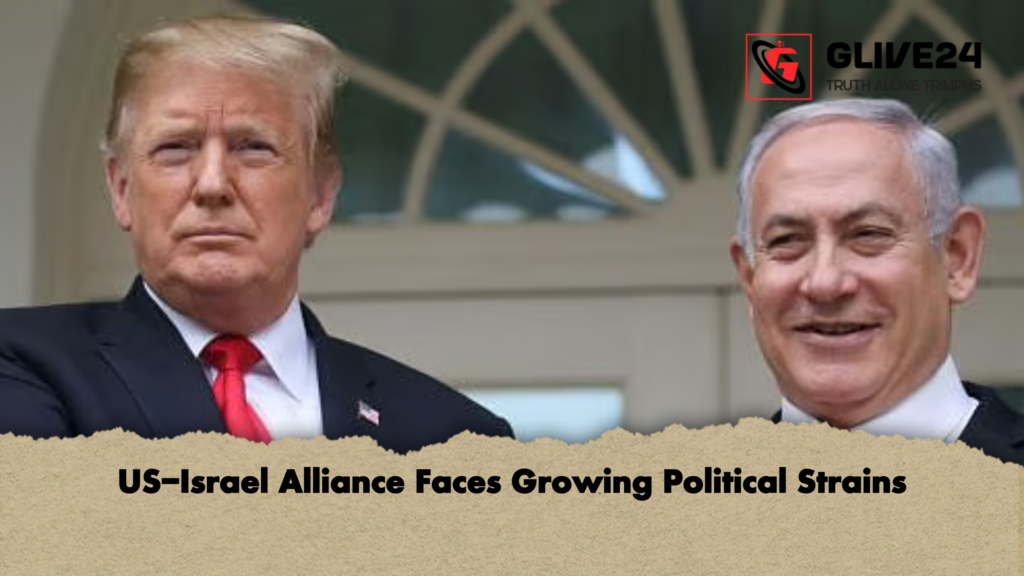
The long-standing alliance between the United States and Israel, once widely regarded as one of the strongest strategic partnerships in international politics, is facing renewed scrutiny. A series of recent political developments in Washington and New York, coupled with shifting public opinion in the United States, has fuelled concerns within Israel that the traditionally unwavering American support it has relied upon for decades may no longer be guaranteed.
The debate has intensified following President Donald Trump’s diplomatic efforts to pursue negotiations with Iran and his public criticism of Israeli Prime Minister Benjamin Netanyahu. These developments have prompted politicians, diplomats and analysts in Israel to ask whether the White House remains as firmly committed to Israel as it has been in previous years.
Fresh concerns emerged after Tuesday’s Democratic congressional primaries in New York City. Three candidates backed by mayoral nominee Zohran Mamdani, who has been openly critical of Israeli government policies, secured victories over rivals regarded as more supportive of Israel. Their success has been interpreted by many Israeli observers as evidence that criticism of Israel is gaining broader political acceptance within sections of the Democratic Party.
Despite these developments, few in Israel believe that the country should seek alternative strategic partners such as China or Russia. Instead, experts involved in shaping Israeli foreign policy argue that the changing political climate in the United States represents a far more significant challenge.
Asaf Zamir, Tel Aviv’s deputy mayor and Israel’s Consul General in New York between 2021 and 2023, described himself as “deeply worried”. He argued that the victorious candidates placed strong criticism of Israel at the centre of their campaigns despite New York remaining home to the world’s largest Jewish population outside Jerusalem. According to Zamir, the changing political mood reflects a broader shift in how Israel is being perceived by American voters.
Several foreign policy analysts warn that Israel may eventually face greater uncertainty over the pillars of American support it has traditionally enjoyed. Those include billions of dollars in annual military assistance, repeated US vetoes of anti-Israel resolutions at the United Nations, and tax advantages that have long benefited organisations supporting Israel.
Daniel C. Kurtzer, former United States ambassador to Israel during the presidency of George W. Bush and now a professor at Princeton University, cautioned that the two allies appear to be approaching what he described as a dangerous turning point. While he believes the relationship remains fundamentally strong, he warned that political divisions in the United States are becoming increasingly difficult to ignore.
Although several candidates viewed as supportive of Israel also won Democratic primaries, Israeli commentators have focused particularly on the victories of Brad Lander and Claire Valdez, both of whom received backing from Mamdani. During their campaigns, the candidates strongly criticised Israel’s military campaign in Gaza. Another successful candidate, Daryaliza Avila Chevalier, questioned Israel’s policies and, like Valdez, described the country as practising apartheid. These positions have intensified debate inside Israel over how its image has changed among progressive American voters.
Zamir rejected the portrayal of Israel as a genocidal or apartheid state. He argued that he supports a two-state solution, considers himself politically left-leaning and believes in peaceful coexistence, yet feels that growing numbers of Americans are accepting what he regards as inaccurate characterisations of Israel. He suggested that this shift in public perception is now influencing electoral outcomes in the United States.
The changing political landscape is widely linked to the war in Gaza, which began after Hamas launched its unprecedented attack on Israel on 7 October 2023. Since then, the conflict has resulted in extensive destruction across the Gaza Strip, a severe humanitarian crisis and large-scale civilian casualties. International organisations and many governments have repeatedly expressed concern over the humanitarian consequences of the war, while Israel has consistently maintained that its military operations are aimed at dismantling Hamas and securing the release of hostages.
The humanitarian impact of the conflict has had a noticeable effect on American public opinion. A New York Times and Siena College survey published last September suggested that, for the first time, more Americans expressed sympathy for Palestinians than for Israelis. A separate Pew Research Center survey released in April found that 60 per cent of Americans viewed Israel unfavourably, compared with 42 per cent in 2022, highlighting a significant shift in attitudes.
Michael Koplow, an analyst at the New York-based Israel Policy Forum, argued that the rise of several left-wing lawmakers alone should not alarm Israeli policymakers. However, he believes their victories signal a broader transformation within the Democratic Party, where criticism of Israel has moved from the political margins into mainstream debate.
According to Koplow, opposition to Israeli government policies is no longer a peripheral issue but has become a central theme in election campaigns and a defining factor in the political outlook of many Democratic voters. For many within the party, concerns over human rights and Palestinian rights have created what they see as an increasing moral divide between the two allies.
Israeli public opinion researcher Dahlia Scheindlin, who grew up in New York, observed that the “special relationship” between the United States and Israel had long been regarded as permanent. She argued that support for Israel has become more conditional as many Americans have reacted to the scale of suffering witnessed during the Gaza conflict, causing long-standing assumptions about unconditional backing to weaken.
Criticism is not confined to Democrats. Some Republican commentators have questioned whether Israel’s regional conflicts risk drawing the United States into wider military confrontations. They have increasingly asked whether the strategic interests of both countries remain as closely aligned as in previous decades.
Alon Pinkas, who served as Israel’s Consul General in New York during the early 2000s, said Israel has spent decades presenting itself as a valuable strategic asset for the United States. He suggested that American policymakers are now asking a more difficult question: whether Israel remains an asset or is becoming a strategic burden.
Analysts believe this debate could intensify if instability in the Middle East results in higher global energy prices or greater economic costs for American consumers.
Despite these concerns, the foundations of the bilateral relationship remain largely intact. The Trump administration has accelerated emergency military assistance and authorised substantial weapons sales to Israel. Washington has continued supporting Israel during negotiations involving Hamas, eased pressure over Israeli settlement activity in the occupied West Bank and taken measures against anti-Israel protests at several American universities.
Nevertheless, observers caution that a further deterioration in relations could have significant consequences. Reports indicate that the administration has sought, in the context of diplomatic engagement with Iran, to restrain certain Israeli military actions against regional adversaries, including Lebanon. Such efforts would have been considered almost unthinkable by many Israelis only a few years ago.
Questions have also emerged over the future of American military assistance. While Israel continues to receive extensive security support, Prime Minister Netanyahu has indicated that the country should gradually reduce its dependence on US aid over the longer term.
Koplow said many Israelis had long assumed Washington would never reconsider its commitments, but argued that such assumptions can no longer be taken for granted.
Kurtzer believes the United States is still likely to use its veto power at the United Nations to shield Israel from unfavourable resolutions in the immediate future. He is less certain, however, about the longer-term direction of American policy, noting that President Trump has often based decisions on what he considers politically advantageous rather than on established diplomatic traditions.
The issue has also become increasingly significant within Israeli domestic politics. Former Prime Minister Naftali Bennett recently warned that relations with the United States had reached their lowest point in Israel’s history and that rebuilding trust would be an exceptionally difficult task.
Bennett argued that, for the first time since Israel’s establishment, there is a growing perception among some Americans that Israel may represent a burden rather than an unquestioned strategic partner. He described that possibility as deeply troubling for Israel’s long-term security and diplomatic standing.
For many Israelis, however, there are few immediate options beyond watching developments unfold. Zamir believes the greatest danger is psychological rather than military. While he expressed confidence that Israel could adapt even if military assistance were reduced, he said his greatest concern is the possible loss of America’s diplomatic backing and the reassurance that, in moments of crisis, Israel has traditionally believed the United States would stand firmly beside it.