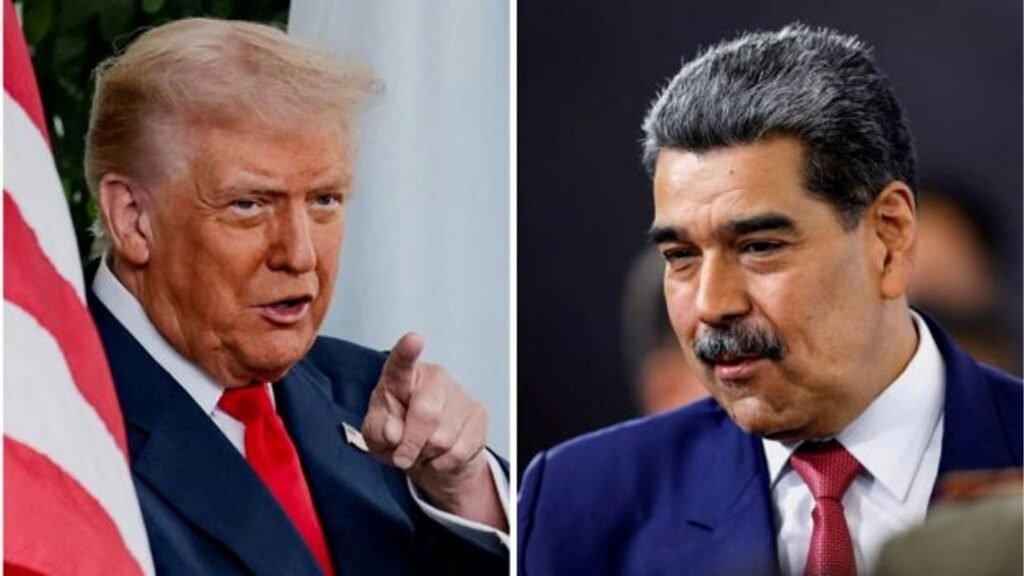
US President Donald Trump has intensified pressure on Venezuelan President Nicolás Maduro, heightening tensions between Washington and Caracas. On Saturday, Trump declared that Venezuelan airspace and its surrounding regions would be considered “completely closed,” prompting a swift and sharp response from the Venezuelan government. Caracas denounced the announcement as a colonial-style threat to its sovereignty and a breach of international law, stressing that it would not comply with any foreign threats or directives. Venezuelan officials insisted that respect for their airspace was non-negotiable.
Trump further elaborated his position on his social media platform, Truth Social, addressing airlines, pilots, drug traffickers, and human smugglers, urging them to treat Venezuelan airspace as entirely restricted. Over recent weeks, senior US officials have consistently criticised Maduro and his administration, framing the rhetoric as part of Washington’s campaign against drug trafficking. However, international analysts and human rights groups have raised concerns that such moves may provide a pretext for an unlawful attempt to depose Maduro.
The US Department of Defence has not issued an immediate comment. In the Caribbean, US forces have maintained a sustained campaign against vessels suspected of carrying narcotics, while simultaneously increasing military deployments in the region. Reports indicate that Trump has authorised covert CIA operations in Venezuela and briefed military personnel on the possibility of an imminent land operation.
Maduro, who has held power since 2013, has categorically denied allegations linking him to drug trafficking and claims that the US intends to remove him from office. He has vowed that both the Venezuelan people and armed forces will resist any attempts at foreign intervention. In a further escalation, the US recently deployed an aircraft carrier to the Caribbean and conducted lethal strikes on multiple vessels accused of narcotics trafficking, resulting in numerous fatalities. United Nations experts have described these attacks as extrajudicial killings.
In August, the US doubled its previous reward, offering $50 million for information leading to Maduro’s capture. Earlier this week, Washington also designated the group “Cartel de los Soles” as a terrorist organisation, asserting links between the cartel and Maduro. Meanwhile, media reports suggest that Trump has communicated directly with Maduro, with discussions reportedly touching on a potential meeting in the United States. Despite diplomatic overtures, tensions remain high, reflecting a complex interplay of military, political, and legal strategies that could further destabilise the region.