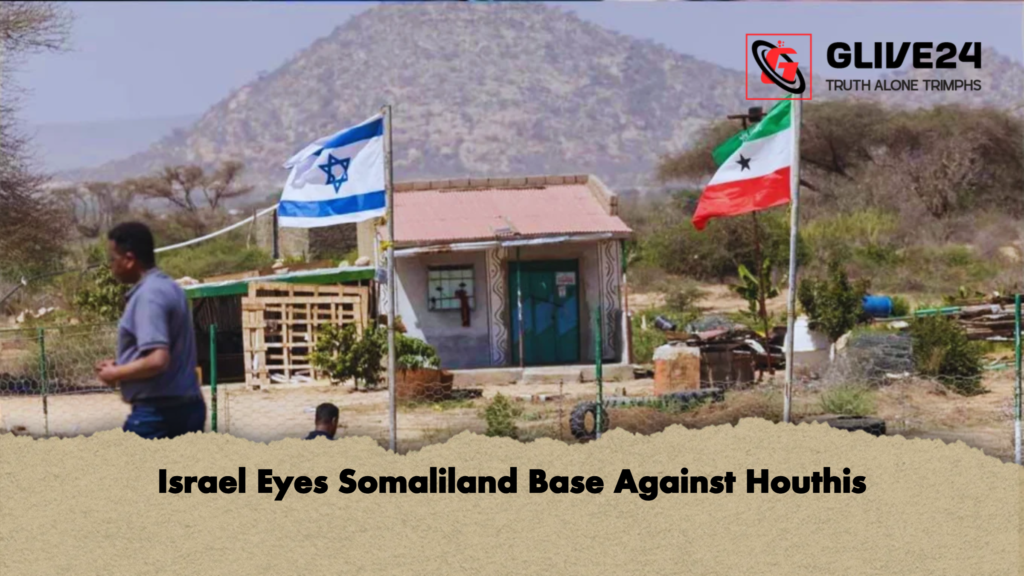
Israel is reportedly exploring the establishment of a military base in Somaliland, the self-declared autonomous region in northern Somalia, as a strategic measure to target Yemen’s Houthi movement. Last December, Israel became the first country to formally recognise Somaliland as an independent state. Bloomberg reported on Wednesday (11 March) that initial groundwork for such a facility may already be underway.
Two Somaliland officials, speaking on condition of anonymity, confirmed that the territory is prepared to grant Israel permission to gather intelligence and conduct operations against the Houthis. Israeli security teams reportedly inspected coastal sites in June last year, evaluating potential locations for a base or operational outpost. Their reconnaissance focused on areas suitable for countering the Ansar Allah movement, the Houthi faction responsible for several regional attacks.
The prospective base would be located near the Gulf of Aden, roughly 260 kilometres from Yemen. Additionally, in Hargeisa, Israel has reportedly rented a fortified hotel suite with blast-resistant windows, a move interpreted as preparatory steps for establishing a diplomatic presence. Somaliland’s Minister of Presidential Affairs, Khadar Hussein Abdi, commented:
“We aim to develop a strategic security partnership that encompasses multiple areas. Whether this will be a military base is still under discussion, but it will be analysed in the future.”
Israel regards the Houthis as one of its most significant regional threats. The Iranian-aligned movement has remained silent following recent US and Israeli strikes on Iran, though Tehran has retaliated with attacks across the region. During the Gaza conflict, Houthi forces expressed solidarity with Palestinians by targeting Israeli assets and international shipping in the Red Sea with missiles and drones. According to an Israeli general, a dedicated intelligence unit has been formed to monitor and counter the Houthis, who possess several hundred rockets capable of striking Israeli territory.
Long-term geopolitical calculations also underpin Israel’s recognition of Somaliland. The Gulf of Aden has seen maritime traffic drop by 70 per cent over the past two years due to Houthi activity, highlighting the strategic importance of a secure regional foothold.
Somaliland–UAE Strategic Links
| Feature | Details |
|---|---|
| Independence declared | 1991 |
| International recognition | December 2025, by Israel |
| Potential base locations | Hargeisa and highlands 100 km west of Berbera |
| Berbera infrastructure | Modern naval port, 4 km runway, hangars, DP World-operated port |
| UAE military presence | Airbase in Berbera |
| Maritime impact | Red Sea navigation down 70% in two years |
Historically, Somaliland was part of the Somali Republic from 1960 until its unilateral independence declaration in 1991. While no UN member states have yet recognised its sovereignty, Israel’s recognition signals a significant shift. The Berbera region, in particular, is strategic due to its deep-water port, UAE military base, and proximity to shipping lanes. In 2017, Somaliland accepted UAE proposals to enhance military facilities in Berbera, with satellite imagery showing upgraded runways suitable for heavy transport and fighter aircraft.
Despite Somalia severing all commercial and security ties with the UAE in January, Somaliland and Puntland administrations have rejected this move, maintaining strong regional alliances. For Israel, establishing a base in Somaliland represents both a tactical countermeasure against the Houthis and a strategic foothold in the Gulf of Aden.