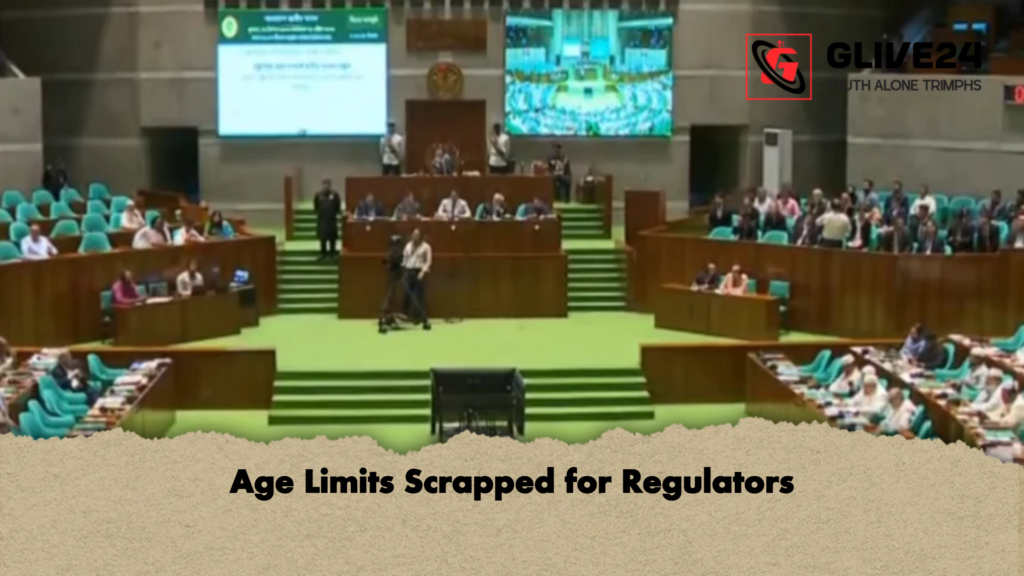
The National Parliament yesterday passed two significant amendment bills removing upper age limits for appointments to the top leadership positions of the Bangladesh Securities and Exchange Commission (BSEC) and the Insurance Development and Regulatory Authority (IDRA). The decision effectively eliminates previously fixed age ceilings for chairpersons and members of both regulatory bodies.
Under the revised provisions, the earlier maximum age limit of 65 years for the chairperson and commissioners of the BSEC has been abolished. Similarly, the amendment to the IDRA law removes the existing upper age limit of 67 years for its chairperson and members. With these changes, eligibility for appointment will no longer be constrained by age restrictions, marking a notable shift in regulatory recruitment policy.
Parliamentary debate and political divisions
The passage of the bills was accompanied by extensive debate and political disagreement in Parliament. Opposition members questioned both the timing and intent behind the amendments, raising concerns over transparency in recent appointments to key financial institutions. Some lawmakers also referred to recent controversies surrounding appointments in other regulatory bodies, including the central bank, suggesting a broader pattern requiring scrutiny.
Independent Member of Parliament Rumeen Farhana proposed sending the bills to a select committee for further review, which briefly limited detailed floor discussion. Following this, Opposition Leader Shafiqur Rahman was given the opportunity to speak, during which he criticised the legislative process and alleged procedural shortcomings. He argued that members had not received the bills in a timely manner, restricting meaningful scrutiny and debate.
The Speaker of Parliament responded by stating that the committee report had been distributed the previous day and that all proceedings had followed established procedural rules. The bills were subsequently passed.
Concerns over governance and neutrality
Following the passage of the amendments, National Citizens Party leader Akhtar Hossain questioned whether the removal of age limits was intended to facilitate appointments for specific individuals. He drew parallels with earlier political decisions involving changes to judicial retirement ages, arguing that such alterations could have long-term institutional implications.
Opposition Deputy Leader Syed Abdullah Mohammad Taher also raised concerns regarding the neutrality of recent appointments in the financial sector. He specifically questioned the independence of the central bank governor and called for greater accountability and, in his view, potential removal from office.
In response, government representatives rejected allegations of political influence, arguing that professional background or past affiliations do not necessarily imply partisan appointment. They also pointed to historical precedents where similar appointment practices had taken place under previous administrations. Officials further defended the current central bank leadership, highlighting its performance and institutional contributions.
The Finance Minister, Amir Khosru Mahmud Chowdhury, defended the amendments, stating that the changes reflect evolving economic and demographic realities. He argued that when the original age limits were introduced, life expectancy was significantly lower, whereas it has since increased considerably. According to him, highly qualified professionals should not be excluded from public service solely due to age, particularly if they remain capable and effective.
He further noted that parliamentary procedures limit extended debate after the passage of bills, though the government had addressed all raised questions during the session.
Summary of amendments
| Institution | Previous age limit | New provision |
|---|---|---|
| Bangladesh Securities and Exchange Commission (BSEC) | Maximum 65 years | Age limit abolished |
| Insurance Development and Regulatory Authority (IDRA) | Maximum 67 years | Age limit abolished |
While the amendments introduce a more flexible framework for appointing leadership to key financial regulatory bodies, the parliamentary proceedings highlighted continuing political disagreement over governance standards, transparency, and institutional independence.