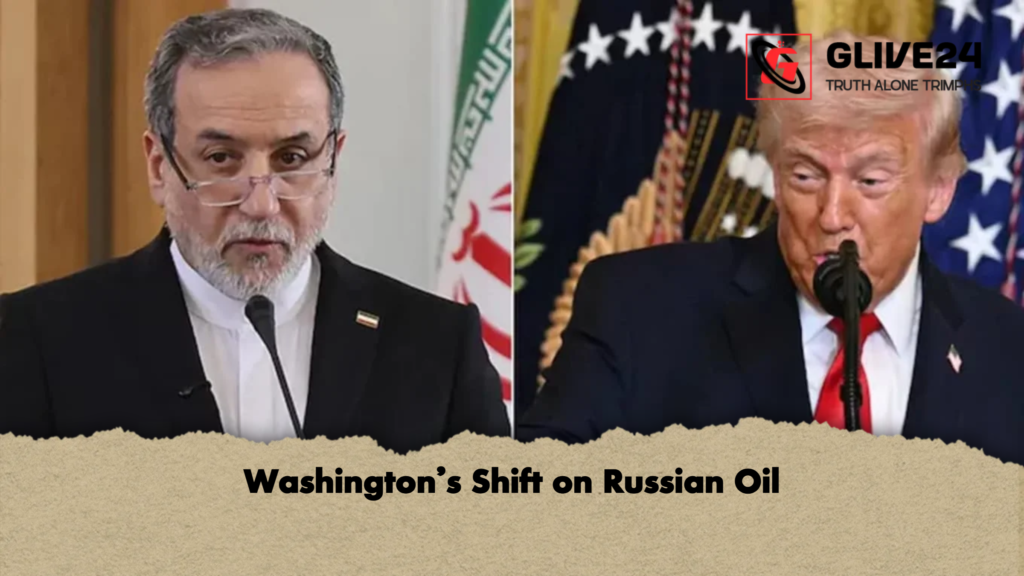
Iran’s Foreign Minister, Abbas Araghchi, has sharply criticised the United States over what he described as a dramatic reversal in Washington’s stance on Russian oil. In remarks posted on the social media platform X on Saturday (14 March), he claimed that the United States had spent months pressuring India to halt imports of Russian crude, only to now seek access to the same oil amid escalating geopolitical tensions and disruptions in global energy supply.
Araghchi argued that Washington had previously admonished New Delhi repeatedly over its continued purchases of Russian oil following the conflict between Vladimir Putin and Ukraine. According to him, the tone from the White House has changed markedly after a brief but intense period of hostilities involving Iran in the Middle East. He suggested that the United States, facing mounting uncertainty in global oil flows, is now appealing to India and other nations to maintain or even expand purchases of Russian crude in order to stabilise energy markets.
In his statement, Araghchi wrote that the United States had “scolded India for months” over Russian oil imports but had altered its position following two weeks of conflict involving Iran. He claimed that the White House was now effectively asking countries around the world to buy Russian oil in order to ease mounting pressure on global supplies.
The Iranian foreign minister also criticised European governments for supporting what he described as an “illegal war” against Iran. He argued that European states believed their support would strengthen American backing against Russia. Araghchi characterised this expectation as misguided and lamentable.
The controversy surrounding Russian oil imports intensified after Donald Trump returned to office for a second presidential term. Trump repeatedly argued that large-scale purchases of Russian crude by countries such as India were providing Moscow with vital revenue. According to the administration, these funds were helping finance Russia’s military operations in Ukraine.
As part of its pressure campaign, Washington urged India to significantly reduce its purchases of Russian crude. At one stage, the United States even imposed tariffs of up to 50 per cent on certain Indian exports in an effort to compel policy changes. The tariffs were later withdrawn, with the White House claiming that India had begun scaling back its Russian oil imports.
However, the Indian government has consistently maintained that its energy policy is guided solely by national interest. Officials in New Delhi have repeatedly stressed that India’s decisions regarding energy procurement are based on economic considerations and supply security rather than external political pressure.
The global energy landscape shifted again on 28 February, when Iran announced that oil flows through the strategically vital Strait of Hormuz could be suspended amid rising regional tensions. The narrow maritime passage is one of the most important energy corridors in the world, carrying a significant proportion of internationally traded crude oil.
Any disruption to traffic through the strait immediately raised fears of supply shortages and volatile oil prices, prompting urgent discussions among major energy-importing nations.
Strategic Importance of the Strait of Hormuz
| Indicator | Key Information |
|---|---|
| Location | Between Iran and Oman |
| Share of global oil trade | Around 20% of seaborne crude |
| Major importing nations | India, China, Japan, South Korea |
| Key exporters relying on the route | Saudi Arabia, Iraq, UAE, Kuwait |
| Date of latest escalation | 28 February 2026 |
Energy analysts note that uncertainty in the Gulf has once again highlighted the fragility of global oil supply chains. With the Strait of Hormuz at risk of disruption, countries have been forced to consider alternative supply sources, including Russian crude, despite earlier sanctions and political opposition.
Against this backdrop, Araghchi’s remarks reflect Tehran’s broader effort to highlight what it portrays as Western double standards in global energy politics. According to the Iranian minister, recent developments demonstrate how geopolitical realities can rapidly reshape the policies of major powers when global energy security is at stake.