
Over the past decade, Bangladesh’s energy sector has become increasingly complex and challenging. While demand for natural gas and petroleum products has surged, domestic production has failed to keep pace. Declining gas output and the limited capacity of the country’s sole oil refinery have heightened reliance on imports to sustain supply across power generation, industry, transportation, and agriculture. Experts warn that limited import sources combined with international market volatility place Bangladesh’s energy security at significant risk.
Table of Contents
Gas Demand and Shortfall
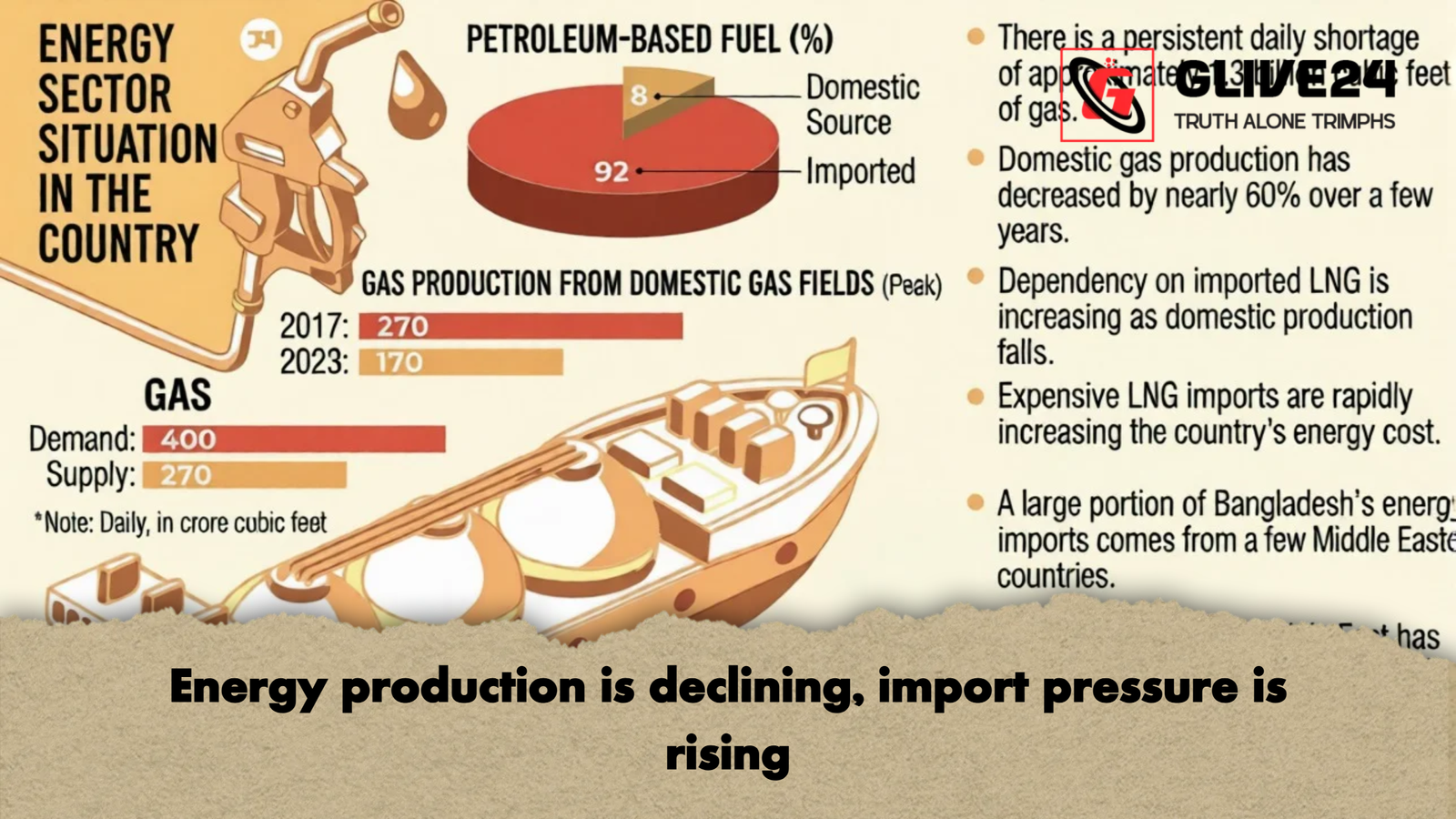
According to Petrobangla, the country’s daily gas demand currently stands at approximately 40 billion cubic feet (bcf). However, combined supply from domestic sources does not exceed 27 bcf, leaving a daily shortfall of around 13 bcf. This deficit is affecting industry, power generation, and household consumption. Many factories experience regular gas shortages, reducing industrial output, while residential areas face intermittent supply interruptions.
| Indicator | Daily Volume |
|---|---|
| Total demand | 40 bcf |
| Domestic production | 17 bcf |
| LNG imports | 8–10 bcf |
| Daily shortfall | 13 bcf |
Gas production peaked in 2017, when output occasionally reached 27 bcf per day. Since then, domestic production has fallen by approximately 60 per cent, averaging 17 bcf per day. The remainder is supplied through imported liquefied natural gas (LNG).
Challenges in Domestic Gas Production
Several factors contribute to the decline in domestic gas output. Most of the country’s large gas fields have been in operation for decades, leading to gradual depletion. The discovery of new major fields has been slow, while exploration activities stalled during periods of political transition, resulting in a prolonged downward trend in production.
A significant portion of Bangladesh’s energy potential lies offshore in the Bay of Bengal, but exploration there has remained largely dormant for years. The country’s maritime zones are divided into 15 deepwater and 11 shallow-water blocks. Despite international tenders to attract foreign investment, no new offshore fields have been brought online since production began at the Sangu field in 1998, which later ceased. Experts warn that without renewed offshore exploration, increasing domestic production will be difficult.
LNG Imports and Costs
Bangladesh began importing LNG in 2018. Initially modest, imports have grown rapidly. In the first year, 41 LNG cargoes were delivered under long-term agreements with Qatar and Oman. By 2025, 56 cargoes were imported under long-term contracts and 53 via the spot market, totalling 109 cargoes. In 2026, this figure is expected to reach approximately 115 cargoes. Each cargo contains roughly 3.36 million MMBtu of gas, equivalent to about 32.4 bcf once regasified—less than the country’s daily demand, highlighting the necessity for regular imports.
| LNG Imports (2025) | Number of Cargoes |
|---|---|
| Long-term contracts | 56 |
| Spot market | 53 |
| Total | 109 |
Rising LNG imports have significantly increased energy costs, with spot prices recently ranging from $20–28 per MMBtu, up from around $10 at the beginning of the year. Domestic gas remains far cheaper, and the nation’s energy import expenditure has surged accordingly.
Petroleum Products and Refinery Constraints
Bangladesh imports approximately 92 per cent of its petroleum products, with only 8 per cent sourced domestically—mainly from condensate processed into petrol and octane. The sole refinery, Eastern Refinery in Chattogram, has a refining capacity of 1.5 million tonnes annually, far below national demand of 7–8 million tonnes. Diesel dominates consumption, accounting for roughly 67 per cent of petroleum use, primarily in transportation (56 per cent), followed by power (18 per cent), agriculture (18 per cent), and industry (5 per cent).
Security Risks and Future Strategy
Most of Bangladesh’s crude oil and LNG imports come from a limited set of Middle Eastern countries, including Saudi Arabia, UAE, Kuwait, Qatar, and Oman. Political instability or military conflicts in the region, or disruptions along the Strait of Hormuz—through which about 20 per cent of global oil is transported—could severely impact supply.
Professor Shasul Alam, energy advisor to the Consumer Association of Bangladesh, emphasises that without accelerating domestic exploration, expanding offshore production, diversifying import sources, investing in renewable energy, and building additional refining capacity, Bangladesh will remain heavily import-dependent and its energy security increasingly vulnerable. Long-term planning and infrastructure development are critical to mitigating future risks.