
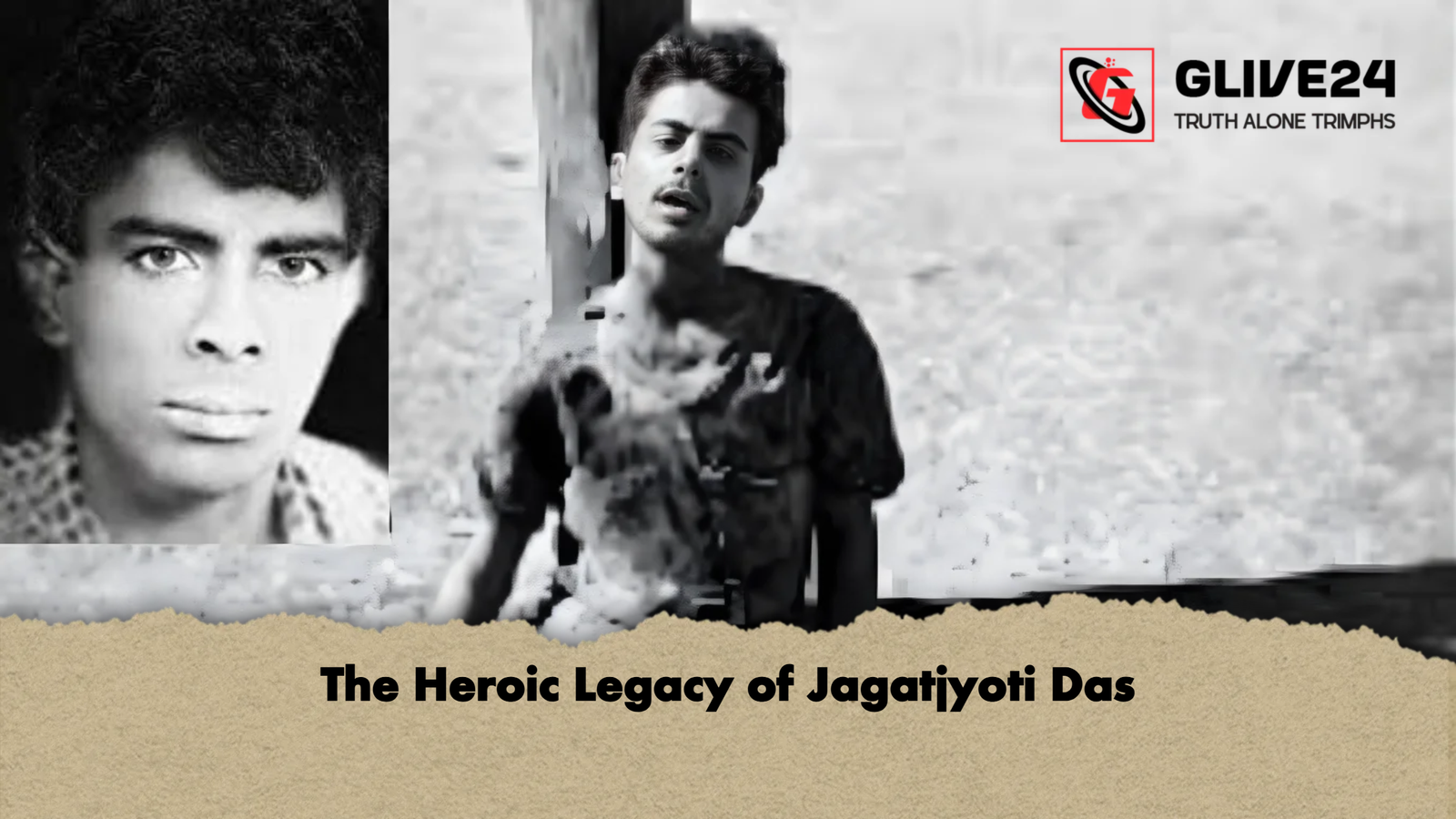
On 16 November 1971, just four days prior to Eid-ul-Fitr, the liberation struggle of Bangladesh lost one of its most formidable guerrilla commanders: Jagatjyoti Das. His death remains a harrowing testament to the brutality of the Pakistani occupation forces and their local collaborators (Razakars). Captured in a semi-conscious state, Jagatjyoti was subjected to public torture at the Ajmiriganj cattle market. He was suspended from an electric pole and tortured by having nails driven into his body. His remains were later cast into the waters of the Kushiyara River.
Table of Contents
Early Life and Background
Born on 26 April 1949, in Jalsukha village under Ajmiriganj Upazila of Habiganj, Jagatjyoti was the son of Jitendra Chandra Das and Harimoti Das. Despite facing significant economic hardships, he successfully completed his secondary education in 1968. Driven by the burgeoning independence movement, he crossed into India to receive military training in Assam and Shillong, preparing himself for the armed resistance against the Pakistani military.
Leadership of the ‘Das Party’
Following his training, Jagatjyoti formed the legendary guerrilla unit known as the ‘Das Party’. Under his command, this group became a source of constant dread for the occupation forces in the vast Bhati (lowland) regions. His strategic operations spanned across Dirai, Sulla, Chhatak, Ajmiriganj, Baniachang, and Tahirpur. The effectiveness of the Das Party in disrupting naval supply lines was so profound that the then-Pakistan government issued a radio broadcast stating it would no longer take responsibility for the safety of personnel or property traveling along those specific routes.
Military Achievements and Final Stand
Jagatjyoti’s military career was defined by extraordinary tactical victories. He famously defeated a Pakistani force of 250 soldiers with only 13 companions and liberated Sripur with a squad of merely a dozen fighters.
His final mission occurred on 16 November 1971. While leading 42 fellow fighters on an expedition toward Bahubal, his unit fell into an ambush orchestrated by enemy forces at Badalpur. Following his capture and execution, the news of his demise was broadcast across both Swadhin Bangla Betar Kendra and All India Radio, marking the loss of a significant national figure.
Profile of Jagatjyoti Das
| Category | Details |
| Full Name | Jagatjyoti Das |
| Date of Birth | 26 April 1949 |
| Place of Birth | Jalsukha, Ajmiriganj, Habiganj |
| Guerrilla Unit | Das Party |
| Area of Operations | Bhati Region (Habiganj, Sunamganj, etc.) |
| Date of Martyrdom | 16 November 1971 |
| Official Title | Bir Bikrom (Posthumous) |
The Question of Recognition
The historical record regarding Jagatjyoti’s official recognition remains a subject of discussion. During the war, the provisional government of Bangladesh (Mujibnagar Government) had reportedly announced his name for the ‘Bir Srestha’—the highest military gallantry award. Swadhin Bangla Betar Kendra repeatedly referred to him with this title.
However, in the official gazette published by the Government of Bangladesh in 1972, he was formally awarded the ‘Bir Bikrom’, the third-highest gallantry award. While the state opted for this title, Jagatjyoti Das continues to be remembered in the public consciousness as a figure whose sacrifice and leadership stood at the very pinnacle of the liberation effort.
To this day, he is often referred to as the “Jesus of Bengal” by those who recall the nature of his public execution, reflecting the profound impact of his martyrdom on the collective memory of the Bhati region and the nation at large.