LAHORE — In a high-stakes final held in Lahore, the Hyderabad Kingsmen were unable to exploit a promising start, ultimately collapsing to a total of 129 all out. Despite a resilient half-century from Saim Ayub, the team’s middle and lower orders proved fragile against a disciplined Peshawar bowling attack. Marnus Labuschagne’s side, having been inserted to bat after losing the toss, failed to see out their full allocation of overs, falling in the 18th over and leaving their opponents with a modest target for victory.
Hyderabad’s Opening Volleys and Subsequent Collapse
The innings commenced with a sense of urgency as the Hyderabad openers sought to establish an early advantage. Maz Sadaqat provided a brief spark of aggression, accumulating 11 runs from a mere 6 deliveries. His stay at the crease was short-lived, however, as he was dismissed before he could establish a long-term presence.
Following the early loss of Sadaqat, the captain Marnus Labuschagne took to the crease. Labuschagne displayed his characteristic intent, scoring 20 runs off 12 balls. His innings featured a high strike rate that suggested Hyderabad were aiming for a formidable total. Nevertheless, the Australian international was unable to capitalise on his start, perishing as the Peshawar bowlers began to find their rhythm. The loss of the captain served as the catalyst for a broader instability within the Hyderabad batting card.
Saim Ayub Provides Lone Defiance
Whilst the wickets fell with concerning regularity at one end, Saim Ayub, batting at number three, provided a masterclass in composure. In an environment where his teammates struggled to adapt to the pressure of a final and the nuances of the Lahore surface, Ayub remained undeterred. He anchored the innings with a disciplined approach, reaching a personal milestone of 50 runs from 42 balls.
Ayub eventually finished as the top scorer for the Kingsmen with 54 runs. Despite his individual brilliance, he found himself increasingly isolated. The lack of a supporting partnership meant that Ayub was forced to balance aggression with caution, a task made more difficult by the consistent fall of wickets at the other end. Once the set batsman was removed, the tail offered little resistance, and the innings concluded abruptly at 129.
Peshawar’s Bowling Excellence
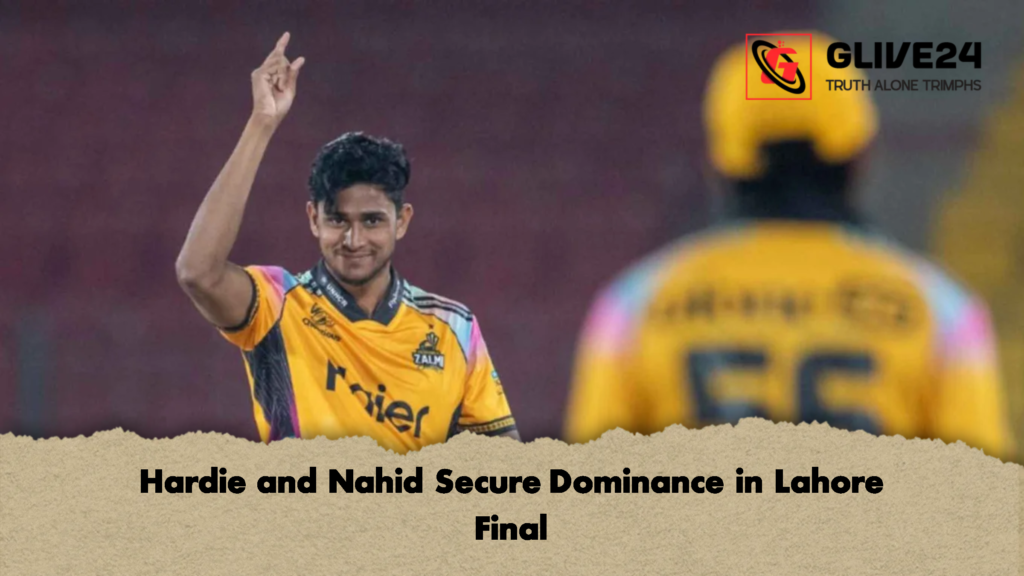
The Peshawar bowling unit delivered a clinical performance, characterised by strategic variations and a steadfast refusal to grant easy runs. The standout performer was Aaron Hardie, whose spell effectively dismantled the Hyderabad middle order. Hardie finished with the exceptional figures of 4 wickets for 27 runs, striking at critical intervals to ensure no significant partnerships could materialise.
Supporting Hardie’s efforts was the pace of Nahid Rana, who proved difficult for the Hyderabad batsmen to negotiate. Rana’s figures of 2 wickets for 22 runs reflected his ability to maintain pressure from the opposite end. The collective effort was rounded off by Mohammad Basit and Sufiyan Muqeem, both of whom claimed a single wicket to keep the run rate suppressed and the pressure mounting.
Detailed Bowling Analysis:
-
Aaron Hardie: 4 wickets for 27 runs (Economy: 6.75)
-
Nahid Rana: 2 wickets for 22 runs (Economy: 5.50)
-
Mohammad Basit: 1 wicket
-
Sufiyan Muqeem: 1 wicket
Technical Assessment of the First Innings
The Hyderabad Kingsmen will likely rue their inability to bat through the remaining 12 deliveries of their innings. Dismissed in the 18th over, the loss of those balls proved costly in a final where every run is magnified. The team’s scoring rate of 7.16 per over was respectable, but the failure to preserve wickets in the middle phase prevented them from reaching a score in the region of 160, which had appeared achievable during Labuschagne’s tenure at the crease.
Peshawar’s bowlers utilised the conditions in Lahore effectively, extracting just enough movement to test the batsmen’s technique. By maintaining a disciplined line and length, they forced the Hyderabad batsmen into errors of judgement. As the match transitions to the second innings, Peshawar requires 130 runs to claim the title. While the target is statistically low, the pressure of a final means that a professional and measured batting performance will be required to cross the finish line.