Gold plays a significant role in the global economy, functioning not only as a precious metal for jewellery and investment but also as an indicator of economic security and geopolitical strength. In the context of global uncertainty, increasing central bank reserves, and rising demand for safe-haven assets, the importance of gold continues to grow steadily.
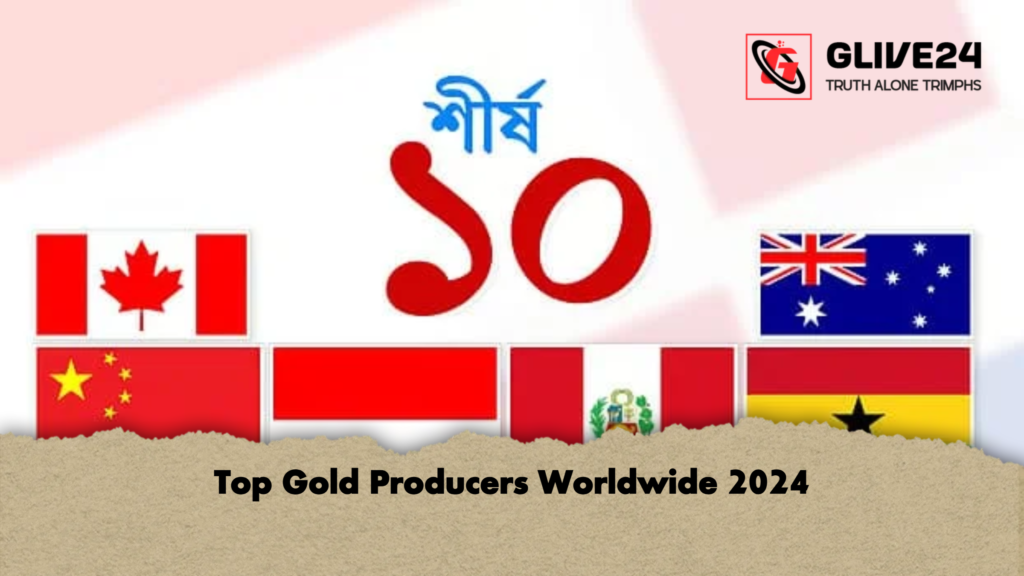
Global gold production remains highly concentrated in a limited number of countries. According to 2024 production data, China remains the world’s largest gold producer, followed by Russia, Australia, Canada, and the United States. Several African and Asian countries are also strengthening their positions in the global gold market, contributing increasingly to overall supply.
China is not only the largest producer but also one of the largest consumers of gold globally. Its influence spans mining, refining, jewellery manufacturing, and central bank reserves, making it a dominant force in the international gold market.
The following table presents the top ten gold-producing countries based on 2024 output:
Global Gold Production (2024)
| Rank | Country | Production (tonnes) |
|---|---|---|
| 1 | China | 380.2 |
| 2 | Russia | 330 |
| 3 | Australia | 284 |
| 4 | Canada | 202.1 |
| 5 | United States | 158 |
| 6 | Ghana | 140.6 |
| 7 | Mexico | 140.3 |
| 8 | Indonesia | 140.1 |
| 9 | Peru | 136.9 |
| 10 | Uzbekistan | 129.1 |
China maintained its position as the world’s leading gold producer in 2024, supported by extensive mining operations, strong state backing, and advanced refining capacity. Its sustained dominance reflects more than a decade of leadership in global production.
Russia ranked second, with production centred in vast mining regions such as Siberia and the Far East. Despite geopolitical tensions and international sanctions, the country has maintained its production capacity and continues to treat gold as a strategic reserve asset within its broader economic framework.
Australia, in third place, remains a major global supplier, with significant mining activity in regions such as Kalgoorlie in Western Australia. The country’s output is supported by large mineral reserves, advanced mining technologies, and a stable regulatory environment.
Canada occupies fourth position, with key mining provinces including Ontario, Quebec, and British Columbia. The country has recorded notable growth over the past decade, supported by technological advancement and strong investment conditions.
The United States ranks fifth, with major gold-producing states including Nevada, Alaska, and Colorado. Although production has declined compared to previous levels due to environmental regulations, rising operational costs, and mine closures, the country remains a significant global producer.
Ghana is the leading gold producer in Africa, ranking sixth globally. Its mining sector has expanded significantly over the past decade due to substantial foreign investment, although challenges such as illegal mining and environmental degradation persist.
Mexico, Indonesia, Peru, and Uzbekistan complete the list. Mexico’s mining industry is well established, with strong output from northern and central regions, though it faces security-related challenges. Indonesia’s production is driven largely by the Grasberg mine, while Peru’s output is concentrated in the Andes despite periodic disruptions linked to social and environmental tensions. Uzbekistan benefits from major assets such as the Muruntau mine and continues to expand its mining sector through modernisation and investment.
Overall, the 2024 data highlights the continued concentration of global gold production in a small group of countries, alongside gradual growth in emerging mining economies.