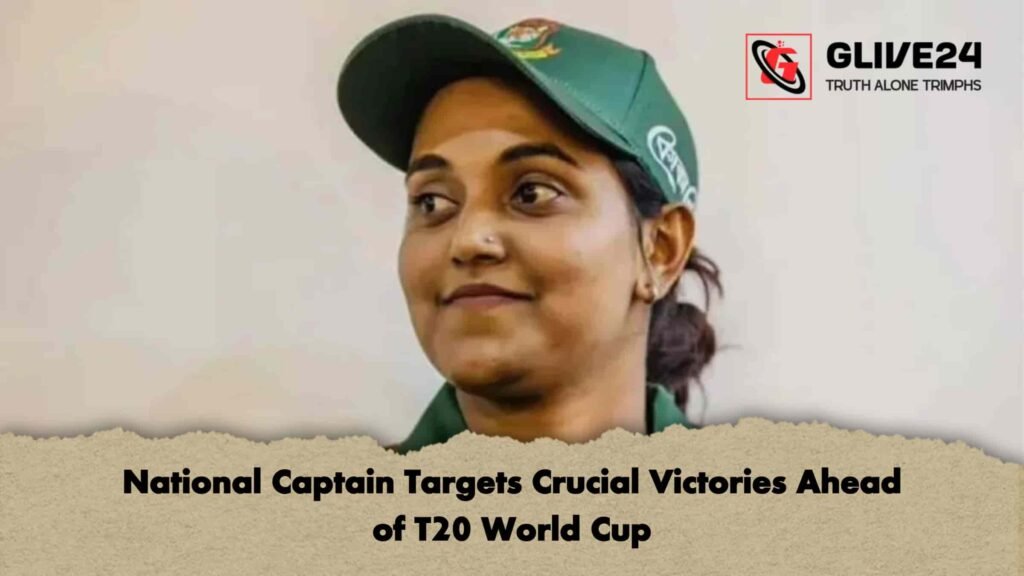
The Bangladesh women’s national cricket team is scheduled to depart for the ICC Women’s T20 World Cup in two separate phases on 24 and 26 May 2026. The team will first travel to Scotland to play in a preparatory tri-nation tournament before arriving at the official World Cup venue in England on 5 June 2026. In a comprehensive dialogue with sports journalist Sekandar Ali for Samakal, team captain Nigar Sultana Joty outlined the squad’s tactical preparations, structural adjustments, and strategic targets.
Table of Contents
World Cup Campaign Itinerary and Milestones
In contrast to previous international tournament cycles where warm-up opportunities were minimal, the national administration has organised a complete preparatory phase to ensure the squad adapts to European playing conditions.
The structural timeline for the team’s upcoming tour is detailed in the table below:
| Campaign Phase | Destination / Opposition | Scheduled Timeline | Strategic Purpose |
| Squad Departure | Dhaka to Scotland | 24 and 26 May 2026 | Phased international transit for squad management. |
| Tri-Nation Series | Scotland & TBD Opponent | Late May 2026 | Competitive adaptation to regional pitch conditions. |
| Tournament Arrival | England (World Cup Host) | Anticipated 5 June 2026 | Final base integration ahead of the group stage. |
| Warm-Up Matches | Official ICC Opponents | Pre-tournament Window | Two practice fixtures to finalise structural combinations. |
Technical Adjustments: Batting Freedom and Seam Depth
Captain Joty expressed confidence in the team’s upward trajectory, citing their aggressive performance during the World Cup qualifiers, where the batting unit consistently registered team totals above 150 runs. She noted that the current squad features several newly emerged match-winners, providing a level of depth that was absent in previous tournaments. Reflecting on the recent bilateral series against Sri Lanka, she described it as an essential learning experience that exposed technical vulnerabilities and allowed the management to test multiple team combinations.
Analysing the batting unit’s development, Joty highlighted positive scoring patterns in the powerplay overs during both the qualifiers and the Sri Lanka tour. The top order has consistently maintained a baseline of 30 to 35 runs during the initial six overs, even when wickets fall. The strategic objective for the World Cup is to push powerplay totals past 40 runs, with opening batters given explicit tactical freedom to play aggressively. This top-order approach is backed by a stable middle-order unit capable of rotating strike and finding boundaries.
Regarding pace bowling options, Joty explained that the management has spent the past year developing a pool of three to four seamers, ultimately selecting two highly mature specialist pacers for the final World Cup roster. She observed:
“These two pace selectors are now significantly more mature. In our previous configurations, we typically fielded a single specialist seamer supported by a medium-pace all-rounder. Due to their individual technical improvements, we can now confidently field two genuine frontline fast bowlers.”
Team Cohesion, Mental Wel-being, and Veteran Counsel
The captain emphasized that navigating English conditions effectively depends on a strong collective mindset and uniform self-belief. She explained that the squad’s residential schedule—living and training together for nine out of twelve months—has created an exceptionally tight team bond. This interpersonal connection will be critical as the players spend the upcoming Eid festival away from home, a factor that will require specific psychological management from the leadership to maintain high team morale.
Joty also noted that veteran former men’s captain Tamim Iqbal recently held a strategic session with the women’s squad to share his personal reflections on competing in England. Iqbal offered a direct self-assessment, explaining that his own historical underperformance at World Cups was often caused by over-complicating his game and placing excessive pressure on himself to deliver extraordinary results. His primary advice to the squad was to focus on enjoying the cricket and exploring the experience, rather than allowing the magnitude of a World Cup to generate negative mental pressure.
Primary Group Objectives and Head-to-Head Targets
When reviewing the tournament group stages, the captain presented a clear strategy based on historical performance data. Bangladesh have identified their matches against the Netherlands and Pakistan as high-probability victory opportunities.
Beyond these matches, the team has explicitly targeted India and South Africa as key objectives. Joty noted that because Bangladesh have secured victories against both India and South Africa in previous competitive cycles, the squad will carry a strong psychological advantage into these fixtures. If the team maintains form and executes its tactical plans, they expect to secure at least one victory against these higher-ranked opponents, allowing Bangladesh to challenge for a prominent position in the global tournament spotlight.