
Khabor Wala Desk
Published: 27th May 2026, 1:00 AM
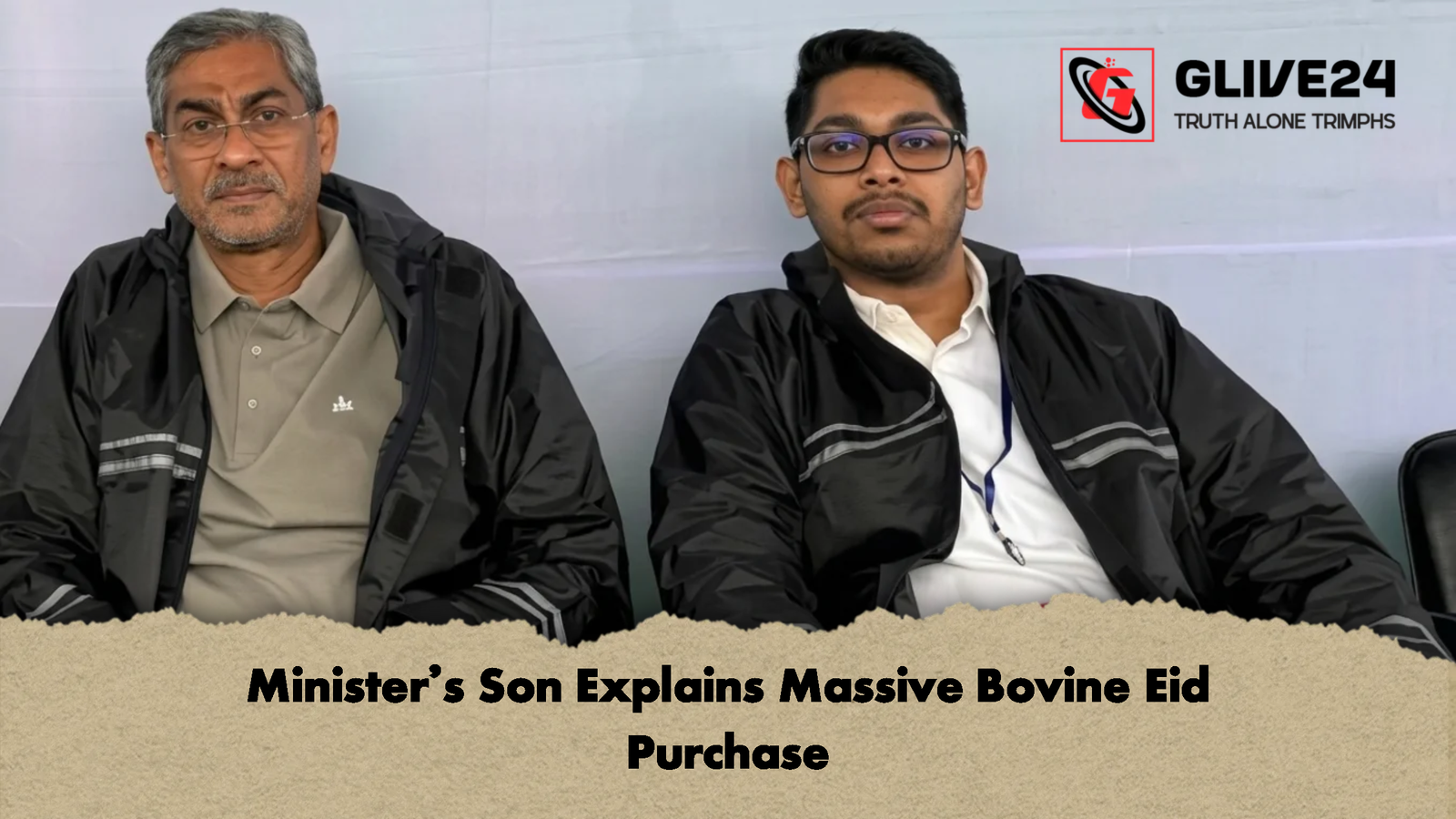
The son of the Bangladeshi Minister for Water Resources, Shahid Uddin Chowdhury Annie, has formally issued a public clarification regarding the substantial purchase of sacrificial cattle valued at 3.2 million Bangladeshi Taka (£19,500 approx.). Sariyan Chowdhury disseminated the detailed explanation through his verified personal Facebook account on Tuesday, 26 May 2026, at precisely 17:52. The communication was directly aimed at addressing widespread public scrutiny and political criticism directed at his father following the transaction at a local cattle market ahead of the upcoming Eid-ul-Adha festival.
The controversy initially ignited when news emerged that the Water Resources Minister had personally visited a traditional marketplace and transacted 32 lakh Taka for bovine acquisitions. In response to the intensifying public debate and online criticism concerning the scale of the expenditure, Sariyan Chowdhury published the statement to contextualise the financial layout, arguing that the transaction had been distorted by critics online.
According to the official text published by Sariyan Chowdhury, the financial expenditure does not represent the acquisition of a singular luxury animal, but rather a bulk seasonal procurement destined for charitable distribution. He stated that the Minister, along with his paternal uncles, manages an established annual tradition of purchasing multiple heads of cattle to satisfy both extended family obligations and institutional religious requirements.
Sariyan Chowdhury explained that, in strict accordance with their historic family practices, the collective household purchased a total of six cattle this year. The livestock is designated to be split between private family rites and the Haji Basir Ullah Chowdhury Orphanage and Madrasa, ensuring that the meat is distributed to disenfranchised individuals and students residing within the charitable complex.
In his written defence, the Minister’s son explicitly questioned the motivations of those criticising the family estate, attributing the backlash to coordinated digital networks. He suggested that the family’s long-standing traditions were being deliberately targeted because of his father’s current position within the state administration, characterising the online reaction as an unverified and illogical smear campaign.
| Assessment Category | Family Defence Argument | Nature of Public Criticism |
| Procurement Scale | Combined purchase of 6 cattle units for multiple households | Single transaction of 32 Lakh Taka seen as excessive |
| Primary Intent | Institutional charity and orphanage support | Perceived display of ministerial affluence |
| Motivation | Long-standing 50-year ancestral tradition | Questions over transparency and political timing |
“Fifty years from today, when my father is no longer holding a ministerial portfolio, if our descendants sacrifice ten cattle, will they still be subjected to such irrational criticism?” Sariyan Chowdhury questioned in his social media brief. He further asserted that his father was uniquely experiencing this targeted backlash from coordinated cyber entities solely due to his high-profile political status as a sitting minister.
Concluding his digital statement, Sariyan Chowdhury reinforced the religious and social obligations underpinning the seasonal livestock procurement. He emphasised that under Islamic jurisprudence, the final products of the ritual sacrifice are strictly categorised as the foundational rights of the impoverished, ensuring that all meat derived from the six cattle would be systematically delivered to local low-income communities.
“The most vital aspect is that all of these cattle constitute the legitimate right of the poor. The rights of the people will safely reach the people, God willing,” the post read. He concluded his public defence by stating that the ultimate judgment rests with the Almighty, whom he described as the supreme planner who observes all actions. Law enforcement and ministerial spokespersons have declined to comment further on the private family expenditures, while the public debate regarding the high-value transaction continues to circulate across local digital platforms.


Comments