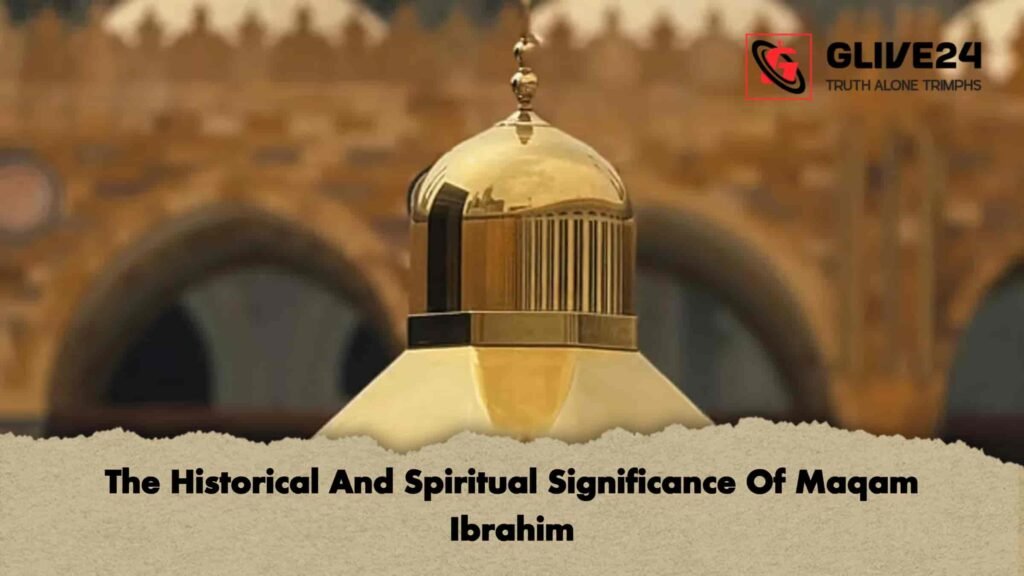
The holy pilgrimage of Hajj features numerous sacred monuments, among which the Maqam Ibrahim (the Station of Abraham) holds a prominent position as a physical testament to Islamic history. The Maqam Ibrahim refers to the specific stone upon which the Prophet Ibrahim (Abraham) stood whilst reconstructing the upper sections of the Holy Kaaba. Islamic scholarship records that the boulder functioned miraculously during the construction process, elevating and lowering automatically to match the required height of the building layout. During this process, the surface of the solid stone softened to receive and permanently preserve the deep footprints of the Prophet Ibrahim.
Scriptural References and Theological Standing
The monument is explicitly acknowledged in the Quran as a clear manifestation of divine power. According to Surah Ali ‘Imran, verse 97: “In it are clear signs and among them is the Station of Abraham.” Islamic jurisprudence and prophetic traditions (Hadith) further establish its celestial origins. A narration documented in Sunan al-Tirmidhi (Hadith 878) states that the Prophet Muhammad said:
“Indeed, the Hajar al-Aswad (the Black Stone) and the Maqam Ibrahim are two sapphires from the sapphires of Paradise. Allah Has extinguished their radiance. Had He not obscured their light, they would have illuminated everything between the East and the West.”
Technical Specifications and Historical Trajectory
The physical placement and preservation framework of the Maqam Ibrahim have undergone distinct structural changes across different historical eras. Originally kept inside the Kaaba, the stone was relocated to the exterior near the entrance during the pre-Islamic period. Following the advent of Islam, it was positioned further away from the door to accommodate worshippers.
The verified technical coordinates, textual references, and contemporary spatial metrics of the monument are systematically structured in the table below:
| Feature Parameter | Historical and Spatial Specification Details | Source / Scriptural Reference |
| Primary Material | Celestial Sapphire (Yaqut) from Paradise | Sunan al-Tirmidhi, Hadith 878 |
| Current Location | 10 to 11 metres away from the Holy Kaaba | Contemporary Sanctuary Survey |
| Enclosure Type | Protective glass dome with a metallic frame | Ministry of Hajj and Umrah |
| Textual Reference I | Surah Ali ‘Imran, Verse 97 | The Holy Quran |
| Textual Reference II | Surah Al-Hajj, Verse 27 | The Holy Quran |
The Proclamation of Hajj
Upon completion of the structural walls of the Kaaba, the Prophet Ibrahim was divinely commanded to summon mankind to the sacred site. As stated in Surah Al-Hajj, verse 27: “And proclaim to the people the Hajj; they will come to you on foot and on every lean camel; they will come from every distant pass.” Standing atop this specific stone, the Prophet Ibrahim delivered the universal proclamation. According to the commentary of Tafsir Ibn Kathir, this call was miraculously conveyed across generations to all human souls destined to perform the pilgrimage, who spiritually responded with the traditional declaration of “Labbayk” (Here I am at Your service, O Lord).
Ritual Importance in Modern Pilgrimage
The Maqam Ibrahim remains central to the completion of both Hajj and Umrah rituals. Prophetic traditions confirm that during the Farewell Pilgrimage (Hajjat al-Wada), the Prophet Muhammad positioned himself such that the Maqam Ibrahim stood directly between his prayer carpet and the Kaaba structure (Sahih al-Bukhari, Hadith 395).
Consequently, after performing the seven circumambulations (Tawaf) around the Kaaba, it is a compulsory religious duty (Wajib) for pilgrims to offer a two-rakah prayer. Performing this specific prayer immediately behind the glass dome of the Maqam Ibrahim is classified as a highly recommended prophetic practice (Sunnah). If overcrowding or physical restrictions prevent prayer at that exact spot, Islamic law permits pilgrims to complete the two rakahs anywhere else within the wider boundaries of the Masjid al-Haram.