
Khabor Wala Desk
Published: 31st May 2026, 6:06 PM
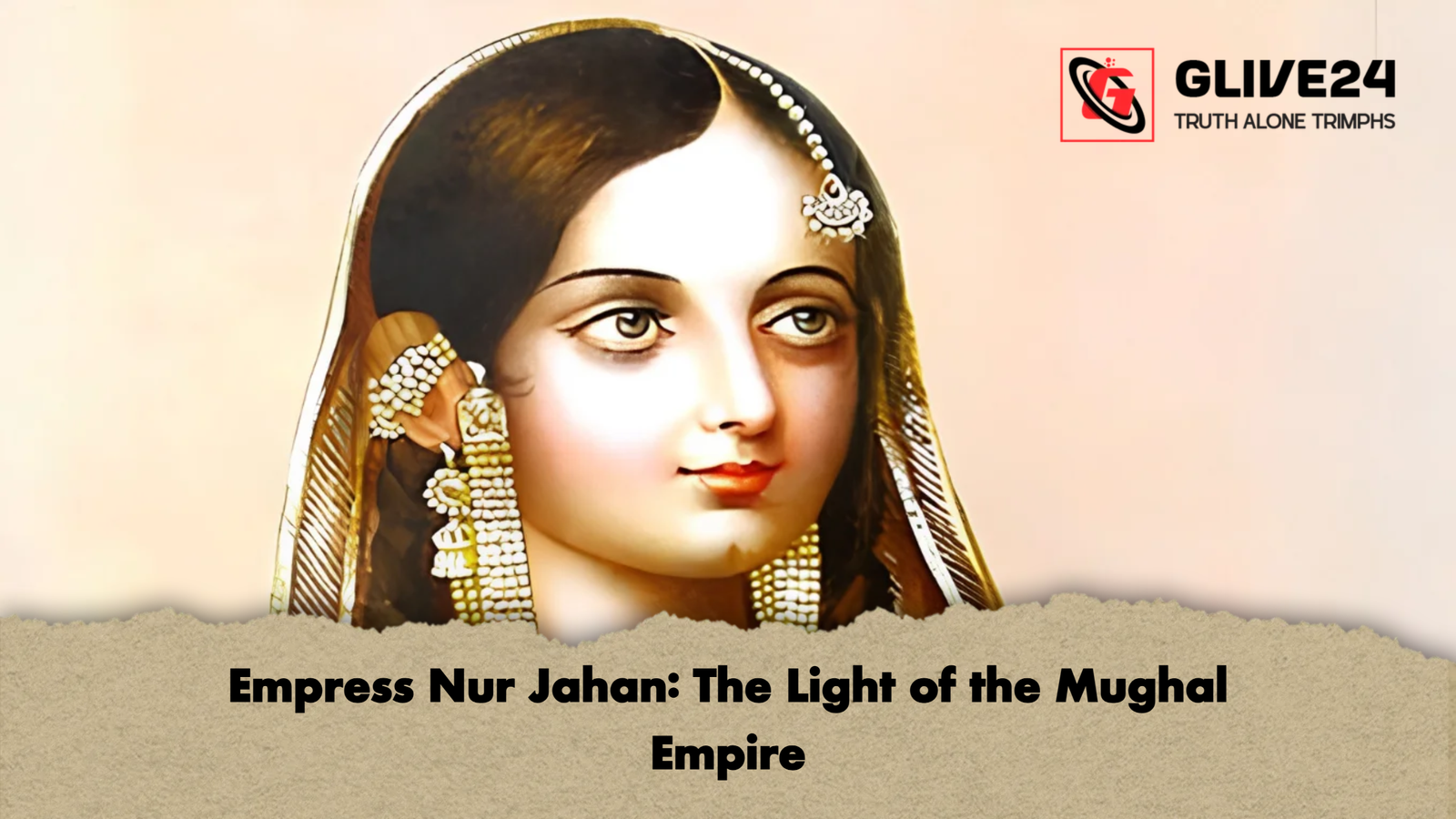
Empress Nur Jahan remains one of the most brilliant and influential female figures in the history of the Mughal Empire. Born Mehr-un-Nissa, she was later bestowed with the title ‘Nur Jahan’ (meaning ‘Light of the World’) by Emperor Jahangir. Beyond her status as a consort, she is immortalised as an exceptionally skilled administrator, an astute political strategist, a courageous leader, and a dedicated patron of culture and the arts.
Table of Contents
Mehr-un-Nissa was born into an aristocratic Persian family on 31 May 1577. Facing severe political and economic adversities, her family migrated from Persia to India, where they ultimately found refuge and employment at the court of the Mughal Emperor Akbar. Raised within the sophisticated environment of the royal court, Mehr-un-Nissa quickly demonstrated remarkable mastery over diverse disciplines, including dance, music, literature, painting, and various intellectual pursuits.
Combining physical grace with profound intellect, she occupied a unique position in contemporary society. Historical accounts indicate that Prince Salim (later Emperor Jahangir) was deeply attracted to her upon their very first meeting. However, due to prevailing political and social considerations, Emperor Akbar did not permit their union. Consequently, Mehr-un-Nissa was married to Ali Quli Istajlu, a prominent warrior who later earned the celebrated title of ‘Sher Afgan’ (the Tiger Tosser).
Following the demise of Emperor Akbar, Prince Salim ascended the throne and assumed the imperial title of Jahangir. Despite the passage of time, he remained captivated by his memories of Mehr-un-Nissa. After Sher Afgan was killed in a clash in 1607, Mehr-un-Nissa returned to the imperial capital of Agra with her daughter, Ladli Begum. In May 1611, several years after her return, Emperor Jahangir married her in a grand ceremony, formally granting her the illustrious title of ‘Nur Jahan’.
Upon her marriage, Nur Jahan rapidly transitioned from being the Emperor’s favourite consort to the primary locus of state administration. Historians note that during a substantial portion of Jahangir’s reign, Nur Jahan exerted a decisive influence on critical imperial policies and state decisions. This consolidation of power was so absolute that Sir Thomas Roe, the English ambassador to the Mughal court, explicitly observed that the actual governing authority of the empire was concentrated in the hands of Nur Jahan.
She was the only Mughal empress in whose name imperial edicts (farmans) were issued, and her name was uniquely minted alongside Jahangir’s on state coinage. To secure her administrative grip, her father, Mirza Ghiyas Beg, was appointed as the chief minister with the title ‘Itimad-ud-Daulah’, while her brother, Asaf Khan, was elevated to a position of immense authority within the imperial household.
| Year | Key Historical Event and Description |
| 1577 | Born Mehr-un-Nissa to an aristocratic Persian family on 31 May. |
| 1594 | Married to her first husband, Ali Quli Istajlu (Sher Afgan). |
| 1607 | Sher Afgan is killed; Mehr-un-Nissa returns to Agra as a widow. |
| 1611 | Marries Emperor Jahangir and officially receives the title ‘Nur Jahan’. |
| 1611–1627 | Exercises supreme administrative authority over the Mughal Empire. |
| 1626 | Leads a successful military manoeuvre to rescue the captive Emperor Jahangir. |
| 1627 | Death of Emperor Jahangir; sudden decline of her political dominance. |
| 1645 | Passes away on 17 December at the age of 72 in Lahore. |
Nur Jahan was equally renowned for her physical courage and tactical military acumen. She frequently accompanied the Emperor on hunting expeditions and gained considerable fame as an exceptionally skilled tiger hunter. Contemporary poets and chroniclers composed numerous works celebrating her bravery and striking personality.
Her diplomatic and military capabilities were severely tested during the latter part of Jahangir’s reign. When Prince Khurram (the future Emperor Shah Jahan) and the powerful imperial general Mahabat Khan staged a rebellion, Nur Jahan personally intervened to manage the crisis. In 1626, when Mahabat Khan successfully staged a coup and took Emperor Jahangir captive, Nur Jahan demonstrated extraordinary leadership, personally orchestrating and executing the diplomatic and military strategy that secured the Emperor’s safe release.
Emperor Jahangir held Nur Jahan in the highest esteem, deeply respecting her intellect and judgement. The depth of their relationship and her unwavering commitment to state ethics are perfectly captured in Jahangir’s celebrated proclamation:
“Nur Jahan is the master of my life, but she is not the master of my justice.”
This statement highlights that, despite his immense personal affection for the Empress, the administration of state justice and the protection of subject rights remained an uncompromised, objective domain.
The final chapter of Nur Jahan’s life was marked by relative obscurity. Following the death of Emperor Jahangir in 1627, a swift succession struggle ensued, culminating in the ascension of Shah Jahan. Consequently, Nur Jahan’s political influence came to an end. She spent the remaining 18 years of her life in quiet retirement in Lahore, receiving a fixed state pension and dedicating her time to charitable works and the care of her daughter.
On 17 December 1645, at the age of 72, the former Empress passed away. She was interred in a modest mausoleum at Shahdara Bagh in Lahore, near the tomb of Jahangir. Nur Jahan was also a gifted poet in her own right, composing verses under the pen name ‘Makhfi’. Her self-composed Persian epitaph, which reflects her philosophical view on life, was later beautifully translated into Bengali by the renowned poet Satyendranath Dutta:
“On the grave of this poor stranger, let there be neither lamp nor rose,
Let neither butterfly’s wing be burnt, nor nightingale’s song be disturbed.”
Through her exceptional beauty, profound wisdom, political foresight, and administrative competence, Empress Nur Jahan endures as one of the most powerful and influential female leaders in global history.

Comments