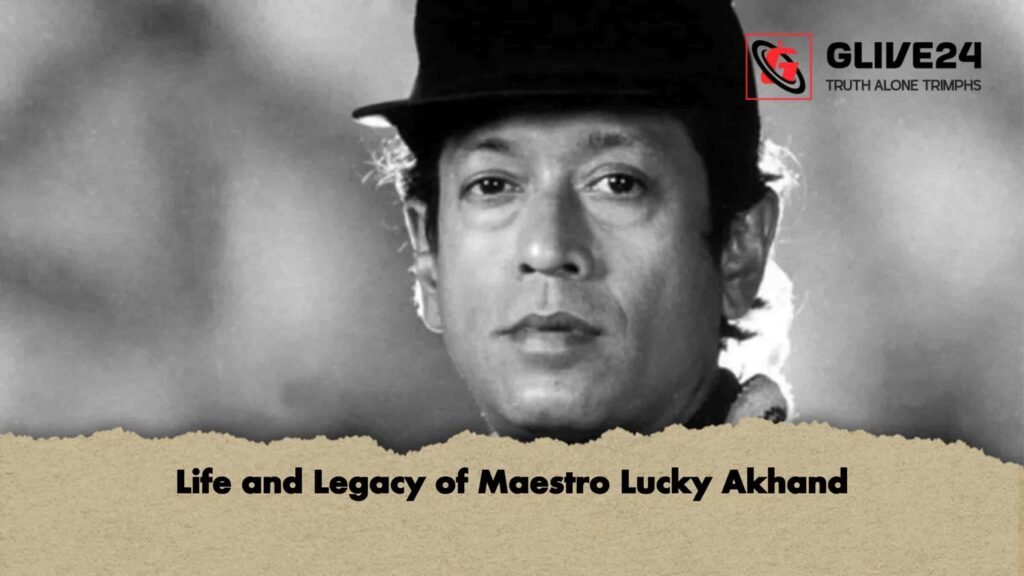
The trajectory of modern Bengali music was profoundly shaped by the contributions of select visionary artists. Among these luminaries, Lucky Akhand stood as an exceptionally bright star—a distinguished composer, music director, vocalist, and a true pioneer of the modern Bengali musical movement.
Through his innovative melodies, meticulous arrangements, and distinctive vocal delivery, he imparted a fresh dimension and an enduring appeal to the genre. Masterpieces such as ‘Ei Neel Monihar’, ‘Abar Elo Je Shondha’, and ‘Amay Deko Na’ continue to resonate deeply within the hearts of listeners, retaining the identical emotional potency they possessed upon their initial release.
Table of Contents
Early Prolificacy and Formative Years
Lucky Akhand was born on 7 June 1956 at Patlatuk Lane in Old Dhaka. Music was an intrinsic part of his heritage, and he commenced his foundational training under the guidance of his father at the tender age of five. By childhood, his precocious talent was already evident through regular appearances on television and radio broadcasts.
His extraordinary capabilities led to unparalleled achievements during his adolescence. At the age of 14, he achieved the rare distinction of becoming a composer for HMV Pakistan. By the age of 16, he further established his credentials by serving as a music director for HMV India. This exceptional early recognition remains a remarkable milestone in the annals of Bengali music.
Artistic Breakthroughs and Musical Hiatus
In 1975, Lucky Akhand undertook the musical arrangement for an album by his younger brother, Happy Akhand. This specific project produced several seminal compositions, including:
-
‘Abar Elo Je Shondha’
-
‘Ke Banshi Bajay Re’
-
‘Shadhinota Tomake Niye’
-
‘Pahari Jhorna’
The track ‘Abar Elo Je Shondha’ achieved widespread national prominence in 1980 after being featured in the film Ghuddi, directed by Syed Salahuddin Zaki, thereby securing a permanent place in Bengali musical history.
In 1984, Akhand’s self-titled debut solo album, Lucky Akhand, was released under the Sargam banner. Throughout his career, he also performed as a member of the popular band Happy Touch and later held the prestigious position of Director of the Music Department at Bangladesh Betar.
The untimely passing of his beloved younger brother, Happy Akhand, in 1987 served as a severe emotional blow. Consequently, Lucky Akhand withdrew from the musical sphere for a prolonged period. Following a hiatus lasting nearly twelve years, he made his formal return to the industry in 1998, arranging the music for the acclaimed albums ‘Porichoy Kobe Hobe’ and ‘Bitrishno Jibone Amar’.
Official Recognition and Final Years
The artist’s profound capabilities garnered official accolades from a very young age. In 1969, he was bestowed with an award in the ‘Modern Bengali Music’ category by the Pakistan Art Council.
During the final chapter of his life, the legendary musician engaged in a prolonged battle against lung cancer. He passed away on 21 April 2017. Although the creator has departed, his artistic output transcends temporal boundaries, ensuring his presence remains in the hearts of the public. On the anniversary of his birth, Lucky Akhand is remembered with the highest esteem. For as long as Bengali music endures, his melodies will continue to echo.
Key Historical Milestones
| Year | Event Description |
| 1956 | Born on 7 June in Patlatuk Lane, Old Dhaka. |
| 1961 | Initiated musical training under his father’s tutelage at age five. |
| 1969 | Received the Pakistan Art Council award for ‘Modern Bengali Music’. |
| 1970 | Appointed as an official composer for HMV Pakistan at age 14. |
| 1972 | Appointed as an official music director for HMV India at age 16. |
| 1975 | Arranged Happy Akhand’s album, introducing ‘Abar Elo Je Shondha’. |
| 1980 | ‘Abar Elo Je Shondha’ gained national fame via the feature film Ghuddi. |
| 1984 | Released the debut solo album Lucky Akhand via the Sargam label. |
| 1987 | Commenced a long musical hiatus following the death of Happy Akhand. |
| 1998 | Returned to music, arranging ‘Porichoy Kobe Hobe’ and ‘Bitrishno Jibone Amar’. |
| 2017 | Passed away on 21 April following a protracted battle with lung cancer. |