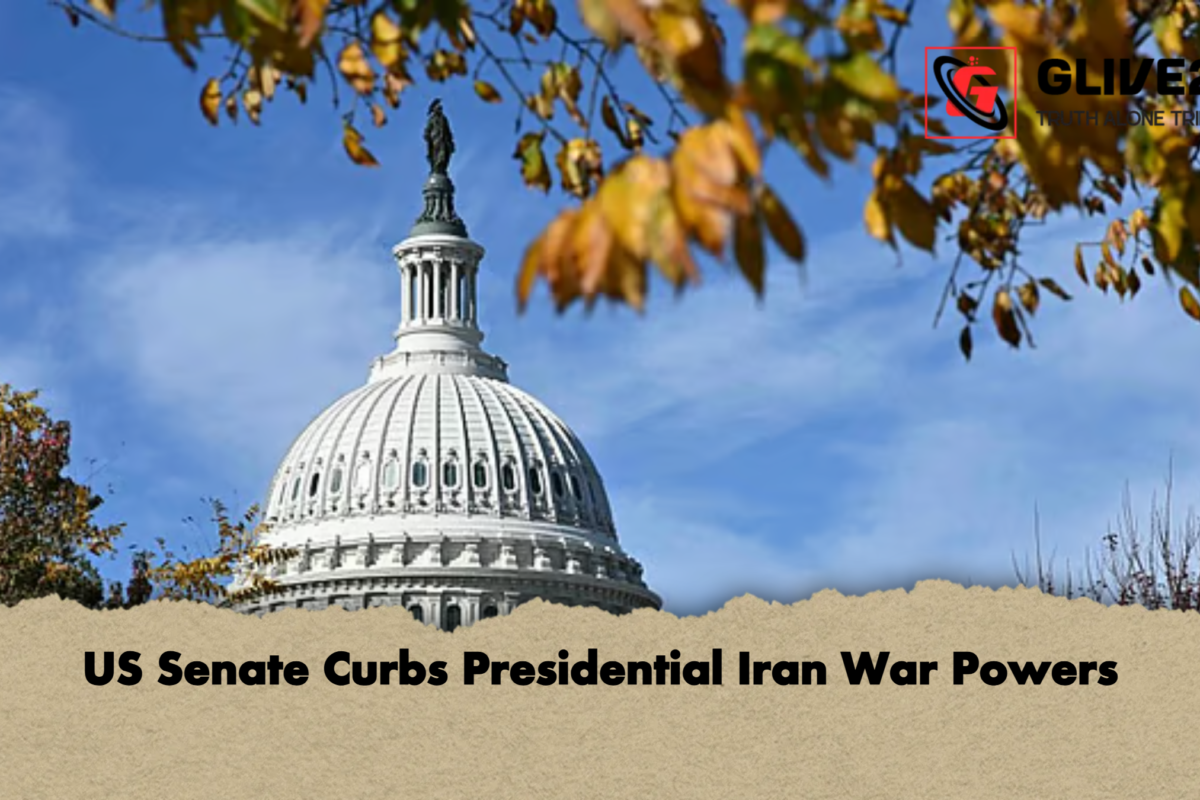
The United States Senate has narrowly approved a significant piece of legislation aimed at limiting the president’s authority to conduct military operations against Iran without congressional approval, marking a notable assertion of legislative power over foreign policy decisions.
The bill passed the upper chamber on Tuesday by a margin of 50–48. It follows earlier approval in the House of Representatives, where the measure cleared 215–208 earlier this month. With both chambers having now supported the proposal, it moves into the next stage of the legislative process, where its long-term viability remains uncertain.
At the heart of the legislation is a clear requirement: any future military action against Iran would need explicit authorisation from Congress before being undertaken by the president. Supporters argue that such a step is necessary to reinforce constitutional checks and balances, particularly in matters of war and peace, which have long been the subject of tension between the executive and legislative branches in the United States.
Despite the Republican Party holding a majority in the Senate, the vote exposed internal divisions. Four Republican senators broke ranks to side with Democrats in favour of the bill: Bill Cassidy of Louisiana, Lisa Murkowski of Alaska, Susan Collins of Maine, and Rand Paul of Kentucky. Their support proved decisive in pushing the legislation over the line.
On the other side, some notable absences shaped the final tally. Mitch McConnell of Kentucky and Dave McCormick of Pennsylvania did not cast votes. Among Democrats, John Fetterman of Pennsylvania opposed the measure, highlighting that disagreements over foreign policy authority are not confined to party lines.
Senate Democratic leader Chuck Schumer described the vote as an important step in a broader effort to rein in unilateral military decision-making by the presidency. He argued that decisions involving potential conflict with Iran should not rest solely with the executive branch, stressing the need for congressional oversight.
The White House now faces a potential constitutional and political confrontation. Even if the bill advances further, the president retains the power to veto it. Overturning such a veto would require a two-thirds majority in both chambers of Congress, a threshold widely regarded as difficult to achieve under current political conditions.
Analysts note that while the Senate vote is symbolically significant, it does not immediately change US military policy. Instead, it reflects ongoing tensions in Washington over war powers and the balance of authority in national security decisions. Historically, similar efforts have struggled to survive the full legislative process when faced with executive opposition.
The development comes against a backdrop of continued international concern over US–Iran relations. Diplomatic channels are reportedly still active in various forms, with efforts focused on reducing tensions and avoiding escalation. However, deep political divisions in Washington suggest that debate over the scope of presidential war powers is likely to continue for some time.
> Nation Remembers Music Pioneer Shafiur Rahman
> High Interest Rates Hindering Private Investment
> Fire Service Member Held With Yaba in Magura
> Biren Dies Hanging World Cup Flag
> Singapore Plans New Insurance Risk Transfer Framework
> Police Vow Swift Action After Schoolboy Shot in Cumilla
> Ireland Shock India as Vaughan Questions Suryavanshi Omission
> Over 200 NCP Activists Join BNP in Savar
> Thousands Attend Funeral of Lakshmipur Mother and Three Daughters
> Iran launches new strikes against Kurdish groups in Iraq
> Anupam Roy Live Concert Announced Dhaka
> Club Goal Rankings in World Cup History
> Oxford Authorities Contradict Claims by Hasnat, Sadik
> Two Arrested With Tapentadol
> Simrin Lubaba Begins New Life After Marriage Shift
> Sanjoy Joins World Cup Album
> Armed Drug Dealer Apprehended in Banani Police Raid

সম্পাদক ও প্রকাশক: এ বি এম জাকিরুল হক টিটন
যোগাযোগের ঠিকানাঃ পশ্চিম কাফরুল, বেগম রোকেয়া সরণি, ঢাকা
© Copyright 2026 Khaborwala। All Rights Reserved



Comments